Stock Analysis · Five Below Inc (FIVE)
Overview
Five Below is a U.S. specialty retailer focused on value-priced discretionary products, mainly aimed at teens, pre-teens, and families. The chain sells a broad mix of trend-driven merchandise, including style, room, sports, tech, create, party, candy, and seasonal items. Its core concept has historically centered on products priced at $5 or below, while its newer “Five Beyond” assortment extends the offering into higher price points to support larger baskets and a wider merchandise range.
The business is almost entirely driven by merchandise sales through its physical store base, with e-commerce playing a much smaller role. Five Below operates in a part of retail where low prices, fast product refresh, and new store openings matter more than brand exclusivity. The company’s proposition is simple: fun, affordable, impulse-friendly shopping that can still work when household budgets are under pressure.
Revenue is primarily generated from product sales across broad merchandising worlds rather than a few reportable business segments. Based on company disclosures, the revenue mix is best understood as follows:
- Store merchandise sales: approximately 95%+ of revenue. This includes all in-store sales across consumables, seasonal goods, toys, décor, beauty, tech accessories, crafts, and novelty items.
- E-commerce and other sales: approximately 1% to 5% of revenue. This includes online transactions and limited related activity, but digital remains a supporting channel rather than the center of the model.
Because Five Below does not report revenue by merchandise category in a precise percentage split, a reliable ranked breakdown by category is not available in public filings. What is clear is that the company depends on high-volume, low-ticket discretionary purchases, with seasonal and trend-based categories playing a meaningful role in traffic and repeat visits.
The financial flow also shows a familiar discount retail pattern: rising sales, solid gross profit generation, and a large operating cost base tied mainly to store labor, occupancy, logistics, and corporate overhead. Over the last several fiscal years, revenue and gross profit expanded materially, and operating income recovered after a softer period in fiscal 2025, suggesting that scale benefits are reappearing as execution improves.
The business has been getting larger quickly, with revenue rising from below $3 billion a few years ago to nearly $4.8 billion more recently. Gross profit has also grown, although operating costs expanded meaningfully alongside store growth. The encouraging point is that earnings recovered as the company regained momentum, rather than relying only on cost cutting.
Key Figures
| Metric | Value | Sector ⓘ |
|---|---|---|
| Date | Sep 12, 2026 | |
| Context | ||
| Sector | Consumer Cyclical | |
| Industry | Specialty Retail | |
| Market Cap ⓘ | $13.47B | |
| Beta ⓘ | 0.99 | |
Value (Cheapness) | ||
| P/E Ratio ⓘ | 21.65 | 17.10 |
| FCF Yield ⓘ | 4.45% | 8.53% |
| EBIT / EV ⓘ | 5.79% | 6.46% |
| PEG ⓘ | 0.98 | |
Growth (Business expansion) | ||
| Revenue Growth ⓘ | 22.90% | 5.75% |
| RPS Growth (5Y CAGR) ⓘ | 14.08% | 9.14% |
| EPS Growth (5Y CAGR) ⓘ | -11.75% | -18.21% |
| Margin Growth (5Y Trend) ⓘ | -2.91% | -0.23% |
| FCF Growth (5Y CAGR) ⓘ | 79.40% | 4.91% |
Quality (Business durability) | ||
| ROIC (Latest) ⓘ | 27.73% | 12.61% |
| ROIC (5Y Median) ⓘ | 20.44% | 10.72% |
| Net Debt / EBIT (Latest) ⓘ | 1.80 | 2.10 |
| Net Debt / EBIT (5Y Median) ⓘ | 3.35 | 2.32 |
| Operating Margin (Latest) ⓘ | 15.42% | 9.25% |
| Operating Margin (5Y Median) ⓘ | 11.27% | 9.64% |
| Debt to Equity (Latest) ⓘ | 82.33% | 75.78% |
| Profit Margin (Latest) ⓘ | 11.65% | 5.33% |
| Free Cash Flow (Latest) ⓘ | $599.25M | |
Momentum (Price trend) | ||
| 3Y Return ⓘ | +53.73% | +14.53% |
| 12M Return (excl. last month) ⓘ | +72.60% | +3.08% |
| 6M Return ⓘ | +12.70% | +0.55% |
| Price vs. 200-Day MA ⓘ | +16.32% | -0.54% |
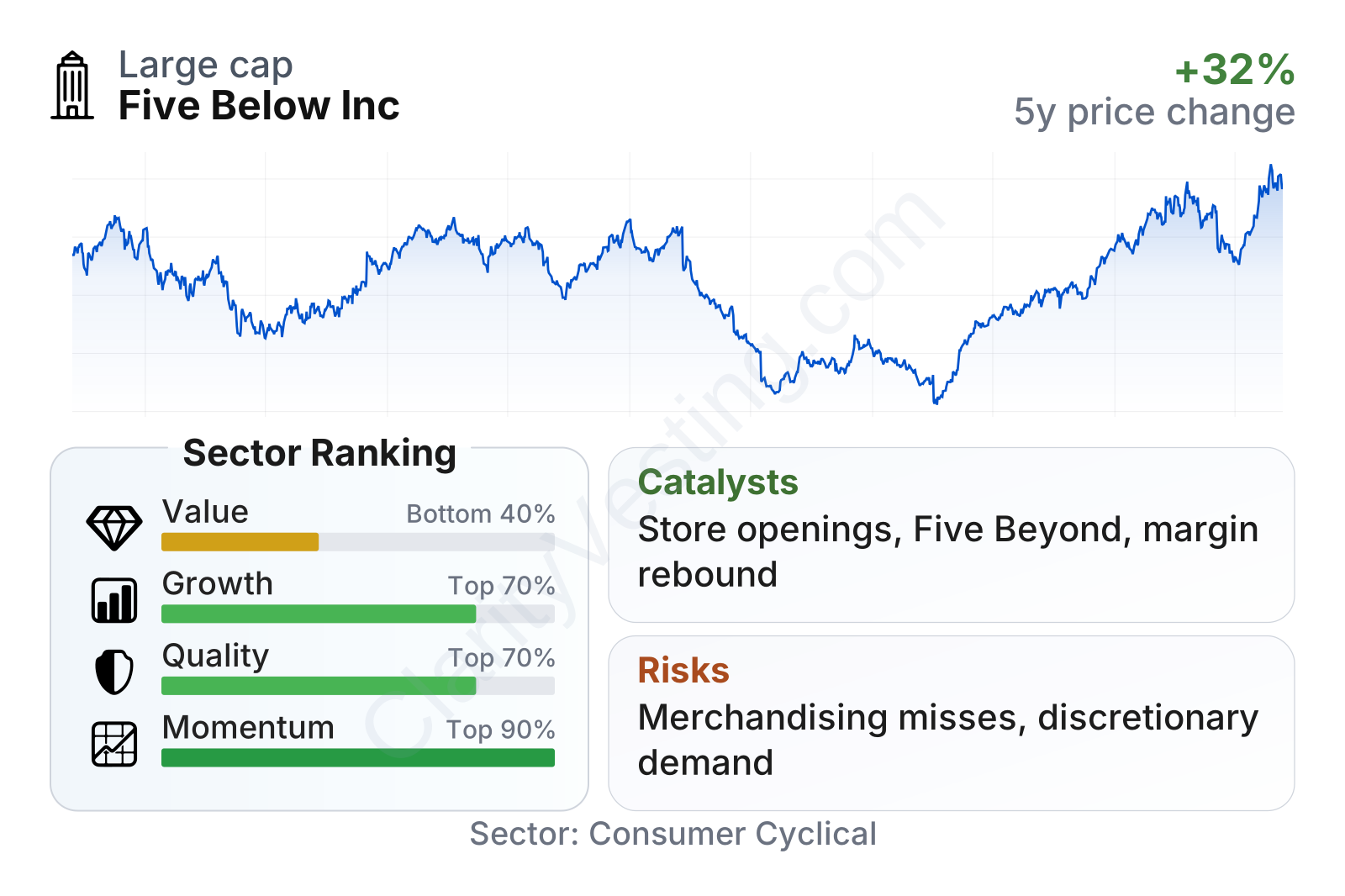
Five Below is now a large specialty retailer with a market value in the mid-teens of billions of dollars and a share-price volatility close to the broader market. The overall profile is mixed in a constructive way: growth, profitability, and recent share momentum look strong relative to much of the consumer discretionary sector, while valuation is not especially cheap.
On the quality side, returns on invested capital are notably above sector norms, operating margin is healthy, and profit margin stands well above the industry median. Free cash flow has also improved meaningfully. On the other hand, value metrics rank weaker because the earnings multiple and cash flow yield do not look discounted versus peers. In short, the company currently looks more like a strong operator than a bargain-priced stock.
Growth
Five Below operates in a retail niche that can still grow even in a mature U.S. market. Value retail remains relevant because consumers continue to look for affordability, small treats, seasonal purchases, and lower-priced discretionary options. That matters in both weaker and more normal economic environments. The company’s concept also benefits from broad appeal: it is not limited to one narrow category, which helps it adapt as consumer tastes shift.
The clearest growth driver is store expansion. Management has long presented a large white-space opportunity for new locations across the United States, and this remains central to the long-term case. New stores add revenue directly, while a larger network improves brand awareness, sourcing scale, and distribution efficiency. The Five Beyond initiative is another meaningful lever because it lifts the average ticket and allows the company to sell larger or more feature-rich items without abandoning its value positioning.
Recent revenue growth has been strong, with year-over-year gains generally staying above the sector median and accelerating again after a slower patch. That suggests growth is not coming from one isolated quarter. It points to a combination of new store contribution and improving demand trends.
Cash generation has also strengthened sharply. Free cash flow was modest a few years ago, then improved substantially more recently. For a growing retailer, that matters because it shows expansion is increasingly being supported by internally generated cash rather than depending entirely on external financing.
Recent company communications in 2026 also point to continued confidence in expansion, merchandising improvements, and traffic-building initiatives. A significant recent opportunity is the combination of broader price architecture through Five Beyond and category development in higher-demand areas such as consumables, seasonal products, and trend-led items. If that mix continues to work, Five Below could keep growing without relying only on adding more stores.
Risks
This article is for informational purposes only and does not constitute financial advice. Some content is AI-generated. See Disclaimer


