Stock Analysis · Fiserv Inc (FISV)
Overview
Fiserv is a financial technology company that provides the digital and behind-the-scenes systems used by banks, credit unions, merchants, and other businesses to move money, process payments, manage accounts, and serve customers. In simple terms, it helps financial institutions run their operations and helps merchants accept and manage payments across in-store, online, and mobile channels.
The business is mainly built around recurring, high-volume transaction activity. That gives Fiserv exposure to long-term trends such as electronic payments, e-commerce, embedded finance, digital banking, and the modernization of payment infrastructure. A large part of its customer base is deeply integrated into its software and processing systems, which can make switching providers costly and disruptive.
Based on the company’s recent reporting structure, revenue is primarily generated from two large segments:
- Merchant Solutions — roughly 45% to 50% of revenue. This includes payment acceptance, point-of-sale and commerce software, acquiring services, and related merchant technology.
- Financial Solutions — roughly 50% to 55% of revenue. This includes core account processing, digital banking, card issuer processing, network services, and technology sold to banks and credit unions.
Within those broad activities, the company earns money from payment processing fees, software and service contracts, account processing, card and network services, and value-added products layered on top of large client relationships. That mix matters because it combines steadier contractual revenue from financial institutions with transaction-driven growth from merchant payments.
The long-term operating picture has been favorable: revenue has climbed from about $16 billion in 2021 to just above $21 billion in 2025, while operating income and net income also moved higher. Gross profit has expanded faster than revenue over that period, showing that scale and mix have supported profitability even as interest expense rose.
The financial flow highlights a business with rising sales, improving gross profit, and strong operating earnings, but also a meaningful financing burden. Interest expense has increased materially over the last several years, which is an important part of the investment debate because it limits how much of the operating progress reaches the bottom line.
Key Figures
| Metric | Value | Sector ⓘ |
|---|---|---|
| Date | Jul 18, 2026 | |
| Context | ||
| Sector | Technology | |
| Industry | Software | |
| Market Cap ⓘ | $27.58B | |
| Beta ⓘ | N/A | |
Value (Cheapness) | ||
| P/E Ratio ⓘ | 8.77 | 31.76 |
| FCF Yield ⓘ | 15.07% | 4.18% |
| EBIT / EV ⓘ | 8.40% | 2.56% |
| PEG ⓘ | 0.51 | |
Growth (Business expansion) | ||
| Revenue Growth ⓘ | N/A | 13.50% |
| RPS Growth (5Y CAGR) ⓘ | 12.43% | 8.57% |
| EPS Growth (5Y CAGR) ⓘ | -30.85% | -21.87% |
| Margin Growth (5Y Trend) ⓘ | 12.78% | 0.41% |
| FCF Growth (5Y CAGR) ⓘ | 10.86% | 9.76% |
Quality (Business durability) | ||
| ROIC (Latest) ⓘ | 7.24% | 8.54% |
| ROIC (5Y Median) ⓘ | N/A | 8.12% |
| Net Debt / EBIT (Latest) ⓘ | 6.07 | 0.38 |
| Net Debt / EBIT (5Y Median) ⓘ | 4.89 | 0.38 |
| Operating Margin (Latest) ⓘ | 22.24% | 9.58% |
| Operating Margin (5Y Median) ⓘ | 25.67% | 8.25% |
| Debt to Equity (Latest) ⓘ | 111.85% | 33.52% |
| Profit Margin (Latest) ⓘ | N/A | 6.96% |
| Free Cash Flow (Latest) ⓘ | $4.16B | |
Momentum (Price trend) | ||
| 3Y Return ⓘ | -60.85% | +30.91% |
| 12M Return (excl. last month) ⓘ | -70.16% | +28.90% |
| 6M Return ⓘ | -24.18% | +5.38% |
| Price vs. 200-Day MA ⓘ | -24.09% | +7.61% |
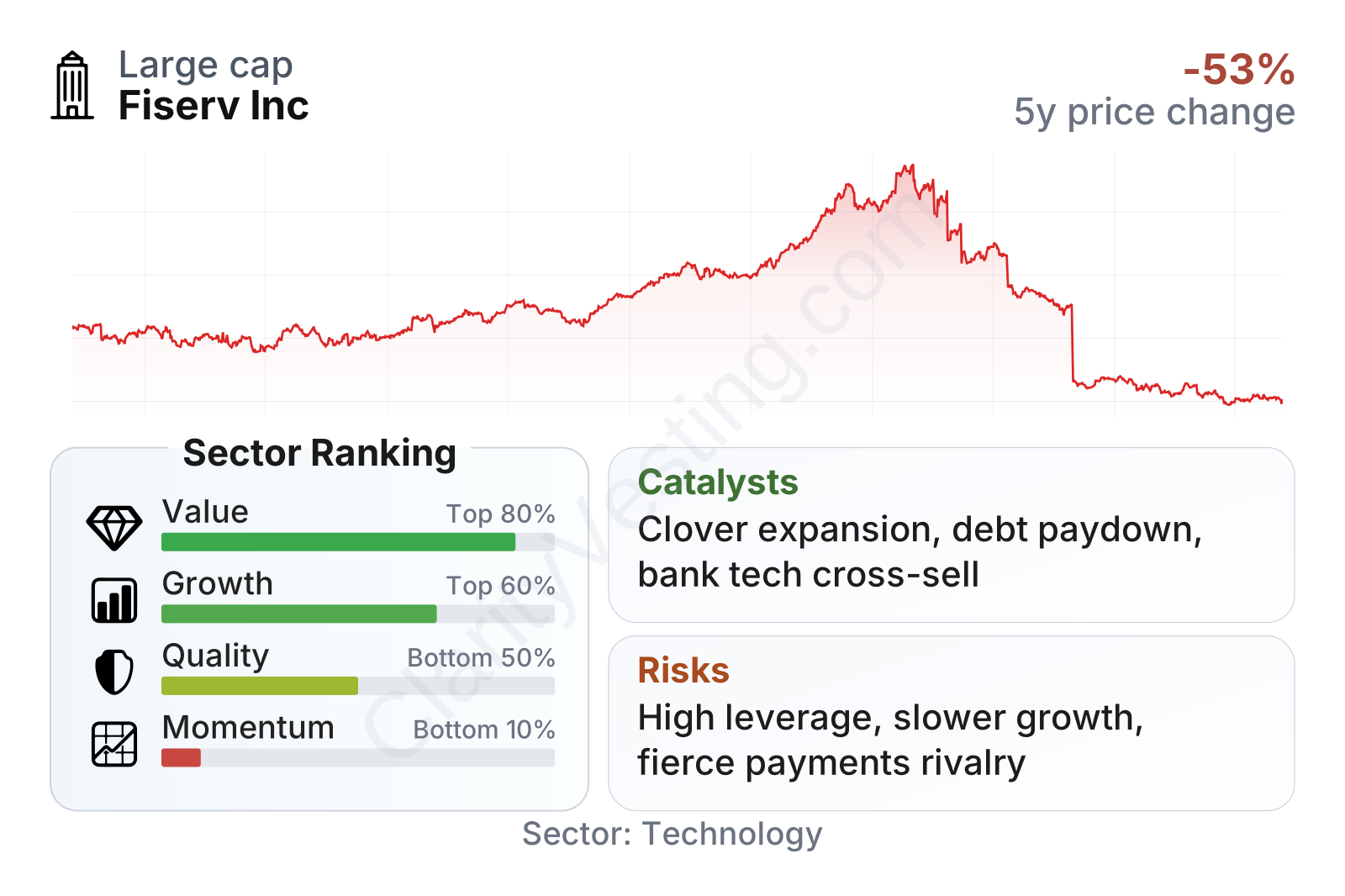
The broad picture is unusual. On valuation and cash generation, Fiserv screens much stronger than the typical software company: earnings multiples are far below the sector median, free cash flow yield is notably higher, and operating profitability remains robust. Growth is more mixed. Longer-term revenue per share and free cash flow trends have been solid, but recent year-over-year revenue momentum has weakened sharply. Quality metrics are held back by leverage rather than by margins, since operating margins remain well above sector norms. Market momentum is clearly poor, with the share price far below prior highs and well under its long-term trend.
Growth
Fiserv operates in a sector that still has structural growth behind it. Cash usage continues to decline in many markets, merchants are adopting integrated commerce tools, banks are investing in digital customer experiences, and payment systems are becoming more software-driven. Those are durable trends rather than short-lived cycles. Fiserv is positioned across several of them at once, which gives it more than one path to expand.
Its strategy also makes sense for the next phase of growth. The company sits at the intersection of merchant acceptance, bank technology, and money movement. That creates cross-selling opportunities: a merchant using payment acceptance tools can be offered additional software and value-added services, while financial institution clients can be migrated toward more modern digital capabilities. Fiserv also benefits from scale. In payments, scale matters because it can support product development, compliance, distribution, and pricing power.
One caution is that revenue growth has clearly slowed. The company had been posting healthy mid- to high-single-digit growth for much of the past few years, but the most recent period moved into a slight decline. That does not erase the longer trend, yet it suggests that the business is no longer being rewarded simply for steady execution. The market now appears to be asking whether Fiserv can restart stronger organic growth rather than just defend margins.
Cash generation remains one of the stronger elements in the growth case. Free cash flow is still running at more than $4 billion on a trailing basis, even after coming down from a recent peak. That level of cash gives management flexibility to invest in product development, fund acquisitions, reduce debt over time, or return capital to shareholders. For a company serving critical financial infrastructure, that kind of cash production is an important sign of resilience.
A meaningful catalyst is the continued expansion of digital payments and merchant software integration. Fiserv’s Clover platform has been one of the company’s most visible growth engines in recent years, helping it deepen relationships with small and midsize businesses while moving beyond basic payment acceptance into broader commerce tools. Another catalyst is financial institutions’ ongoing need to update legacy systems, particularly in digital banking, card issuance, and real-time payments. Recent company communications have continued to emphasize product innovation, embedded capabilities, and broader adoption of integrated solutions, all of which support the case that Fiserv is aiming to grow through deeper client penetration rather than relying only on industry volume growth.
Risks
The biggest financial risk is leverage. Fiserv carries materially more debt than the typical company in its sector, and that shows up clearly in both debt-to-equity and net-debt-to-EBIT measures. This is not a minor difference: leverage is several times higher than sector norms, and interest expense has risen meaningfully over time. As long as cash flow stays strong, the balance sheet is manageable, but the debt load reduces flexibility if growth slows further, integration costs rise, or credit conditions tighten.
The leverage trend is important because it has moved higher over time rather than lower. Debt-to-equity has risen from already-elevated levels to more than 100%, far above the sector median. That does not automatically indicate distress, but it does mean balance sheet discipline is central to the long-term outlook.
Another risk is growth deceleration. Payment and financial software markets are attractive, but they are also competitive and increasingly mature in some areas. If merchant volume weakens, client spending slows, or newer products fail to scale fast enough, Fiserv could remain in a low-growth phase longer than expected. That matters because the company’s valuation looks inexpensive partly because the market is discounting that possibility.
Competition is serious but Fiserv is still one of the major players. In merchant acquiring and payment acceptance, it competes with companies such as Global Payments, Block, JPMorgan Payments, Adyen, and Worldpay. In financial institution processing and banking technology, competition includes Jack Henry, Fidelity National Information Services, and core banking vendors with niche or regional strength. Fiserv’s competitive advantages come from scale, long customer relationships, broad product coverage, regulatory and operational know-how, and the difficulty clients face when replacing mission-critical systems. It is not the uncontested leader in every niche, but it is clearly among the most established and strategically important providers across the payments and bank technology landscape.
Profitability itself is not the main concern. Margins have been comfortably above sector medians for several years, even though the latest level is below the recent peak. That suggests the underlying business remains efficient. The more relevant question is whether strong margins can continue to offset slower revenue growth and higher financing costs.
There is also execution risk around product evolution. Payments and financial software are changing quickly, with customers expecting omnichannel tools, real-time capabilities, fraud controls, and modern user experiences. If Fiserv underinvests, integrates poorly, or loses share in attractive areas such as cloud-based merchant software, larger rivals and focused specialists could take business. No major public red flag such as a large scandal or governance breakdown stands out in the recent company record, but the combination of weak share-price momentum and slowing top-line growth shows that the market is already treating execution risk as meaningful.
Valuation
On conventional earnings and cash flow measures, Fiserv appears inexpensive relative to its sector. The current price implies a low earnings multiple compared with the typical technology company, and free cash flow yield is unusually strong. That creates a clear contrast with many software names that trade at much richer valuations despite lower profitability.
The valuation reset has been dramatic. A few years ago, the stock traded at a multiple much closer to, and at times above, the sector median. That premium has largely disappeared, and the current earnings multiple is now far below sector norms. Part of that change reflects the sharp share-price decline, but part also reflects market skepticism about the durability of growth and the burden of leverage.
Whether the current price is justified depends on which side of the business one emphasizes. On one side, Fiserv has scale, sticky customer relationships, high operating margins, and substantial cash generation. On the other, recent revenue momentum has weakened, debt remains heavy, and the stock’s collapse suggests confidence has been damaged. In that context, the low multiple does not look random. It appears to reflect a market view that this is no longer a straightforward growth compounder, but a mature financial technology platform that must prove it can stabilize growth while managing leverage.
That said, the gap between operating quality and valuation is large. If revenue growth improves even modestly while margins and cash generation remain healthy, the current pricing would look notably less demanding than sector averages suggest. If growth remains flat to negative, the discount is easier to understand.
Conclusion
Fiserv remains a large, deeply embedded financial technology company serving essential parts of the payments and banking ecosystem. The business has real strengths: recurring client relationships, broad product reach, strong margins, and billions of dollars in annual free cash flow. Those qualities help explain why operating results have held up better than the stock price.
The challenge is that the market is no longer focusing mainly on stability. It is focusing on slower revenue growth, rising leverage, and whether Fiserv can still generate compelling expansion from platforms such as Clover and from ongoing digitization across financial services. That makes the company look less like a high-confidence growth name and more like a cash-rich infrastructure provider undergoing a credibility test.
Overall, Fiserv’s current positioning looks fundamentally sturdier than the share-price collapse implies, but the discount also reflects real pressure points rather than simple market noise. The company stands out today because profitability and cash generation remain strong while growth and balance sheet questions dominate the debate. That combination creates an analytically interesting setup: operationally solid, strategically relevant, but still needing clearer evidence that its next phase can be driven by renewed top-line momentum rather than margin strength alone.
Sources:
- Fiserv, Inc. — Annual Report on Form 10-K for fiscal year 2025
- Fiserv, Inc. — Quarterly Report on Form 10-Q for quarter ended March 31, 2026
- SEC EDGAR — Fiserv, Inc. filings database
- Fiserv Investor Relations — earnings releases and shareholder materials
- Fiserv Investor Relations — company presentations on Merchant Solutions, Financial Solutions, and Clover
- Wikipedia — Fiserv
This article is for informational purposes only and does not constitute financial advice. Some content is AI-generated. See Disclaimer


