Stock Analysis · Fidelity National Information Services Inc (FIS)
Overview
Fidelity National Information Services, better known as FIS, is a large financial technology company that provides the software and infrastructure used by banks, merchants, and capital markets firms. In simple terms, FIS helps financial institutions move money, process payments, manage customer accounts, and run back-office systems that are difficult and expensive to replace. Its products are often deeply embedded in clients’ operations, which gives the business a recurring and relatively sticky revenue base.
Since the sale of a large part of its merchant business in 2023, FIS has become more focused on banking technology and capital markets software. That matters because the company is now easier to understand than it was during the period when it tried to combine banking systems, merchant acquiring, and market infrastructure under one roof. Today, the investment case depends less on consumer-facing payment volume and more on whether banks and large financial institutions keep modernizing critical systems.
Based on the company’s recent reporting structure, revenue is mainly generated from two large segments, with a smaller corporate and other contribution. Approximate mix can vary by quarter, but the business is broadly split as follows:
- Banking Solutions: roughly a little over half of revenue. This segment includes core banking, digital banking, payments processing for financial institutions, card and account services, and related software.
- Capital Market Solutions: roughly a little under half of revenue. This includes software and services used for trading, processing, risk management, treasury, and investment operations.
- Corporate and other: a small residual amount, typically not a major driver of the overall business.
One visible trend in the business mix over the last several years is that revenue has become smaller but cleaner after divestitures, while profitability has improved from the disruption period. Gross profit has recovered gradually, operating income improved meaningfully in 2024, and net income swung back into positive territory after the large losses tied to write-downs and restructuring in 2022 and 2023. The remaining company is more concentrated around mission-critical financial software.
Key Figures
| Metric | Value | Sector ⓘ |
|---|---|---|
| Date | Jul 18, 2026 | |
| Context | ||
| Sector | Technology | |
| Industry | Information Technology Services | |
| Market Cap ⓘ | $21.66B | |
| Beta ⓘ | 0.81 | |
Value (Cheapness) | ||
| P/E Ratio ⓘ | 8.25 | 31.76 |
| FCF Yield ⓘ | 12.84% | 4.18% |
| EBIT / EV ⓘ | 8.66% | 2.56% |
| PEG ⓘ | 0.24 | |
Growth (Business expansion) | ||
| Revenue Growth ⓘ | 30.10% | 13.50% |
| RPS Growth (5Y CAGR) ⓘ | -2.05% | 8.57% |
| EPS Growth (5Y CAGR) ⓘ | -36.49% | -21.87% |
| Margin Growth (5Y Trend) ⓘ | 2.28% | 0.41% |
| FCF Growth (5Y CAGR) ⓘ | -5.74% | 9.76% |
Quality (Business durability) | ||
| ROIC (Latest) ⓘ | 11.25% | 8.54% |
| ROIC (5Y Median) ⓘ | 2.23% | 8.12% |
| Net Debt / EBIT (Latest) ⓘ | 0.96 | 0.38 |
| Net Debt / EBIT (5Y Median) ⓘ | 13.75 | 0.38 |
| Operating Margin (Latest) ⓘ | 31.52% | 9.58% |
| Operating Margin (5Y Median) ⓘ | 12.75% | 8.25% |
| Debt to Equity (Latest) ⓘ | 131.79% | 33.52% |
| Profit Margin (Latest) ⓘ | 23.35% | 6.96% |
| Free Cash Flow (Latest) ⓘ | $2.78B | |
Momentum (Price trend) | ||
| 3Y Return ⓘ | -24.61% | +30.91% |
| 12M Return (excl. last month) ⓘ | -50.49% | +28.90% |
| 6M Return ⓘ | -32.62% | +5.38% |
| Price vs. 200-Day MA ⓘ | -20.64% | +7.61% |
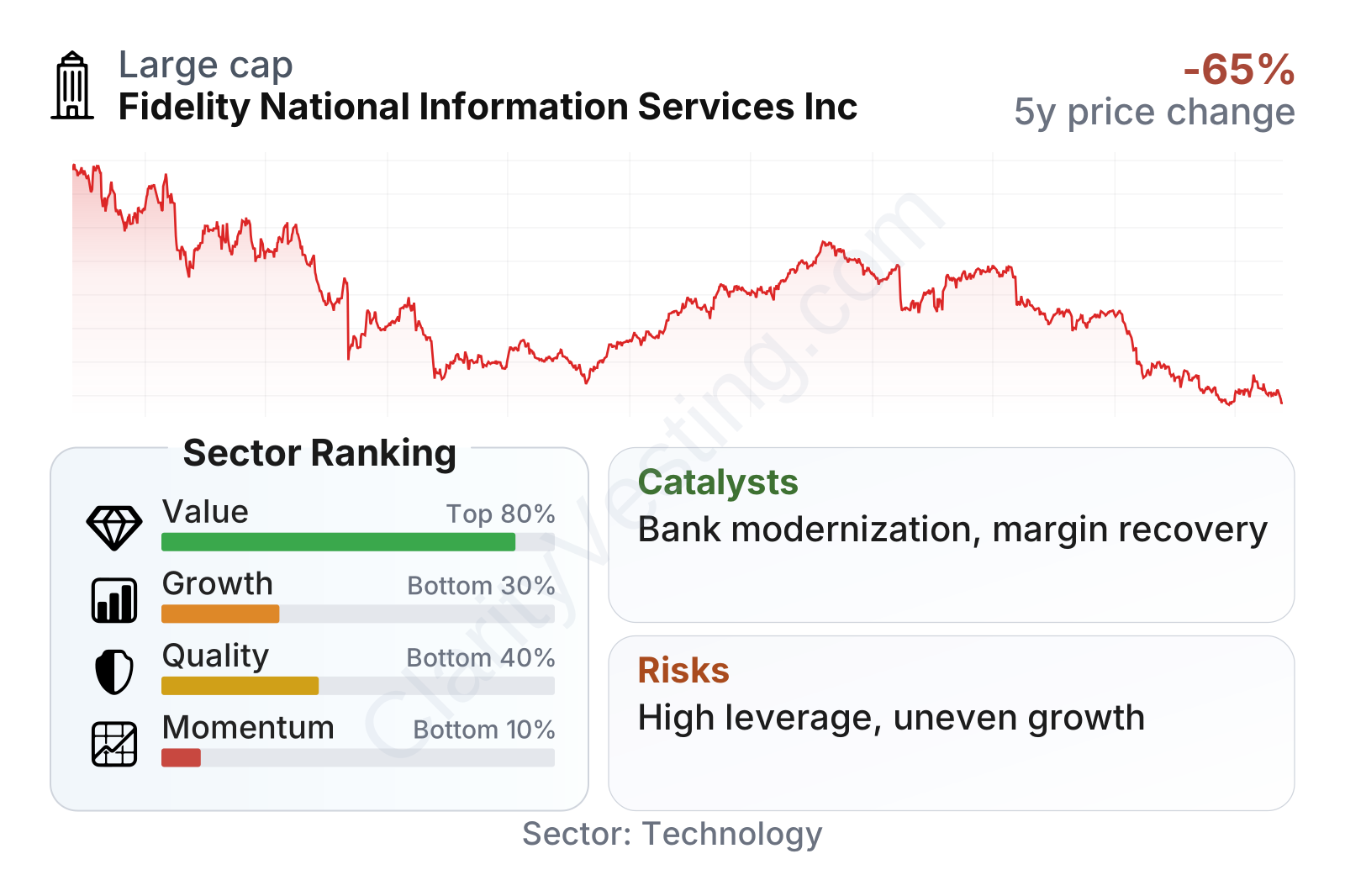
FIS currently stands out more for valuation and cash generation than for market enthusiasm. The company’s market capitalization is around $20 billion, and the stock’s beta below 1 suggests it has historically moved somewhat less than the broader market. Relative to much of the technology sector, the shares screen as inexpensive, while free cash flow yield and operating profitability look notably strong. At the same time, the broader factor profile is uneven: growth and momentum remain weak versus peers, which helps explain why the stock has not received a premium multiple despite the recovery in margins and earnings.
The longer stock chart shows a sharp de-rating from 2021 through early 2023, followed by a partial recovery and then renewed pressure into 2026. That pattern usually signals a company still trying to rebuild credibility after a major strategic reset. In other words, the market appears to acknowledge FIS’s improved economics, but it is still waiting for more consistent execution.
Growth
FIS operates in a sector that should continue expanding over the long term. Banks, asset managers, insurers, and payment networks still have decades-old systems, and replacing or upgrading them is a multiyear need rather than a short-term choice. Regulatory complexity, cybersecurity demands, real-time payments, digital account opening, and cloud migration all support continued spending on financial infrastructure. This is not the fastest-growing part of technology, but it is a durable one.
FIS’s current strategy is more focused than it was a few years ago. Management has emphasized simplification, product investment, operating efficiency, and growth in banking and capital markets platforms. That direction makes strategic sense because these are areas where clients usually sign long contracts and are reluctant to switch providers. If execution improves, even modest revenue growth can translate into stronger earnings because the business has a meaningful fixed-cost base.
Recent revenue trends suggest that growth has reaccelerated after a difficult transition period. Year-over-year revenue was negative during the restructuring phase, then returned to low single-digit expansion, and more recently moved sharply higher. That latest jump looks encouraging, although long-term readers should be careful not to assume one very strong quarter automatically represents a new normal. Over a five-year period, growth has still lagged many technology peers, which is why FIS looks more like a turnaround in a stable industry than a high-growth platform.
Cash generation is one of the more constructive parts of the picture. Free cash flow has been volatile because of portfolio changes and one-time effects, but it remains substantial in absolute dollars. A business that can regularly produce billions in annual free cash flow has more flexibility to reduce debt, repurchase shares, fund product development, and absorb slower periods without putting the balance sheet under immediate stress.
As for catalysts, the clearest ones are internal rather than speculative. Better execution in Banking Solutions, steadier demand in Capital Market Solutions, and continued margin discipline could all support a stronger earnings profile. Another meaningful opportunity is the ongoing modernization cycle at financial institutions. FIS does not need a brand-new consumer app to grow; it mainly needs clients to keep spending on core systems, payments connectivity, fraud tools, and workflow automation.
Recent company updates have also pointed to product launches and partnerships tied to digital payments modernization, core banking capabilities, and capital markets workflow tools. None of these items alone transforms the company overnight, but together they reinforce the idea that FIS is positioned around infrastructure that financial institutions still need to upgrade.
Risks
The main risk is that FIS has already gone through a major strategic reset, which means the company still has to prove that the new version of the business can deliver dependable growth. The past several years included asset write-downs, portfolio changes, and uneven earnings quality. While profitability has improved recently, the company’s long-term record is not clean enough to ignore.
Leverage is another issue worth watching closely. Debt-to-equity has climbed well above the sector norm and has trended upward over time. Net debt relative to EBIT has improved from earlier stressed levels, but balance-sheet leverage still looks elevated compared with many technology peers. This does not necessarily signal immediate danger given the company’s cash generation, yet it does reduce flexibility if growth stalls or interest costs rise again.
Profitability has been highly volatile. Margins were severely distorted in 2022 and 2023, then recovered strongly, with the latest profit margin well above the sector median. The improvement is real, but the history matters: when a company moves from deep reported losses to strong margins in a short period, readers should remember that part of the swing may reflect one-time items, restructuring effects, and changing business mix. The key question is not whether margins have rebounded, but whether they can remain durable.
Competition is serious, although FIS does have real advantages. Its biggest strength is scale in highly regulated, mission-critical systems where clients do not switch providers easily. That creates recurring revenue and high customer retention. FIS is not the undisputed leader across all financial technology, but it is one of the major incumbent providers in bank processing and capital markets operations. In those niches, size, client relationships, compliance know-how, and installed base matter a great deal.
Main competitors vary by segment:
- Banking technology: Fiserv, Jack Henry, NCR Atleos in some areas, and a growing group of cloud-native banking software vendors.
- Capital markets technology: Broadridge, SS&C, Nasdaq in selected workflow and market infrastructure areas, and specialized private software providers.
- Payments and financial infrastructure overlap: Fiserv, Global Payments, and other processing and network-enabled platforms depending on the product line.
Compared with these rivals, FIS appears strongest where large institutions need broad, integrated platforms and operational resilience. It appears less advantaged in newer cloud-native categories where smaller entrants may grow faster. So the company’s competitive position is solid, but not unchallenged.
There is also execution risk tied to product modernization. Financial institutions increasingly want more flexible, API-based, cloud-enabled tools. If FIS updates its platforms too slowly, its entrenched position could gradually weaken. That risk is especially relevant because incumbents often keep customers for a long time, but once a replacement cycle starts, lost contracts can be difficult to recover.
Valuation
FIS currently looks inexpensive on plain earnings and cash flow measures. Its earnings multiple is far below the sector median, and its free cash flow yield is unusually high for a company with entrenched positions in financial infrastructure. On the surface, that suggests the market is applying a discount to reflect execution concerns, leverage, and the company’s uneven recent history rather than dismissing the underlying business model.
The valuation trend has been dramatic. FIS traded at much higher and sometimes distorted earnings multiples during the period when profits were unstable, but the latest reading sits in a much lower range and far below the broader technology sector. A low multiple alone does not make a stock attractive in a fundamental sense; sometimes it simply reflects a business with limited growth and a credibility gap. In FIS’s case, both interpretations likely apply at least in part.
Whether the current price is justified depends on which version of FIS proves more representative going forward. If the company is now a steadier, cash-rich infrastructure provider with improving margins, the valuation appears compressed. If instead revenue growth fades back to low single digits and margin gains prove hard to sustain, then a discounted multiple makes sense. The market seems to be pricing FIS as a company that has repaired part of the damage but has not yet fully earned a higher-quality rating.
Conclusion
FIS is easier to understand today than it was a few years ago: it is now primarily a financial infrastructure company serving banks and capital markets clients with software and processing systems that are deeply embedded in day-to-day operations. That business has real staying power, and the recent rebound in margins, earnings, and cash generation shows that the reset has produced tangible improvement.
The challenge is that the company still carries the weight of its recent past. Growth has not been consistently strong over a long stretch, leverage remains higher than many peers, and the share price weakness shows that the market is still skeptical about the durability of the turnaround. FIS does not look like a fast-moving technology compounder; it looks more like a large incumbent trying to convert a sticky client base into steadier, higher-quality results.
That makes the current picture relatively clear. Operationally, the company appears stronger than the stock’s sentiment suggests, and financially it generates enough cash to support the recovery case. But the discount in valuation is also understandable because execution still needs to be proven over time. Overall, FIS currently stands out less as a pure growth name and more as a rebuilding platform whose improving fundamentals are meaningful, but not yet fully trusted.
Sources:
- Fidelity National Information Services, Inc. — Annual Report on Form 10-K for the fiscal year ended December 31, 2025
- Fidelity National Information Services, Inc. — Quarterly Report on Form 10-Q for the quarter ended March 31, 2026
- Fidelity National Information Services, Inc. — Current Reports on Form 8-K filed in 2026
- SEC EDGAR — Fidelity National Information Services, Inc. filings database
- FIS Investor Relations — 2026 earnings materials and company-hosted presentations
- Wikipedia — Fidelity National Information Services
This article is for informational purposes only and does not constitute financial advice. Some content is AI-generated. See Disclaimer


