Stock Analysis · Figs Inc (FIGS)
Stock Analysis · Figs Inc (FIGS)

Overview

Figs Inc is a healthcare apparel company best known for premium medical scrubs and related products for nurses, physicians, and other healthcare professionals. The company built its brand around better fit, comfort, fabric performance, and a more modern shopping experience than traditional uniform suppliers. Rather than relying mainly on wholesale distribution, Figs has focused on a direct-to-consumer model through its own digital channels, which gives it more control over branding, pricing, and customer relationships.

Its business is still centered on apparel for medical professionals, but the product range has expanded beyond core scrubs into outerwear, underscrubs, footwear partnerships, and other lifestyle-oriented items aimed at the same customer base. That makes Figs less like a traditional commodity uniform seller and more like a specialized branded apparel platform serving a distinct professional niche.

Revenue is primarily generated from product sales, with the largest contributors appearing to be concentrated in a few broad categories.

  • Scrubs and core medical apparel: by far the largest source of revenue, likely the clear majority of sales.
  • Complementary apparel and outerwear: a meaningful but smaller contributor, including jackets, base layers, and related products.
  • Other accessories and adjacent items: the smallest contributor, including products that extend the brand beyond core uniforms.

Geographically, the business remains heavily weighted toward the United States, with international sales still a smaller part of the mix. That concentration is important: it gives Figs a large domestic runway if it keeps gaining share, but it also means the company is not yet broadly diversified across regions.

The long-term appeal of the model is easy to understand. Healthcare workers need repeat purchases, often wear uniforms daily, and value comfort and durability. If a brand becomes the preferred choice within that community, customer loyalty can be stronger than in many general apparel categories. Over time, the main question is whether Figs can keep turning a recognizable niche brand into durable, profitable growth.

The financial flow over the last several years shows a business with consistently strong gross profit, but also one where operating expenses have had a major impact on bottom-line results. Revenue reached a new high in 2025 and earnings recovered meaningfully, which suggests the brand still has pricing power and demand resilience when execution improves.

Key Figures

MetricValueSector
DateJul 18, 2026
Context
SectorConsumer Cyclical
IndustryApparel Manufacturing
Market Cap $1.72B
Beta 1.01
Value
(Cheapness)
P/E Ratio 44.8718.58
FCF Yield 2.29%7.99%
EBIT / EV 3.59%5.91%
PEG N/A
Growth
(Business expansion)
Revenue Growth 28.00%5.50%
RPS Growth (5Y CAGR) 8.32%9.20%
EPS Growth (5Y CAGR) -36.89%-26.43%
Margin Growth (5Y Trend) 5.07%-0.18%
FCF Growth (5Y CAGR) -4.50%5.02%
Quality
(Business durability)
ROIC (Latest) 9.69%12.03%
ROIC (5Y Median) 6.61%10.82%
Net Debt / EBIT (Latest) -0.262.12
Net Debt / EBIT (5Y Median) -2.382.25
Operating Margin (Latest) 7.77%9.28%
Operating Margin (5Y Median) 7.48%9.64%
Debt to Equity (Latest) 14.07%75.23%
Profit Margin (Latest) 6.10%5.28%
Free Cash Flow (Latest) $39.45M
Momentum
(Price trend)
3Y Return +36.20%+10.68%
12M Return (excl. last month) +134.35%+5.26%
6M Return -16.38%-2.41%
Price vs. 200-Day MA -11.27%+1.55%
Better than sector median
Slightly worse than sector median
More than 20% worse than sector median

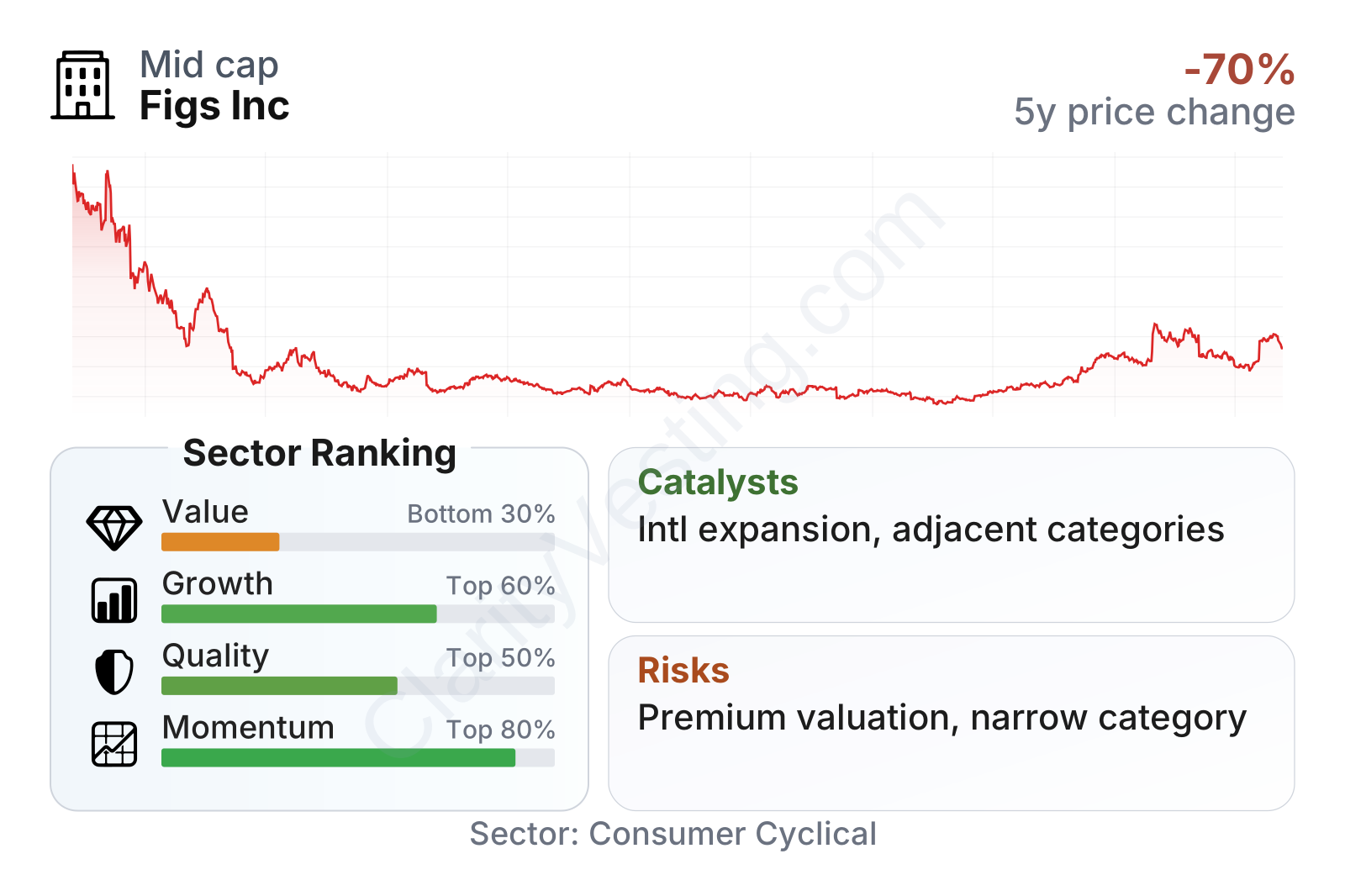
Figs currently sits at roughly a $1.9 billion market value, placing it in the small- to mid-cap range. The stock’s volatility has been close to the broader market, but its trading history has been much more dramatic: after a sharp drop from post-IPO levels, the shares rebounded strongly over the past year. That rebound reflects improving operating momentum, but also means expectations have risen.

The overall metrics paint a mixed picture. Growth has recently accelerated well above the sector median, especially on the latest year-over-year revenue reading, while profitability has also improved. At the same time, the stock still screens as expensive compared with much of its sector, and cash flow yield remains on the weaker side. Financial strength is a clear positive: leverage is very low and net cash remains an important cushion.

Growth

Healthcare apparel is not the fastest-growing corner of consumer goods, but it has attractive structural qualities. Demand is tied to a large and essential workforce rather than to highly discretionary fashion cycles alone. Hospitals, clinics, and outpatient care settings continue to expand over time, and healthcare employment growth creates a steady base of potential customers. In that sense, Figs operates in a niche with recurring demand and room for brand-led premium positioning.

Its strategy makes logical sense for long-term expansion. The company is targeting a specific professional identity rather than selling generic uniforms, and that allows it to market around community, product quality, and brand affinity. The direct-to-consumer model can support better margins than traditional distribution if scale is managed carefully. It also gives Figs a platform to sell more products to the same customer over time, raising lifetime value rather than depending only on constant new-customer acquisition.

Recent revenue growth suggests the business has reaccelerated after a softer stretch in 2024. The latest year-over-year growth rate is notably ahead of the sector median, which is encouraging because it points to renewed demand rather than just broad industry tailwinds. Over a longer period, however, growth has been uneven, so the key issue is whether this stronger pace can continue without sacrificing margins.

Cash generation has also been positive, although not perfectly smooth. Free cash flow moved from negative territory in 2023 to a strong recovery, then moderated again more recently while staying positive. That pattern suggests the underlying business can produce cash, but not yet with the consistency usually associated with more mature apparel leaders. For a company at Figs’ size, dependable cash generation matters because it provides flexibility for marketing, product expansion, and international growth without relying on debt.

A meaningful catalyst is product broadening around the existing customer base. Figs does not need to invent a new market to grow; it can increase spending per customer through new fits, new categories, footwear and accessories, and international reach. Another potential driver is operating leverage. Selling, general, and administrative spending has stayed relatively contained compared with revenue growth in the latest full year, so if sales continue to rise, profit growth could outpace revenue growth.

Recent company updates have also pointed to improving momentum in revenue and earnings recovery. That matters because Figs had gone through a period where the brand remained relevant but financial progress slowed. The latest improvement suggests the business may be moving from a reset phase back toward scaled growth.

Risks

The biggest risk is that Figs remains a narrow-category brand in a competitive apparel market. While medical scrubs are a real niche, they are still apparel products that can face imitation, discounting, and shifting preferences. If competitors narrow the quality or style gap, Figs may have to spend more on marketing or accept lower margins to defend market share.

Competition is significant. Figs benefits from strong brand recognition in premium healthcare apparel, but it is not the only company serving this audience. Traditional medical uniform providers such as Strategic Partners/Cherokee and Barco Uniforms remain established, while broader activewear and specialty apparel players can also move into adjacent categories. In healthcare footwear and accessories, the field is even more crowded. Figs appears to be one of the most recognizable premium direct-to-consumer names in this niche, but that is different from having unchallenged leadership across the whole uniform market.

The company’s competitive advantages are real but not absolute. Its brand, community-based marketing, product design, and direct relationship with customers all help differentiate it from commodity uniform sellers. The challenge is durability: apparel advantages can fade faster than advantages in software, infrastructure, or regulated industries. Figs has to keep product quality and brand relevance high for the moat to remain meaningful.

Balance-sheet risk is relatively low. Debt to equity is around 14%, far below the sector median, and net debt relative to EBIT remains favorable because the company holds more cash than debt. That gives Figs room to absorb weaker periods without the financial strain seen in more leveraged retailers or apparel names.

Profitability risk, however, should not be ignored. Net margin has improved and is now slightly above the sector median, but the recent history shows how quickly earnings can compress. In 2024 and early 2025, margin weakened sharply before rebounding. That tells readers that the business can be profitable, yet still sensitive to execution, cost control, and the pace of demand.

Another risk is concentration. Figs depends heavily on the U.S. market and on a fairly specific customer demographic. That focus is part of the brand’s strength, but it also limits diversification. If domestic healthcare apparel demand slows, customer acquisition gets more expensive, or the brand loses momentum with core professionals, there are fewer offsetting business lines than at larger diversified apparel companies.

There does not appear to be a recent public scandal or major governance event overshadowing the investment case. The more relevant concern is operational consistency: after the post-IPO surge, the company went through a period of uneven growth and margin pressure, which raises the bar for management to prove that the latest recovery is sustainable rather than temporary.

Valuation

Figs is trading at a valuation that looks demanding relative to its sector on conventional earnings-based measures. Its price-to-earnings ratio is around 50x, well above the sector median near the high teens, and its free cash flow yield is also lower than many peers. In plain terms, the market is valuing the company as a premium brand with room for further growth, not as an average apparel manufacturer.

The historical valuation pattern shows that this premium has often been substantial. Even after periods of earnings recovery, the multiple has remained far above typical sector levels. That does not automatically make the shares mispriced, but it does mean the valuation leaves less room for disappointment if growth slows again or margins fail to keep improving.

Whether the current price is justified depends largely on two things: first, that Figs can sustain above-sector revenue growth; and second, that it can convert more of that growth into stable profit and cash flow. The company’s strong balance sheet and improving margins support part of that argument. On the other hand, the stock already reflects a meaningful amount of optimism following its rebound, while the business still has a shorter and less consistent profitability record than many premium-valued consumer brands.

So the valuation context is best described as full. The market is acknowledging a distinctive brand, low leverage, and renewed growth momentum, but it is also assigning a price that assumes continued execution. For a niche apparel company still proving the steadiness of its earnings base, that is an ambitious setup.

Conclusion

Figs stands out because it turned an overlooked healthcare uniform category into a branded, direct-to-consumer business with clear customer identity and solid gross profit economics. The company’s financial profile has notable strengths: low leverage, positive cash generation, and a return to faster top-line growth. Just as important, its niche is tied to an essential workforce, giving the business a more resilient demand foundation than many fashion-driven apparel names.

At the same time, the company is not yet operating with the consistency usually associated with the most durable long-term consumer franchises. Revenue growth has been uneven, margins have swung materially, and the current valuation still prices in a favorable path for execution. That leaves Figs in an interesting but demanding position: it looks stronger operationally than it did during its slowdown, yet the market is no longer treating it like a deeply discounted recovery case.

The overall picture leans toward a company with genuine brand quality and credible long-term potential, but one that still needs to prove that recent momentum can become a durable pattern rather than a short rebound. In other words, the business case is more compelling than the valuation margin for error.

Sources:

  • Figs, Inc. Annual Report on Form 10-K for fiscal year 2025
  • Figs, Inc. Quarterly Report on Form 10-Q for quarter ended March 31, 2026
  • SEC EDGAR database — Figs, Inc. filings
  • Figs Investor Relations — earnings releases and shareholder materials
  • Wikipedia — Figs (company)

This article is for informational purposes only and does not constitute financial advice. Some content is AI-generated. See Disclaimer


Sign up for exclusive research and insights.

Unsubscribe anytime.
