Stock Analysis · Fair Isaac Corporation (FICO)
Overview
Fair Isaac Corporation, better known as FICO, is a software and analytics company best known for the FICO credit score used widely in U.S. lending decisions. In simple terms, the company helps banks, credit card issuers, mortgage lenders, insurers, and other large organizations make better decisions using data. Its tools are used to assess credit risk, detect fraud, manage customer accounts, automate business decisions, and improve collections and marketing.
FICO operates through two main businesses. The first is Scores, which includes credit scoring products sold mainly to lenders and credit bureaus. The second is Software, which includes decision-management, fraud, customer management, and analytics platforms sold under recurring and usage-based models. The score business is especially powerful because it is deeply embedded in U.S. consumer lending, while the software business gives FICO room to expand into broader enterprise decisioning.
The company’s revenue mix is usually led by software, but profits are heavily supported by the score franchise because it carries exceptionally high margins. Based on recent company disclosures, the broad revenue picture can be summarized as follows:
- Software: roughly 55% to 65% of revenue, driven by platform subscriptions, term licenses, maintenance, and usage-based analytics.
- Scores: roughly 35% to 45% of revenue, mainly from business-to-business score sales tied to credit card, auto, personal loan, and mortgage activity.
Within those categories, mortgage-related scoring can be more cyclical, while non-mortgage lending and software subscriptions provide broader support. One important point for long-term readers is that not all revenue dollars are equal here: the Scores segment tends to be smaller than Software by revenue, but it often contributes a very large share of operating profit.
The business model is attractive because FICO’s products sit near the center of high-value decisions. If a lender can reduce losses, price risk better, or catch fraud earlier, the software can pay for itself quickly. That gives FICO strong pricing power, especially in areas where its products are already part of industry workflows and regulatory processes.
The financial flow highlights a business with very high gross profitability and expanding operating income over time. Revenue has climbed steadily in recent years, while costs have risen much more slowly than gross profit, showing the operating leverage that makes FICO’s model so powerful.
Key Figures
| Metric | Value | Sector ⓘ |
|---|---|---|
| Date | Jul 18, 2026 | |
| Context | ||
| Sector | Technology | |
| Industry | Software - Application | |
| Market Cap ⓘ | $29.15B | |
| Beta ⓘ | 1.29 | |
Value (Cheapness) | ||
| P/E Ratio ⓘ | 39.87 | 31.76 |
| FCF Yield ⓘ | 3.06% | 4.18% |
| EBIT / EV ⓘ | 3.56% | 2.56% |
| PEG ⓘ | 0.83 | |
Growth (Business expansion) | ||
| Revenue Growth ⓘ | 38.70% | 13.50% |
| RPS Growth (5Y CAGR) ⓘ | 15.85% | 8.57% |
| EPS Growth (5Y CAGR) ⓘ | 3.79% | -21.87% |
| Margin Growth (5Y Trend) ⓘ | 8.04% | 0.41% |
| FCF Growth (5Y CAGR) ⓘ | 16.62% | 9.76% |
Quality (Business durability) | ||
| ROIC (Latest) ⓘ | 62.88% | 8.54% |
| ROIC (5Y Median) ⓘ | 38.43% | 8.12% |
| Net Debt / EBIT (Latest) ⓘ | 3.00 | 0.38 |
| Net Debt / EBIT (5Y Median) ⓘ | 2.80 | 0.38 |
| Operating Margin (Latest) ⓘ | 50.84% | 9.58% |
| Operating Margin (5Y Median) ⓘ | 42.89% | 8.25% |
| Debt to Equity (Latest) ⓘ | -173.99% | 33.52% |
| Profit Margin (Latest) ⓘ | 33.68% | 6.96% |
| Free Cash Flow (Latest) ⓘ | $892.68M | |
Momentum (Price trend) | ||
| 3Y Return ⓘ | +49.00% | +30.91% |
| 12M Return (excl. last month) ⓘ | -36.59% | +28.90% |
| 6M Return ⓘ | -20.50% | +5.38% |
| Price vs. 200-Day MA ⓘ | -10.15% | +7.61% |
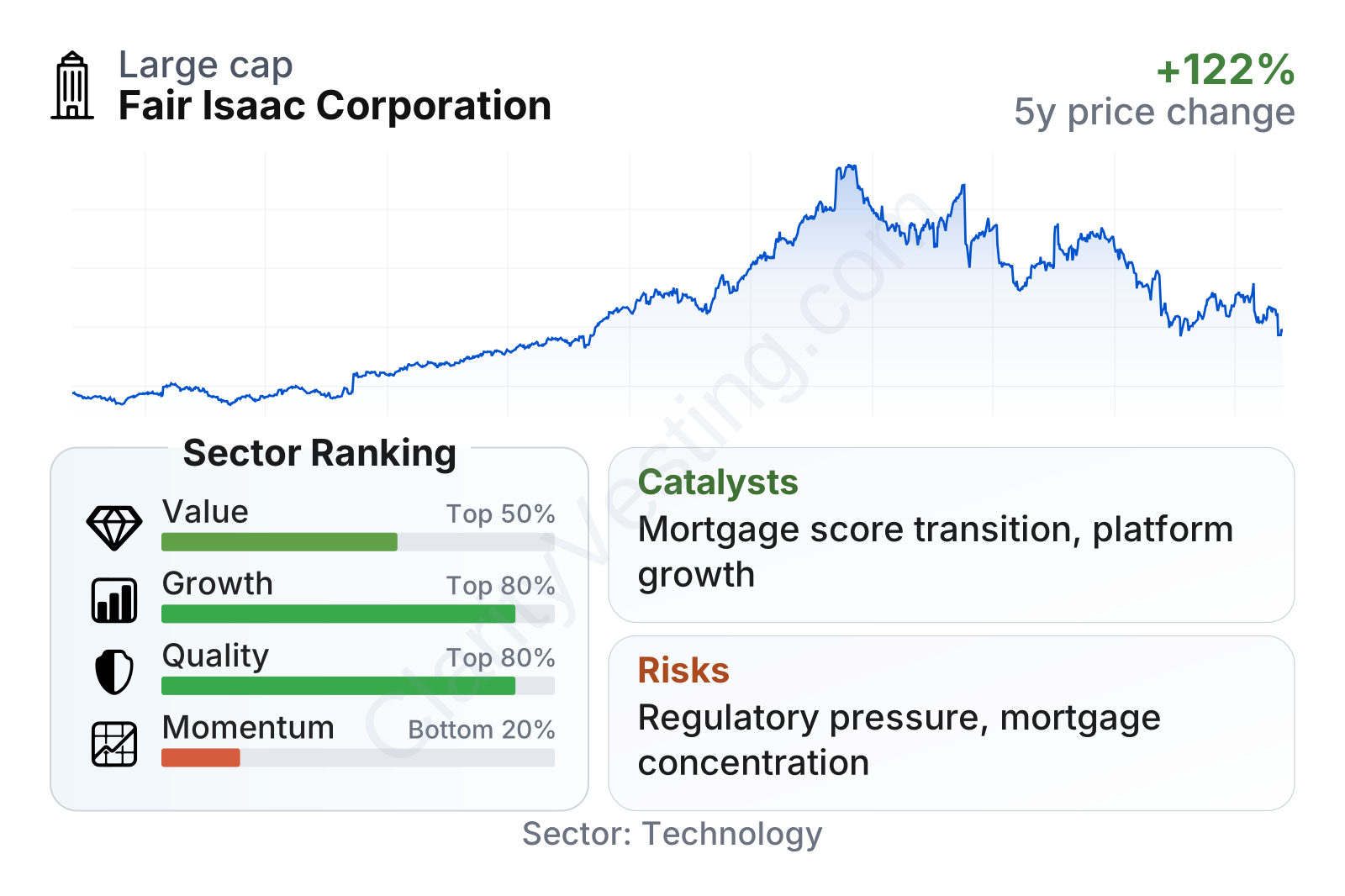
FICO stands out on business quality and growth. Profitability is far above the typical software company in its sector, with operating and net margins that are unusually strong and a return on invested capital that sits in a very high range. Growth has also been stronger than the sector median across revenue, free cash flow, and margin expansion. The weaker area is recent stock momentum, as the share price has pulled back sharply from prior highs. That decline has reduced the valuation premium compared with where it stood at the peak, but the company still trades as a high-quality franchise rather than an average software name.
The company’s market value is in the large-cap range at roughly $25 billion, and its beta a little above 1 suggests the stock can move more than the broader market. That fits the pattern of a company with premium margins, meaningful expectations, and periodic sharp swings when growth, pricing, or regulation becomes a market focus.
Growth
FICO operates in a favorable long-term area: data-driven decisioning. Financial institutions and large enterprises increasingly rely on analytics, automation, and artificial intelligence to make credit, fraud, collections, and customer-management decisions at scale. That is a structural trend rather than a short-lived one. As lending, payments, and compliance become more complex, organizations generally need more software and better models, not less.
FICO’s strategy also makes sense for future expansion. Management has been pushing customers toward the FICO Platform, a broader decisioning environment that can unify data, analytics, and workflow tools. The logic is straightforward: instead of selling point solutions one by one, FICO can become more embedded across a client’s full decision process. That can lift recurring revenue, deepen switching costs, and increase the lifetime value of each enterprise customer.
Revenue growth has clearly accelerated. For several years, growth was solid but not spectacular, generally in the single digits to mid-teens. More recently, it has stepped up sharply, reaching a level far above the sector median. That kind of acceleration matters because it suggests FICO is not relying only on a mature credit-score franchise; it is also finding additional momentum through pricing, platform adoption, and broader software demand.
Cash generation has strengthened in a very visible way. Free cash flow has nearly doubled over the last few years and is now approaching the $900 million range on a trailing basis. For a business like FICO, this is important because cash flow gives management flexibility to invest in products, support acquisitions if needed, and continue returning capital while carrying leverage.
A major catalyst has been the company’s ability to reprice its score products and keep broad customer adoption. FICO’s scoring tools remain deeply embedded in consumer lending, and that position gives it unusual commercial leverage. Another catalyst is the continuing modernization of financial institutions, especially around fraud prevention, automated underwriting, and decision orchestration. These are areas where FICO already has established products and customer relationships.
Recent company communications have also pointed to strong platform momentum, expanding software annual recurring revenue, and resilient demand outside the more cyclical mortgage market. In addition, the long-running shift toward more digital lending and more real-time risk management creates a favorable backdrop for the company’s analytics and decisioning tools.
Risks
The main risk is concentration in a franchise that is both powerful and highly visible. FICO’s score business is one of the company’s greatest strengths, but it also exposes the company to regulatory, political, and customer pushback risks. Because the credit score plays such a central role in U.S. lending, pricing changes or market-share disputes can attract unusual scrutiny. If lenders, regulators, or housing-finance institutions push for alternative models, the long-term economics of the score franchise could face pressure.
Another risk is cyclicality in parts of lending. Mortgage activity, in particular, can be weak for long periods when interest rates remain elevated. While FICO has diversified beyond mortgage, housing-related volume still matters. If major categories of consumer lending slow down at the same time, transaction-linked score revenue can soften even if software subscriptions remain healthy.
Competition is real, although FICO remains the best-known name in credit scoring. In Scores, the biggest competitive reference point is VantageScore, which has tried to expand its role in consumer lending and mortgage-related decisions. In Software, FICO competes with a broader set of analytics and decision-management companies, including large enterprise vendors, fraud specialists, and internal customer-built systems. Rivals may not match FICO’s brand in credit scoring, but they can compete aggressively on price, flexibility, cloud architecture, or AI tooling.
FICO’s competitive advantages are still meaningful. The company benefits from brand recognition, decades of historical model development, extensive lender adoption, regulatory familiarity, and integration into established workflows. In practical terms, many customers do not switch scoring and decisioning systems casually because the costs, risks, and operational disruptions can be high. That creates a moat, though not an untouchable one.
The balance sheet needs careful interpretation. Debt-to-equity appears negative, which does not mean there is no debt. It reflects negative book equity, largely influenced by aggressive share repurchases and capital structure choices. A better practical read is that leverage is meaningful: net debt is around three times EBIT, well above the sector median. That is manageable for a company with FICO’s margins and cash flow, but it leaves less room for error if growth slows materially or financing conditions tighten.
Profit margins are exceptionally strong and have continued to improve, which is a major advantage. At the same time, very high margins can become a risk factor of their own if customers or policymakers argue that pricing power has become too strong. When a company’s economics are this far above the industry norm, it tends to draw closer attention.
There is no widely cited recent scandal or governance breakdown defining the company at this stage, but the key risk to monitor is business-model scrutiny rather than operational drama. For FICO, the most important negative surprise would likely come from regulation, customer resistance to pricing, or a meaningful weakening in the competitive position of its scoring products.
Valuation
Valuation looks much less stretched than it did during the stock’s peak period, when the earnings multiple moved to unusually high levels relative to the sector. After the sharp reset in the share price, the P/E ratio has come down to the mid-30s, only modestly above the sector median. That is still not cheap in an absolute sense, but it is a very different setup from the triple-digit multiple seen at prior highs.
The key question is whether that premium is supported by fundamentals. FICO’s case rests on a rare combination: strong revenue growth, very high margins, excellent returns on capital, and rising free cash flow. On those measures, the company clearly looks stronger than the average software business. The PEG ratio below 1 also suggests the earnings multiple is not extreme relative to recent growth.
On the other hand, the stock still reflects confidence in the durability of the score franchise and continued software expansion. That means the current valuation leaves room for normal execution, but probably not for a major disruption in pricing power, regulation, or competitive standing. In that sense, the shares no longer look inflated the way they once did, yet they still assume that FICO remains an elite business.
Conclusion
FICO is a distinctive company: part mature infrastructure, part growth software platform. Its core franchise in credit scoring gives it a level of market relevance that very few software businesses can match, and its margins, returns on capital, and cash generation confirm that this is not just a well-known brand but a highly efficient enterprise. The more recent push into broader decisioning software strengthens the long-term profile by adding recurring revenue and widening the company’s role inside customer operations.
The central challenge is that such a strong position naturally attracts scrutiny. FICO’s best asset, its pricing power and embedded role in lending, is also the area most exposed to regulatory pressure, customer resistance, and competitive alternatives. Add a leveraged capital structure and the picture becomes less straightforward than the raw profitability numbers suggest.
Even so, the overall profile remains tilted toward business strength rather than fragility. The stock no longer carries the extreme valuation it once did, but it still trades with a premium that reflects unusually high-quality economics. For long-term analysis, FICO currently looks like a company with elite fundamentals and credible growth drivers, balanced against a narrower margin for disappointment than a typical software name.
Sources:
- Fair Isaac Corporation — Annual Report on Form 10-K for fiscal year 2025
- Fair Isaac Corporation — Quarterly Report on Form 10-Q for quarter ended March 31, 2026
- SEC EDGAR — Fair Isaac Corporation filings and exhibits
- Fair Isaac Corporation Investor Relations — Earnings releases and shareholder materials
- Fair Isaac Corporation Investor Relations — Company overview and segment information
- Wikipedia — Fair Isaac Corporation
This article is for informational purposes only and does not constitute financial advice. Some content is AI-generated. See Disclaimer


