Stock Analysis · First Financial Bankshares Inc (FFIN)
Overview
First Financial Bankshares is a Texas-based regional bank holding company. Through First Financial Bank, it provides traditional banking services to consumers, small businesses, and commercial customers, with a strong focus on relationship banking in Texas markets. Its business is relatively easy to understand: it gathers deposits from customers, lends part of that money out, invests in securities, and earns fees from banking services.
The largest source of revenue is typically net interest income, which is the spread between what the bank earns on loans and securities and what it pays on deposits and other funding. Based on recent annual results, the revenue mix appears to be concentrated as follows:
- Net interest income: about 80% to 90% of total revenue. This includes interest earned on commercial loans, real estate loans, consumer loans, and investment securities, minus interest paid on deposits and borrowings.
- Noninterest income: about 10% to 20% of total revenue. This usually includes service charges on deposit accounts, trust and wealth-related fees, interchange and card income, mortgage-related income, and gains or losses tied to securities or other banking activities.
Within lending, the company has historically emphasized commercial and real estate lending rather than a highly specialized niche. On the funding side, customer deposits are the core engine of the franchise, which is important because low-cost deposits can support profitability when loan demand is healthy.
Over the last several years, total revenue has generally moved upward, reaching a meaningfully higher level by 2025 than in 2021. Net income also recovered after pressure in 2023, showing that the business has been able to absorb a more difficult rate environment better than many regional peers. Expense growth has risen as well, but profitability remains strong for the sector.
The long-term pattern shows a bank that has expanded revenue and preserved a large share of that revenue as profit, even through a period of sharply higher funding costs. That resilience is a central part of the FFIN investment case.
Key Figures
| Metric | Value | Sector ⓘ |
|---|---|---|
| Date | Nov 21, 2026 | |
| Context | ||
| Sector | Financial Services | |
| Industry | Banks - Regional | |
| Market Cap ⓘ | $4.27B | |
| Beta ⓘ | 0.81 | |
Value (Cheapness) | ||
| P/E Ratio ⓘ | 14.76 | 12.01 |
| P/B Ratio ⓘ | 2.31 | 1.48 |
| FCF Yield ⓘ | 7.68% | 8.77% |
| Dividend Yield ⓘ | 2.75% | 3.01% |
| EBIT / EV ⓘ | N/A | 8.31% |
| PEG ⓘ | 2.55 | |
Growth (Business expansion) | ||
| Revenue Growth ⓘ | 25.80% | 6.70% |
| RPS Growth (5Y CAGR) ⓘ | 12.98% | 12.35% |
| EPS Growth (5Y CAGR) ⓘ | -1.85% | -0.27% |
| BVPS Growth (5Y CAGR) ⓘ | 2.11% | 4.83% |
| Margin Growth (5Y Trend) ⓘ | -16.30% | -4.16% |
| FCF Growth (5Y CAGR) ⓘ | -3.81% | 4.69% |
| DPS Growth (5Y CAGR) ⓘ | 7.32% | 8.82% |
Quality (Business durability) | ||
| ROIC (Latest) ⓘ | N/A | 9.49% |
| ROE (Latest) ⓘ | 15.52% | 14.02% |
| ROA (Latest) ⓘ | 1.90% | 1.53% |
| ROIC (5Y Median) ⓘ | 18.40% | 7.80% |
| ROE (5Y Median) ⓘ | 14.39% | 12.09% |
| ROA (5Y Median) ⓘ | 1.72% | 1.28% |
| Net Debt / EBIT (Latest) ⓘ | N/A | 0.88 |
| Net Debt / EBIT (5Y Median) ⓘ | -0.54 | 0.73 |
| Net Debt / EBITDA (Latest) ⓘ | -1.12 | 0.71 |
| Operating Margin (Latest) ⓘ | N/A | 23.37% |
| Operating Margin (5Y Median) ⓘ | 38.34% | 24.29% |
| Debt to Equity (Latest) ⓘ | 3.54% | 59.34% |
| Profit Margin (Latest) ⓘ | 43.28% | 26.65% |
| Free Cash Flow (Latest) ⓘ | $327.93M | |
Momentum (Price trend) | ||
| 3Y Return ⓘ | +14.52% | +73.29% |
| 12M Return (excl. last month) ⓘ | -5.05% | +18.35% |
| 6M Return ⓘ | -8.30% | +3.24% |
| Price vs. 200-Day MA ⓘ | -9.11% | +2.17% |
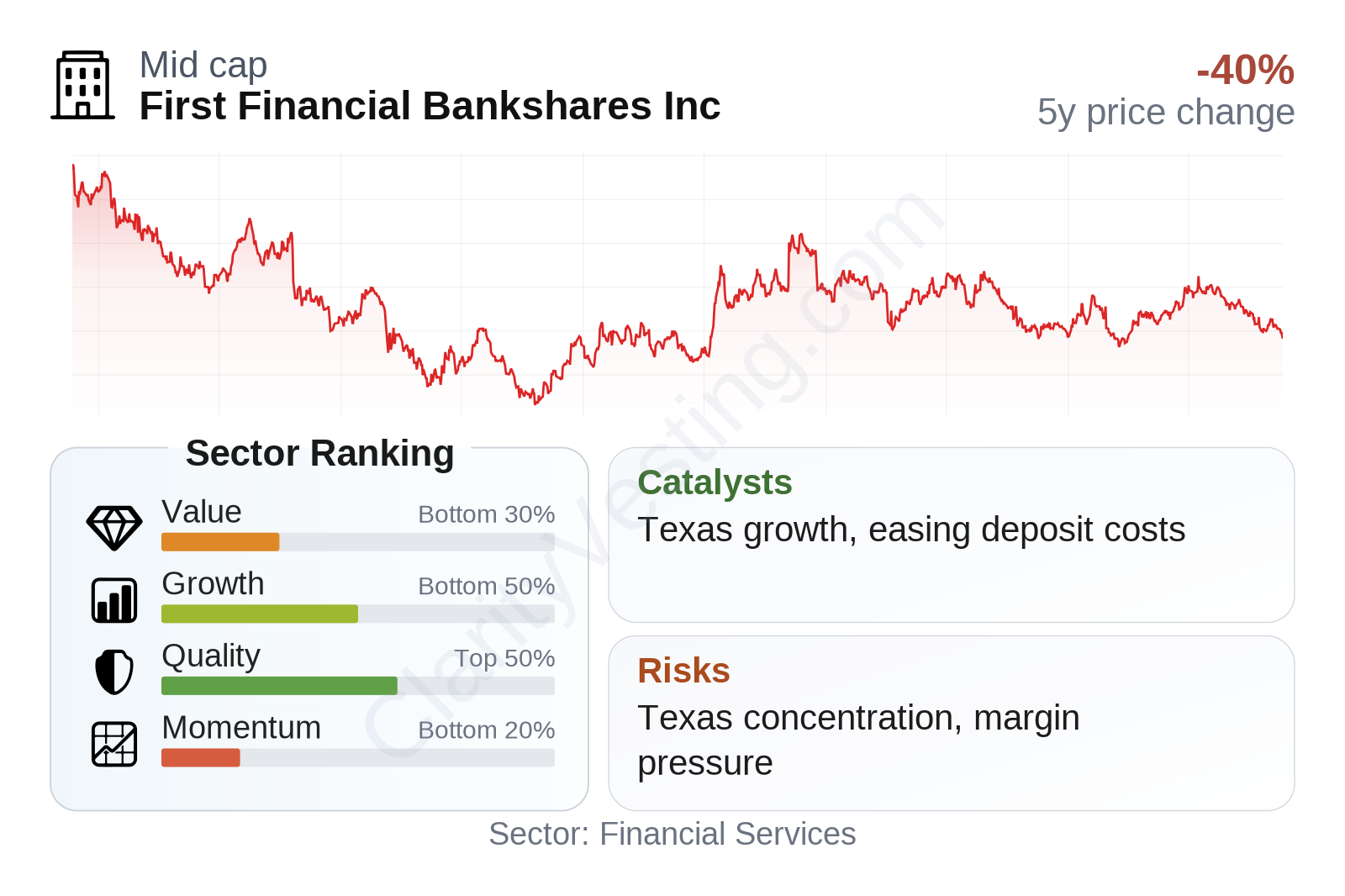
FFIN looks like a high-quality regional bank with solid growth relative to peers, but the market is not pricing it as a bargain. Profitability measures are above the sector median, and revenue growth has recently outpaced many regional banks. At the same time, valuation sits in the weaker end of the sector ranking because the stock trades at premiums on both earnings and book value. Share-price momentum has also been soft, which suggests the market is waiting for clearer evidence that earnings strength can continue.
The share-price history reflects a familiar regional-bank pattern: a sharp reset during the 2022-2023 banking stress period, followed by a partial recovery rather than a full return to prior highs. That matters because it shows the stock has been resilient enough to recover, but not so strong that the market has fully removed its concerns about bank funding costs, loan growth, and credit quality.
Growth
Regional banking is not a fast-growing industry in the same way as software or semiconductors, but it can still offer durable long-term expansion when a bank operates in attractive local markets. That is where FFIN stands out. Its footprint is centered in Texas, one of the more favorable U.S. banking markets because of population growth, business formation, construction activity, and ongoing corporate relocation. Those conditions can support more deposits, more commercial loans, and more fee-generating customer relationships over time.
Management’s strategy is straightforward and sensible for a regional bank: grow in familiar markets, keep underwriting disciplined, and maintain a strong balance sheet. This is not a company trying to transform itself with aggressive acquisitions or unusual products. For long-term analysis, that simplicity can be an advantage because the business is easier to follow and less exposed to strategy drift.
Earnings per share have not moved in a perfectly straight line, which is normal for a bank during large interest-rate swings. After peaking earlier in the cycle, earnings dipped in 2023 and then improved again through 2024 and 2025. That suggests the company has been able to reprice assets, manage deposit costs, and recover profitability after an industry-wide stress period. The recent earnings trajectory is constructive, even if not consistently high-growth.
Book value per share also improved after a drop in 2022, and by 2025 it had moved well above the 2023 level. For banks, book value matters because it represents the capital base supporting future lending and earnings. The recovery here indicates that capital strength has been rebuilt rather than steadily eroded, which supports future flexibility.
A meaningful catalyst is the possibility of a more stable or easier rate environment. If deposit pricing pressure eases while loan yields remain healthy, regional banks can benefit through stronger net interest margins. FFIN’s recent revenue growth, which has been much stronger than the sector median on a year-over-year basis, suggests it is positioned to capture that operating leverage if conditions remain supportive.
Another positive factor is that the company continues to post profitability metrics above many peers while remaining conservatively levered. That combination can help it win business from customers who prefer stability after the volatility seen across the regional-bank space in recent years.
Risks
This article is for informational purposes only and does not constitute financial advice. Some content is AI-generated. See Disclaimer