Stock Analysis · National Vision Holdings Inc (EYE)
Overview
National Vision Holdings Inc. is a U.S. optical retailer focused on affordable eye care. The company sells prescription glasses, contact lenses, and related products, and it also provides eye exams through independent optometrists and ophthalmologists affiliated with its stores. Its brands include America’s Best, Eyeglass World, and Vista Optical, along with an e-commerce presence.
The business is built around value pricing and high store traffic. America’s Best is the largest concept and is known for bundled offers such as eye exams and multiple pairs of glasses. Eyeglass World targets a slightly different customer need with a broader assortment and faster service, while Vista Optical operates primarily inside or adjacent to select retail locations.
Based on recent company disclosures, revenue is mainly generated from retail optical sales and services in the United States. A practical breakdown is:
- America’s Best: approximately 80% to 85% of revenue. This includes eyeglasses, lenses, contact lenses, accessories, and exam-related traffic generated through the chain’s value-focused stores.
- Eyeglass World: approximately 10% to 15% of revenue. This banner sells prescription eyewear, same-day service products in many locations, contact lenses, and accessories.
- Military and other channels, including Vista Optical and e-commerce: approximately 3% to 8% of revenue, depending on period and store base. This bucket includes smaller retail formats and online sales.
The broad financial pattern over the last several years shows a business with solid gross profit generation but uneven profitability after operating expenses. Revenue recovered after a difficult stretch, yet selling and administrative costs have remained heavy, which has limited earnings conversion.
The operating model still produces more than $1 billion in gross profit in stronger years, but the key challenge has been turning that into durable net income. The improvement from losses in 2023 and 2024 to positive net income in 2025 suggests the business is capable of recovering, though cost control remains central.
Key Figures
| Metric | Value | Sector ⓘ |
|---|---|---|
| Date | Sep 12, 2026 | |
| Context | ||
| Sector | Consumer Cyclical | |
| Industry | Specialty Retail | |
| Market Cap ⓘ | $1.39B | |
| Beta ⓘ | 0.98 | |
Value (Cheapness) | ||
| P/E Ratio ⓘ | 28.31 | 17.10 |
| FCF Yield ⓘ | 3.54% | 8.53% |
| EBIT / EV ⓘ | 4.11% | 6.46% |
| PEG ⓘ | N/A | |
Growth (Business expansion) | ||
| Revenue Growth ⓘ | 2.50% | 5.75% |
| RPS Growth (5Y CAGR) ⓘ | 3.34% | 9.14% |
| EPS Growth (5Y CAGR) ⓘ | 0.47% | -18.21% |
| Margin Growth (5Y Trend) ⓘ | -5.46% | -0.23% |
| FCF Growth (5Y CAGR) ⓘ | -18.12% | 4.91% |
Quality (Business durability) | ||
| ROIC (Latest) ⓘ | 5.62% | 12.61% |
| ROIC (5Y Median) ⓘ | 2.52% | 10.72% |
| Net Debt / EBIT (Latest) ⓘ | 7.98 | 2.10 |
| Net Debt / EBIT (5Y Median) ⓘ | 11.19 | 2.32 |
| Operating Margin (Latest) ⓘ | 4.07% | 9.25% |
| Operating Margin (5Y Median) ⓘ | 2.95% | 9.64% |
| Debt to Equity (Latest) ⓘ | 77.70% | 75.78% |
| Profit Margin (Latest) ⓘ | 2.47% | 5.33% |
| Free Cash Flow (Latest) ⓘ | $49.08M | |
Momentum (Price trend) | ||
| 3Y Return ⓘ | +2.25% | +14.53% |
| 12M Return (excl. last month) ⓘ | -15.25% | +3.08% |
| 6M Return ⓘ | -33.32% | +0.55% |
| Price vs. 200-Day MA ⓘ | -25.73% | -0.54% |
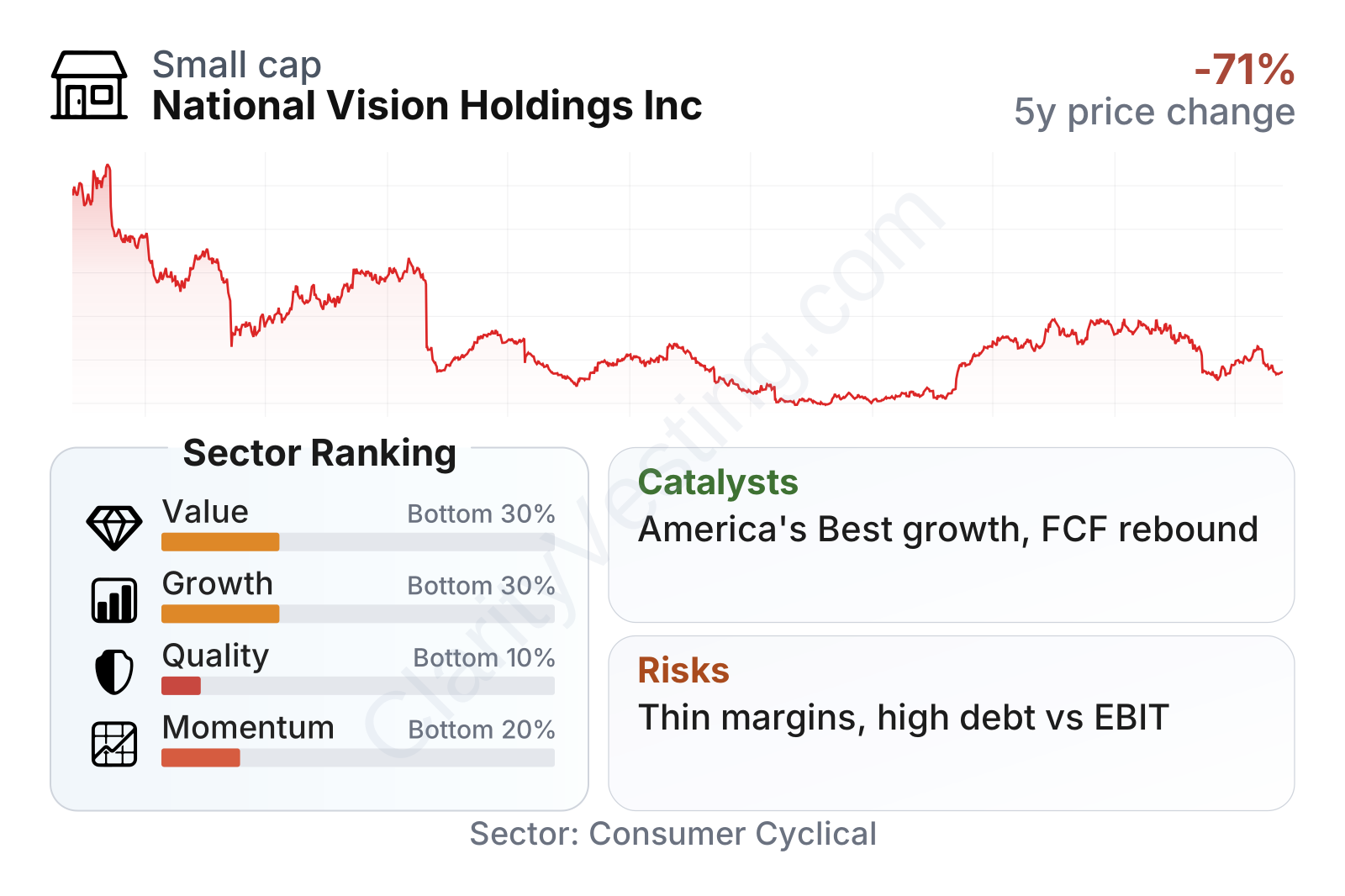
National Vision is a mid-sized retailer with a share price history that has been highly volatile over the past few years. The latest factor snapshot looks mixed to weak: valuation is not especially low relative to the sector, growth ranks in the lower end of the group, and quality measures are particularly soft. Profitability has improved from recent lows, but leverage compared with current earnings remains elevated, which helps explain why market performance has lagged much of the broader consumer retail universe.
Growth
The company operates in a sector with durable long-term demand drivers. Vision care is supported by an aging population, recurring prescription needs, screen usage, and the fact that eyeglasses and contact lenses are repeat-purchase products. In that sense, National Vision participates in a category that is more resilient than many discretionary retail niches, even if customers can still delay purchases during weaker economic periods.
Its strategy also has a clear logic for future expansion. The company focuses on the value end of optical retail, where affordability can matter more when household budgets are under pressure. Store growth, productivity improvements, better exam capacity, and recovery in comparable sales are the main ways the business can expand. Management has also been working on execution issues that weighed on results in prior periods, including merchandising, staffing, and operational consistency.
Revenue growth has turned positive again after a rough period in 2022 through 2024. More recently, year-over-year gains slowed from stronger mid-single-digit and higher levels to roughly low-single-digit growth, which suggests the recovery is real but not yet fully settled. That matters because the company’s current investment case depends less on rapid expansion and more on proving that steady sales can produce healthier margins.
Cash generation is one of the more encouraging recent developments. Free cash flow moved up sharply from depressed levels and reached above $100 million on a trailing basis in early 2026, showing that the business can still convert sales into cash when operations stabilize. That creates room for debt management, store investment, and balance-sheet repair, all of which are important for a retailer coming out of a margin downturn.
A notable recent opportunity is the company’s continued emphasis on America’s Best, its largest and most scalable banner. Because this format is aimed at value-conscious consumers, it may benefit if shoppers continue trading down from higher-priced optical providers. Any sustained recovery in eye exam availability and conversion into eyewear sales could also become a meaningful growth driver.
Risks
This article is for informational purposes only and does not constitute financial advice. Some content is AI-generated. See Disclaimer