Stock Analysis · Expedia Group Inc (EXPE)
Overview
Expedia Group is one of the largest online travel companies in the world. It operates a portfolio of travel brands that help people search, compare, and book trips. Its ecosystem includes well-known names such as Expedia, Hotels.com, Vrbo, Orbitz, Travelocity, Hotwire, and the business travel platform Egencia. In practical terms, Expedia connects travelers with airlines, hotels, vacation rental owners, car rental providers, cruise operators, and other travel suppliers, then earns money by facilitating those bookings.
The business is mainly built around online travel marketplaces and travel technology. Expedia serves both consumers and business partners. On the consumer side, it sells hotel stays, air tickets, car rentals, cruises, vacation packages, and vacation rentals. On the partner side, it provides advertising, distribution, and travel technology tools to airlines, hotels, and other travel companies. This combination gives the group exposure to both direct booking demand and the broader digital infrastructure of the travel industry.
Based on recent company reporting, Expedia’s revenue mix is still heavily centered on lodging, which includes hotels and alternative accommodations such as Vrbo properties. Air travel tends to generate lower margins even when booking volumes are large, while advertising and business-to-business services can be attractive because they require less working capital and can scale efficiently.
The main sources of revenue can be summarized approximately as follows:
- Lodging bookings and related revenue: roughly 70% to 75% of total revenue, driven by hotel bookings and Vrbo vacation rentals.
- Advertising, media, and B2B/travel technology services: roughly 15% to 20%, including partner solutions and marketing services sold to travel suppliers.
- Air ticket revenue: roughly 5% to 10%, usually high in volume but lower in profitability than lodging.
- Other travel products: a smaller share, including car rentals, cruises, insurance, and package-related services.
What stands out in Expedia’s financial structure is how much of each revenue dollar is retained after direct costs. Gross profit has risen strongly over the past several years, while cost of revenue has grown much more slowly. That suggests Expedia’s platform model remains efficient as volume expands, even though the company continues to spend heavily on product development and brand support.
Key Figures
| Metric | Value | Sector ⓘ |
|---|---|---|
| Date | Jul 18, 2026 | |
| Context | ||
| Sector | Consumer Cyclical | |
| Industry | Travel Services | |
| Market Cap ⓘ | $32.52B | |
| Beta ⓘ | 1.23 | |
Value (Cheapness) | ||
| P/E Ratio ⓘ | 23.58 | 18.58 |
| FCF Yield ⓘ | 14.41% | 7.99% |
| EBIT / EV ⓘ | 7.05% | 5.91% |
| PEG ⓘ | 0.87 | |
Growth (Business expansion) | ||
| Revenue Growth ⓘ | 14.70% | 5.50% |
| RPS Growth (5Y CAGR) ⓘ | 18.09% | 9.20% |
| EPS Growth (5Y CAGR) ⓘ | -29.94% | -26.43% |
| Margin Growth (5Y Trend) ⓘ | 9.78% | -0.18% |
| FCF Growth (5Y CAGR) ⓘ | 0.28% | 5.02% |
Quality (Business durability) | ||
| ROIC (Latest) ⓘ | 24.08% | 12.03% |
| ROIC (5Y Median) ⓘ | 10.47% | 10.82% |
| Net Debt / EBIT (Latest) ⓘ | -1.41 | 2.12 |
| Net Debt / EBIT (5Y Median) ⓘ | 1.85 | 2.25 |
| Operating Margin (Latest) ⓘ | 14.40% | 9.28% |
| Operating Margin (5Y Median) ⓘ | 9.84% | 9.64% |
| Debt to Equity (Latest) ⓘ | 817.01% | 75.23% |
| Profit Margin (Latest) ⓘ | 9.81% | 5.28% |
| Free Cash Flow (Latest) ⓘ | $4.69B | |
Momentum (Price trend) | ||
| 3Y Return ⓘ | +124.88% | +10.68% |
| 12M Return (excl. last month) ⓘ | +48.99% | +5.26% |
| 6M Return ⓘ | -8.28% | -2.41% |
| Price vs. 200-Day MA ⓘ | +10.18% | +1.55% |
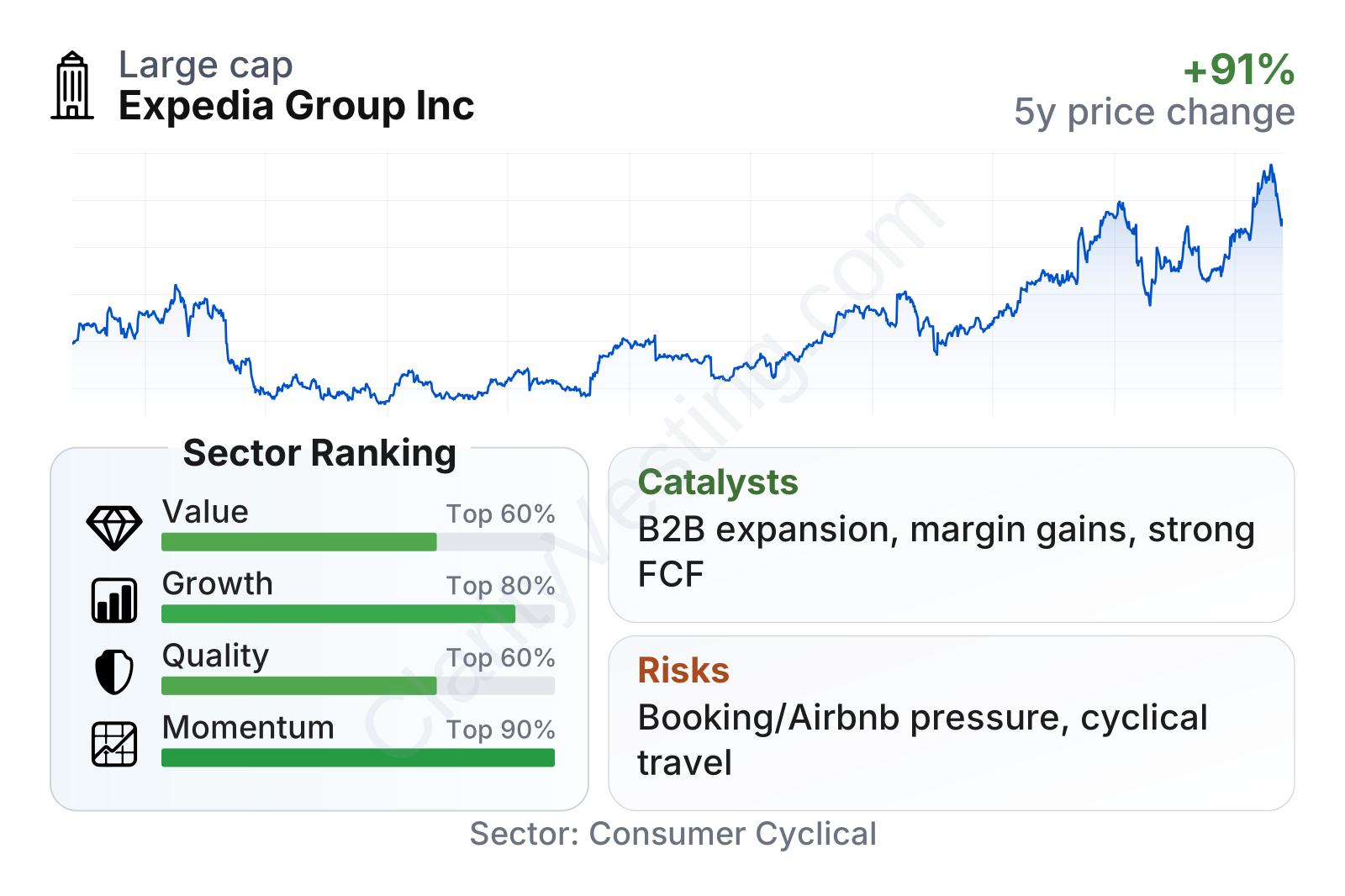
Expedia’s market value is in the low-$30 billion range, making it a large player in travel services but still smaller than the very biggest global online platforms. The stock has shown meaningful volatility, which is not unusual for a cyclical travel company, and its beta above 1 suggests it tends to move more than the broader market.
The overall profile is mixed but solid. On value measures, Expedia does not screen as deeply cheap on earnings, but it looks stronger on cash generation, with free cash flow yield clearly above the sector median. On quality, returns on invested capital and operating margins are notably better than many peers, while net debt relative to EBIT looks conservative. Growth metrics are helped by healthy recent sales expansion and improving margins, although long-term earnings growth still reflects the disruption from the pandemic years.
Momentum has also been strong over multi-year and trailing 12-month periods, even if the shorter-term share performance has cooled. That usually means the market has already recognized much of the company’s recent operating progress, which matters when discussing valuation later.
Growth
Online travel remains a structurally growing part of the broader travel industry. Consumers continue shifting toward digital booking, mobile trip planning, and app-based loyalty ecosystems. At the same time, travel suppliers increasingly rely on large online platforms for customer acquisition, international reach, and inventory distribution. That backdrop supports Expedia’s long-term relevance, even though travel demand can be uneven from year to year.
Expedia’s strategy for future growth is logical. The company has been focusing on three broad areas: strengthening its technology platform, improving customer loyalty across brands, and increasing the mix of higher-margin travel products and partner services. The “One Key” loyalty program across Expedia, Hotels.com, and Vrbo is meant to reduce friction between brands and encourage repeat use. If that system keeps improving cross-selling, it could raise lifetime customer value and reduce dependence on paid marketing.
Vrbo is an important part of the growth case. Vacation rentals remain a major segment of leisure travel, and Vrbo gives Expedia exposure to a category that behaves differently from traditional hotel bookings. Expedia is also investing in international expansion for Vrbo and in improving traveler and host experiences, which can matter in a market where network effects and trust are critical.
Revenue growth has normalized from the post-pandemic rebound, but the recent pattern is still encouraging. After the extraordinary recovery phase faded, Expedia continued posting positive year-over-year growth, and the latest pace appears stronger than the sector median. That points to a business still gaining from healthy travel demand, pricing discipline, and execution improvements rather than simply living off a one-time reopening effect.
Cash generation is another favorable sign. Free cash flow had been uneven after travel demand normalized, but the latest trailing period shows a sharp recovery to a much higher level. That matters because strong cash flow gives Expedia more flexibility for technology investment, debt management, share repurchases, and selective strategic initiatives without stretching the balance sheet in economic slowdowns.
A notable catalyst in recent company updates has been the continued push to unify the platform and improve execution after a period when product transition issues affected growth. Better app engagement, loyalty adoption, and B2B expansion could all support future results. The travel industry itself also benefits from long-term demand drivers such as international travel recovery, experience-led spending, and the ongoing migration from offline to online booking channels.
Risks
Expedia operates in an attractive market, but it is also exposed to several real risks. The first is cyclicality. Travel spending is highly sensitive to consumer confidence, business budgets, fuel prices, exchange rates, and geopolitical disruptions. Even a well-run platform can face weaker booking volumes if households cut discretionary spending or if international mobility is disrupted.
Competition is the second major risk. Expedia is a leading online travel company, but it is not the clear global leader across every category. Booking Holdings is generally viewed as the strongest competitor in online accommodations, especially internationally, while Airbnb remains a major force in alternative accommodations. Google is also an important indirect competitor because its travel search and advertising tools influence how consumers discover flights and hotels. That creates pressure on customer acquisition costs and can limit pricing power.
Compared with these rivals, Expedia has meaningful advantages but also some weaker points. Its brand portfolio is broad, its relationships with travel suppliers are deep, and its scale supports technology investment. Vrbo gives it a relevant position in vacation rentals, and its B2B segment adds diversification. However, Booking has historically shown stronger international reach and asset efficiency, while Airbnb has a more distinctive brand and network in alternative stays. Expedia’s edge is breadth and distribution power rather than undisputed category leadership.
The balance sheet deserves careful interpretation. Debt-to-equity looks extremely high relative to the sector and has climbed over time. On its face, that can appear alarming. However, this ratio is distorted by Expedia’s capital structure and lower book equity, so it should not be read in isolation. A more reassuring signal is that net debt to EBIT is actually favorable, with the company holding a net cash-like position relative to current earnings power. In other words, leverage is not as strained as the equity-based ratio suggests, but the accounting optics are still worth noting.
Profitability has improved materially. Net margin has climbed from weak or negative levels in earlier periods to nearly 10%, now comfortably above the sector median. That indicates better operating discipline and stronger scale benefits. The risk is that travel margins can compress quickly if promotional intensity rises, if airlines and hotels push harder on direct bookings, or if Expedia has to spend more on search marketing to maintain traffic.
There is also execution risk. Expedia has spent several years modernizing platforms, integrating brands, and refining loyalty initiatives. These efforts can create long-term benefits, but large technology transitions are rarely frictionless. If product changes reduce conversion, confuse users, or fail to improve retention, revenue growth may lag expectations even in a healthy travel market.
Regulatory and reputational risks are present as well. Vacation rentals face local regulatory scrutiny in some cities, and online marketplaces must manage issues involving fees, transparency, privacy, and customer service quality. None of that is unique to Expedia, but large consumer platforms can see brand damage quickly if trust weakens.
Valuation
Expedia’s valuation looks moderate rather than plainly cheap. Its current price-to-earnings ratio sits above the sector median, which suggests the market is assigning some premium for margin improvement, healthy travel demand, and stronger cash generation. That premium is not extreme by the company’s own recent history, but it does mean the stock is no longer priced like a turnaround or distressed cyclical name.
On the other hand, earnings multiples only tell part of the story. Expedia’s free cash flow yield is notably stronger than the sector median, and its PEG ratio suggests the valuation is not especially stretched relative to its growth profile. This creates a more balanced picture: the market is paying up for a better business than it was a few years ago, but cash generation offers some support to that higher multiple.
The central question is whether the current valuation is justified by fundamentals. At this stage, the answer appears to lean yes, but with less room for disappointment than before. Expedia now combines above-median margins, strong free cash flow, improving loyalty and platform execution, and ongoing exposure to a large digital travel market. That said, the shares already reflect a fair amount of that progress, so valuation looks more like a confidence-in-execution pricing level than a clear bargain.
Conclusion
Expedia Group stands today as a stronger, more efficient travel platform than it was several years ago. The company has rebuilt profitability, expanded cash generation, and maintained a powerful position in the global online travel ecosystem through a combination of lodging, vacation rentals, advertising, and partner services. Its broad brand portfolio and scale remain meaningful assets in a market where customer traffic, supplier relationships, and technology all matter.
The main challenge is that Expedia operates in a business where competition never relaxes. Booking, Airbnb, and Google all shape the economics of digital travel, and travel demand itself remains cyclical. Expedia therefore needs to keep improving product quality, loyalty engagement, and marketing efficiency to defend its position and translate scale into durable growth.
From a financial perspective, the picture is constructive. Margins have improved, returns on capital are healthy, and free cash flow has become an important strength. Valuation is no longer especially forgiving, but it is still broadly consistent with a company that has moved from recovery mode into steadier execution. The overall direction is favorable: Expedia looks more like a mature digital travel compounder with cyclical swings than a pure rebound case, though that also means expectations are higher and future progress has to be earned.
Sources:
- Expedia Group, Inc. — Annual Report on Form 10-K for fiscal year 2025
- Expedia Group, Inc. — Quarterly Report on Form 10-Q for quarter ended March 31, 2026
- Expedia Group Investor Relations — Q1 2026 earnings release
- Expedia Group Investor Relations — shareholder letters and company-hosted earnings materials
- SEC EDGAR — Expedia Group, Inc. filings database
- Wikipedia — Expedia Group
This article is for informational purposes only and does not constitute financial advice. Some content is AI-generated. See Disclaimer