Stock Analysis · ExlService Holdings Inc (EXLS)
Overview
ExlService Holdings Inc is a data, analytics, and operations company that helps other businesses run processes more efficiently and make decisions using technology. In practical terms, EXL works for large enterprises in industries such as insurance, healthcare, banking, financial services, retail, media, and utilities. Its services combine business process outsourcing, data engineering, artificial intelligence, analytics, digital product development, and consulting.
The company organizes its business around two main segments: Insurance, Healthcare and Emerging Business; and Analytics. The first segment covers a broad set of outsourced operations and digital transformation work for clients, while the second focuses on data-driven services such as AI, advanced analytics, modeling, and decision support. Over time, EXL has been moving toward more analytics-led and technology-enabled work, which generally carries better margins and stronger long-term demand than basic back-office outsourcing.
Based on recent annual disclosures, the main revenue sources appear to be approximately:
- Insurance, Healthcare and Emerging Business: about 65% to 70% of revenue. This includes claims and policy support, healthcare operations, finance and accounting, customer operations, and digital transformation services.
- Analytics: about 30% to 35% of revenue. This includes data management, AI, machine learning, marketing analytics, risk analytics, and decision-support tools.
Within end markets, insurance has historically been EXL’s largest vertical, with healthcare and banking/financial services also important contributors. The business mix matters because insurance and healthcare clients often sign recurring, multi-year contracts, which can make revenue more stable than project-based consulting work.
The company has expanded both organically and through acquisitions, adding capabilities in data, AI, and domain-specific software. Financially, the business has shown a clear pattern in recent years: revenue has climbed steadily, gross profit has widened, and operating income has grown faster than sales, suggesting that scale and mix improvement have supported profitability.
The long-term flow of revenue into profit shows a favorable pattern: sales have risen materially since 2021, while operating income and net income have also expanded. That indicates EXL has not only grown, but has generally converted a meaningful share of that growth into earnings.
Key Figures
| Metric | Value | Sector ⓘ |
|---|---|---|
| Date | Sep 12, 2026 | |
| Context | ||
| Sector | Technology | |
| Industry | Information Technology Services | |
| Market Cap ⓘ | $5.35B | |
| Beta ⓘ | 0.81 | |
Value (Cheapness) | ||
| P/E Ratio ⓘ | 22.32 | 29.51 |
| FCF Yield ⓘ | 5.14% | 4.25% |
| EBIT / EV ⓘ | 6.53% | 2.85% |
| PEG ⓘ | 0.90 | |
Growth (Business expansion) | ||
| Revenue Growth ⓘ | 15.60% | 15.40% |
| RPS Growth (5Y CAGR) ⓘ | 18.33% | 8.56% |
| EPS Growth (5Y CAGR) ⓘ | -21.52% | -11.88% |
| Margin Growth (5Y Trend) ⓘ | 2.20% | 0.46% |
| FCF Growth (5Y CAGR) ⓘ | 19.31% | 9.80% |
Quality (Business durability) | ||
| ROIC (Latest) ⓘ | 22.10% | 9.44% |
| ROIC (5Y Median) ⓘ | 18.46% | 8.30% |
| Net Debt / EBIT (Latest) ⓘ | 1.01 | 0.54 |
| Net Debt / EBIT (5Y Median) ⓘ | 0.77 | 0.44 |
| Operating Margin (Latest) ⓘ | 15.92% | 9.58% |
| Operating Margin (5Y Median) ⓘ | 15.26% | 8.25% |
| Debt to Equity (Latest) ⓘ | 56.34% | 33.33% |
| Profit Margin (Latest) ⓘ | 11.17% | 7.14% |
| Free Cash Flow (Latest) ⓘ | $275.04M | |
Momentum (Price trend) | ||
| 3Y Return ⓘ | +21.46% | +45.48% |
| 12M Return (excl. last month) ⓘ | -19.30% | +23.48% |
| 6M Return ⓘ | +18.68% | +20.93% |
| Price vs. 200-Day MA ⓘ | +5.52% | +7.43% |
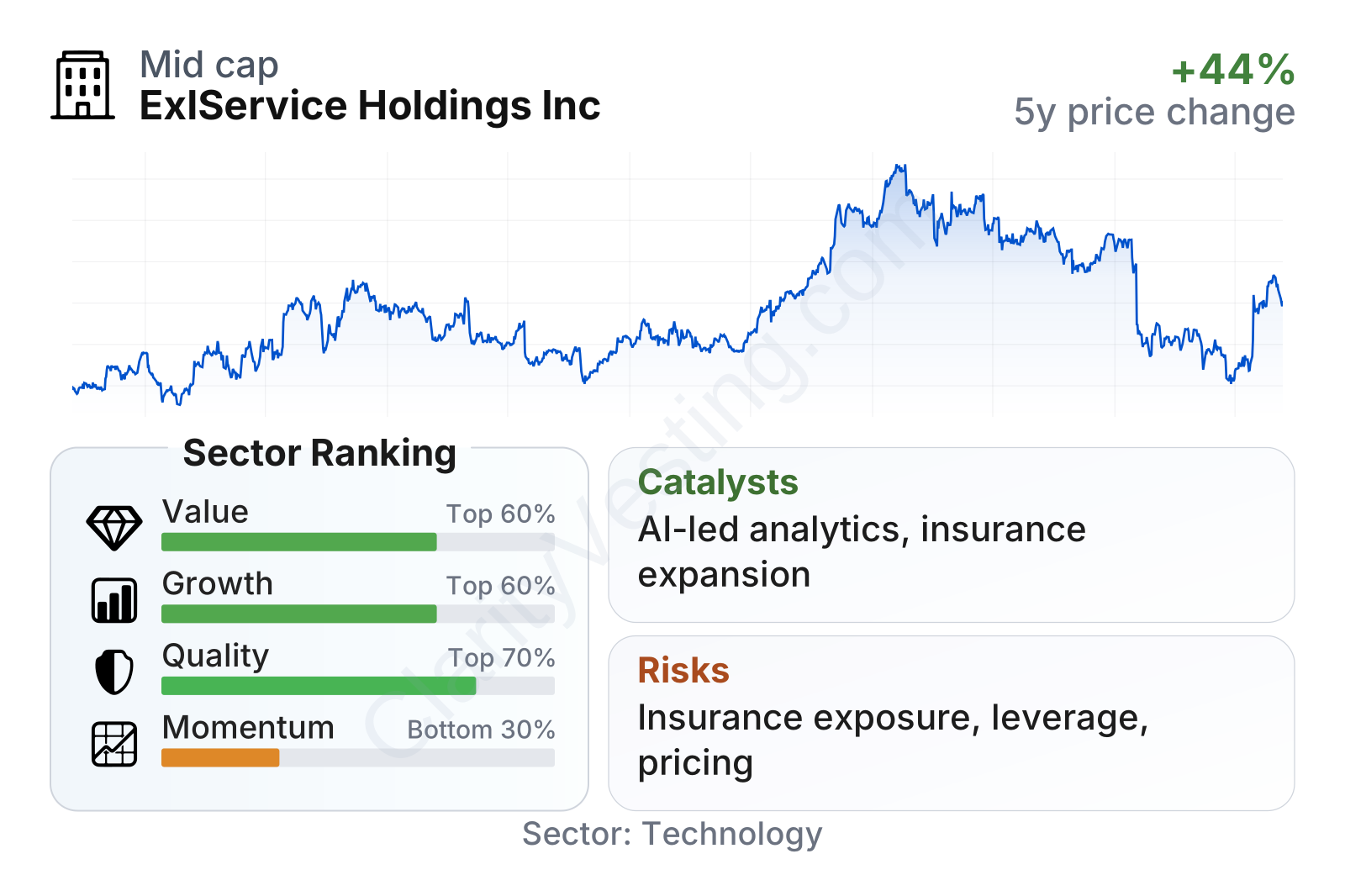
EXL sits in the mid-cap range and has a relatively low beta, which points to share-price moves that have often been less volatile than the broader market. The overall profile is mixed but interesting: valuation metrics look better than much of the sector, profitability is clearly above sector norms, growth has remained solid, while recent stock momentum has been weak.
The quality side stands out most. Return on invested capital is far above the sector median, operating margin is well above average, and profit margin is also meaningfully stronger than peers. Free cash flow generation is healthy as well. The weaker area is balance-sheet leverage, which is not extreme, but it is higher than the sector median and deserves monitoring.
Growth
EXL operates in a part of the technology services market that is still benefiting from long-term demand drivers. Companies across insurance, healthcare, banking, and other regulated industries are trying to automate manual work, reduce operating costs, improve customer service, and make better use of their internal data. That plays directly into EXL’s positioning because it combines outsourced operations with analytics and AI tools rather than offering only labor-based services.
The strategy makes sense for future growth because EXL is focused on areas where clients usually need both industry knowledge and technical capability. In insurance, for example, clients often need claims processing, underwriting support, data models, fraud detection, and workflow automation in one combined solution. That can create deeper client relationships and make switching providers less convenient.
Revenue growth has moderated from the unusually strong pace seen after the pandemic rebound, but it has remained in a healthy range and recently re-accelerated into the mid-teens. That is a constructive sign because it suggests demand has stayed resilient even after the industry-wide normalization from the very high growth rates of earlier years.
Cash generation has improved sharply over the last few years. Free cash flow has moved from roughly $100 million levels in early 2022 to close to $300 million more recently. That matters because it gives EXL room to fund acquisitions, invest in AI capabilities, and manage debt without depending heavily on outside financing.
A notable catalyst is the continued shift by clients toward generative AI, automation, and data modernization. EXL has been emphasizing these capabilities in its offerings and acquisitions, which could support larger deal sizes and higher-value work. Another positive factor is the company’s exposure to insurance and healthcare, where spending on analytics and workflow improvement tends to be tied to efficiency needs rather than purely discretionary technology budgets.
Recent company updates have also highlighted continued investment in AI-enabled solutions and domain-led digital transformation. For EXL, that is important because the opportunity is not only to win new projects, but also to deepen relationships with existing enterprise clients by layering analytics and AI onto already outsourced processes.
Risks
This article is for informational purposes only and does not constitute financial advice. Some content is AI-generated. See Disclaimer


