Stock Analysis · Evertec Inc (EVTC)
Stock Analysis · Evertec Inc (EVTC)

Overview

Evertec is a payments and financial technology company with deep roots in Puerto Rico and a growing presence across Latin America and the Caribbean. In simple terms, it helps move money and process transactions. Its services are used by banks, merchants, government agencies, and businesses that need payment processing, card services, software, and transaction technology. While it is classified in the technology sector, Evertec is closer to a specialized payments infrastructure company than a traditional software business.

The company operates through a mix of transaction processing and business solutions. Its business is relatively diversified, but a large share still comes from payment-related activity and long-standing client relationships in Puerto Rico. Based on company reporting, the main revenue sources can be described approximately as follows:

  • Merchant acquiring and payment processing: card acceptance, transaction routing, and related services for merchants; roughly the largest revenue contributor.
  • Payment services for financial institutions: debit and credit processing, ATM and network services, card issuing support, and switching services; also a major contributor.
  • Business solutions: technology outsourcing, software, and process support for banks, governments, and enterprises; a meaningful but smaller share.

Geographically, Puerto Rico remains the company’s core market, but management has spent the last several years expanding in Latin America through acquisitions, cross-border payments capabilities, and broader merchant coverage. That matters because it reduces dependence on one economy while keeping Evertec focused on markets where electronic payments still have room to grow.

Over the last five years, total revenue has moved from around $590 million to roughly $930 million, showing that the company has expanded materially. Profitability has not been perfectly smooth, but the business still converts a large portion of sales into operating income compared with many technology peers. The broad picture is that Evertec is not a hyper-growth platform, but it is an established transaction infrastructure provider with strong local positioning and recurring activity.

The long-term pattern is fairly clear: revenue has risen strongly since 2021, operating income recovered after a weaker 2023, and interest expense has become a more visible drag after the company added debt. That combination suggests a business that is scaling, but with a capital structure that deserves attention.

Key Figures

MetricValueSector
DateJul 18, 2026
Context
SectorTechnology
IndustrySoftware - Infrastructure
Market Cap $1.87B
Beta 0.72
Value
(Cheapness)
P/E Ratio 14.5531.76
FCF Yield 7.97%4.18%
EBIT / EV 7.83%2.56%
PEG 2.14
Growth
(Business expansion)
Revenue Growth 8.40%13.50%
RPS Growth (5Y CAGR) 15.62%8.57%
EPS Growth (5Y CAGR) -24.46%-21.87%
Margin Growth (5Y Trend) -10.78%0.41%
FCF Growth (5Y CAGR) -4.29%9.76%
Quality
(Business durability)
ROIC (Latest) 11.81%8.54%
ROIC (5Y Median) 13.28%8.12%
Net Debt / EBIT (Latest) 3.930.38
Net Debt / EBIT (5Y Median) 3.570.38
Operating Margin (Latest) 22.59%9.58%
Operating Margin (5Y Median) 23.89%8.25%
Debt to Equity (Latest) 169.83%33.52%
Profit Margin (Latest) 13.95%6.96%
Free Cash Flow (Latest) $148.67M
Momentum
(Price trend)
3Y Return -22.33%+30.91%
12M Return (excl. last month) -25.46%+28.90%
6M Return +0.89%+5.38%
Price vs. 200-Day MA +7.12%+7.61%
Better than sector median
Slightly worse than sector median
More than 20% worse than sector median

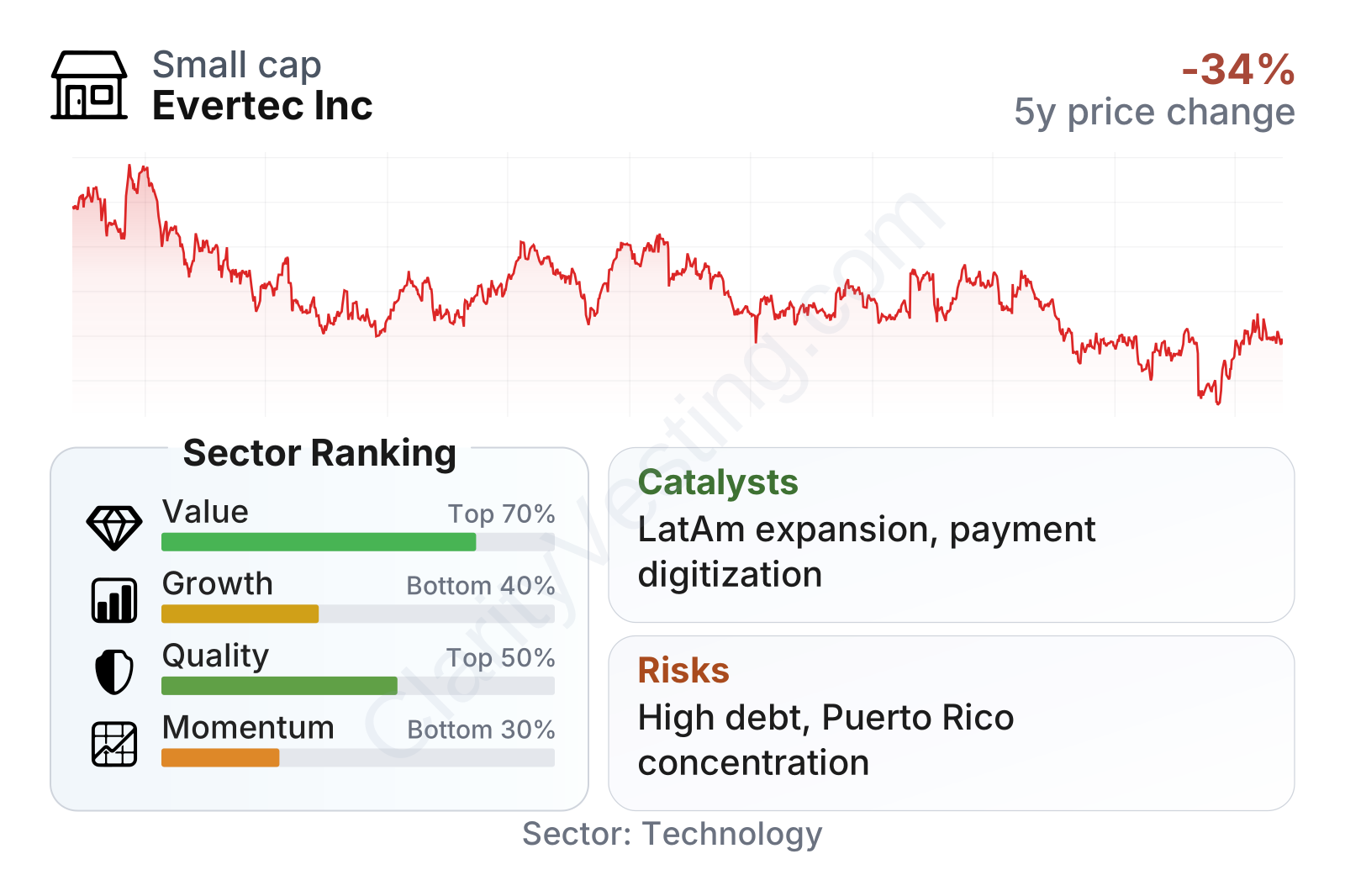
Evertec combines some attractive operating characteristics with slower market recognition. Its profitability and return on invested capital stand above the sector median, and cash generation remains solid for a company of this size. On valuation measures, it screens cheaper than much of the technology sector. The weaker side of the profile is growth and market momentum: recent revenue growth has been positive but below many peers, earnings growth over longer periods has been uneven, and the stock’s recent price performance has lagged the sector. The balance sheet is the main constraint, with leverage far above the sector norm.

Growth

Evertec operates in a favorable long-term area: digital payments. Across Puerto Rico, Latin America, and the Caribbean, cash usage is still being replaced gradually by cards, electronic transfers, and integrated payment solutions. That secular shift gives the company a supportive backdrop even if economic growth in its regions is not especially fast. Payments infrastructure also tends to benefit from recurring transaction volumes rather than one-off product sales, which can make expansion steadier over time.

The company’s strategy for future growth is logical. It has been building scale in merchant acquiring, payment processing, and business solutions while extending its reach beyond Puerto Rico. This is important because Evertec’s home market is relatively mature and limited in size. Expanding into nearby markets with similar payments modernization needs gives it a realistic path to increase volume without having to compete head-on in the most crowded global software categories.

Revenue growth has cooled from the stronger bursts seen in 2024, but it remains positive, recently running in the high-single-digit range. That makes Evertec more of a steady compounder candidate than a rapid-growth name. The longer-term record is still respectable, especially considering that revenue per share over five years has grown faster than the sector median. The issue is not whether the business is growing, but whether it can sustain enough acceleration to re-rate meaningfully.

Free cash flow remains one of the more persuasive parts of the growth profile. Even after coming down from a stronger 2025 level, trailing free cash flow is still healthy, and the company’s free cash flow yield stands well above the sector median. That gives Evertec room to fund acquisitions, invest in platforms, reduce debt, or return capital, depending on management priorities. For a transaction-focused company, that flexibility matters because scale and network reach often improve competitive positioning over time.

One notable catalyst is continued electronic payment adoption in Puerto Rico and Latin America, especially among merchants moving from cash to card and digital channels. Another is the company’s ability to deepen services with financial institutions and government clients that already rely on its infrastructure. Evertec also has an opportunity to benefit from integration and cross-selling following its regional expansion efforts, which could lift transaction volume without requiring entirely new customer acquisition in every case.

Recent company communications in 2026 have continued to point to ongoing execution in merchant solutions, payment processing, and regional growth initiatives rather than a dramatic strategic pivot. That is not the kind of headline catalyst that transforms the business overnight, but it supports the view of Evertec as a company trying to extend an established franchise into adjacent markets where digital payments remain underpenetrated.

Risks

The main risk is concentration. Evertec has a strong franchise in Puerto Rico, and that has historically been a strength, but it also means the business can be more exposed to local economic conditions, natural disasters, regulatory changes, and customer concentration than a broader global payments processor. A company with a dominant local position can still face outsized disruption if that local market stumbles.

Another major risk is leverage. Evertec’s debt-to-equity ratio is far above the sector median, and net debt relative to EBIT is also elevated. The company generates enough operating income and cash flow to support this today, but the higher debt burden reduces flexibility if growth slows, interest rates remain high, or integration efforts disappoint.

The leverage picture has improved somewhat from peak levels, but it remains high versus most technology peers. That makes the business less forgiving if transaction volumes soften or if expansion investments take longer than expected to pay off.

Competition is also real, although Evertec’s position is somewhat unusual. It does not compete only with large global payment processors; it also competes with regional banks, local processors, and specialized fintech firms. In merchant acquiring and payment services, global players such as Fiserv, Fidelity National Information Services, Global Payments, and other regional processors are much larger. Evertec’s advantage is not scale on a worldwide basis, but local entrenchment, regulatory familiarity, and established infrastructure in Puerto Rico and selected Latin American markets.

Profit margins remain comfortably above the sector median even after coming down from unusually high levels seen earlier in the period. That suggests Evertec does have genuine operating advantages in its niche. However, the margin trend also shows that those advantages are not unlimited. Costs, integration spending, financing expense, or pricing pressure can still narrow the gap.

The company appears to have competitive advantages, but mostly in the form of sticky relationships, embedded infrastructure, local market know-how, and switching costs rather than global technological dominance. That can be enough to defend a profitable niche, especially in payment systems where reliability and compliance matter. Still, it does not make Evertec the clear leader across the broader payments industry; it is better described as a strong regional operator with defensible positions in selected markets.

There have not been widely visible public signs in recent company disclosures of the kind of severe governance crisis, scandal, or reputational event that would overshadow the business today. The more practical risks are execution risk on regional expansion, dependence on major customer relationships, and the possibility that economic softness in Puerto Rico or Latin America slows transaction growth.

Valuation

Evertec’s valuation stands out because it looks inexpensive relative to much of the technology sector. The current price-to-earnings ratio is around the low teens, far below the sector median near 30. Its free cash flow yield and EBIT relative to enterprise value also point to a business that the market is pricing more conservatively than many peers.

The longer-term valuation pattern shows a clear reset. After trading at much higher earnings multiples in earlier periods, Evertec now sits well below both its own past peaks and the sector median. Part of that discount makes sense. The company is not growing as fast as many technology businesses, it carries meaningfully more debt, and its stock momentum has been weak. In other words, the market is not treating it like a premium software company.

At the same time, the discount does not appear random. Evertec still posts solid margins, respectable returns on capital, and healthy cash generation. Those characteristics can justify a valuation above distressed levels, but probably not a sector-leading multiple unless growth becomes more durable and leverage trends down further. The present valuation looks more aligned with a mature, profitable payments infrastructure provider than with a fast-scaling fintech platform.

This creates an interesting tension in the stock’s profile. On one side, the market is assigning a restrained multiple to a business with above-average profitability. On the other, the company’s slower growth and debt load explain why that multiple remains below broader technology averages. The current pricing therefore seems to reflect skepticism, but not a collapse in business quality.

Conclusion

Evertec stands out as a profitable and cash-generative payments infrastructure company with durable positions in Puerto Rico and a sensible expansion path across Latin America and the Caribbean. The business is easier to understand than many technology names: it processes transactions, supports financial institutions and merchants, and benefits from the steady shift toward electronic payments. That makes the long-term backdrop supportive even without explosive growth.

The challenge is that Evertec is not a pure growth vehicle. Revenue is still rising, but at a more moderate pace than many sector peers, and the company’s balance sheet adds a meaningful layer of risk. Its competitive edge appears strongest in regional execution and customer stickiness rather than global scale or unique technology. That is enough to support attractive margins, but it also places limits on how aggressively the market may value the business.

Overall, Evertec currently looks like a disciplined, established operator whose financial quality is stronger than its stock market profile suggests, but whose debt burden and narrower growth profile keep the outlook from looking fully straightforward. The central question is less about business viability and more about whether steady payment-volume growth, regional expansion, and continued cash generation can outweigh the limits imposed by leverage and market concentration.

Sources:

  • EVERTEC, Inc. — Annual Report on Form 10-K for fiscal year 2025
  • EVERTEC, Inc. — Quarterly Report on Form 10-Q for quarter ended March 31, 2026
  • SEC EDGAR — EVERTEC, Inc. filings database
  • EVERTEC Investor Relations — earnings releases and investor presentation materials, 2026
  • Wikipedia — EVERTEC basic company background

This article is for informational purposes only and does not constitute financial advice. Some content is AI-generated. See Disclaimer


Sign up for exclusive research and insights.

Unsubscribe anytime.
