Stock Analysis · EverCommerce Inc (EVCM)
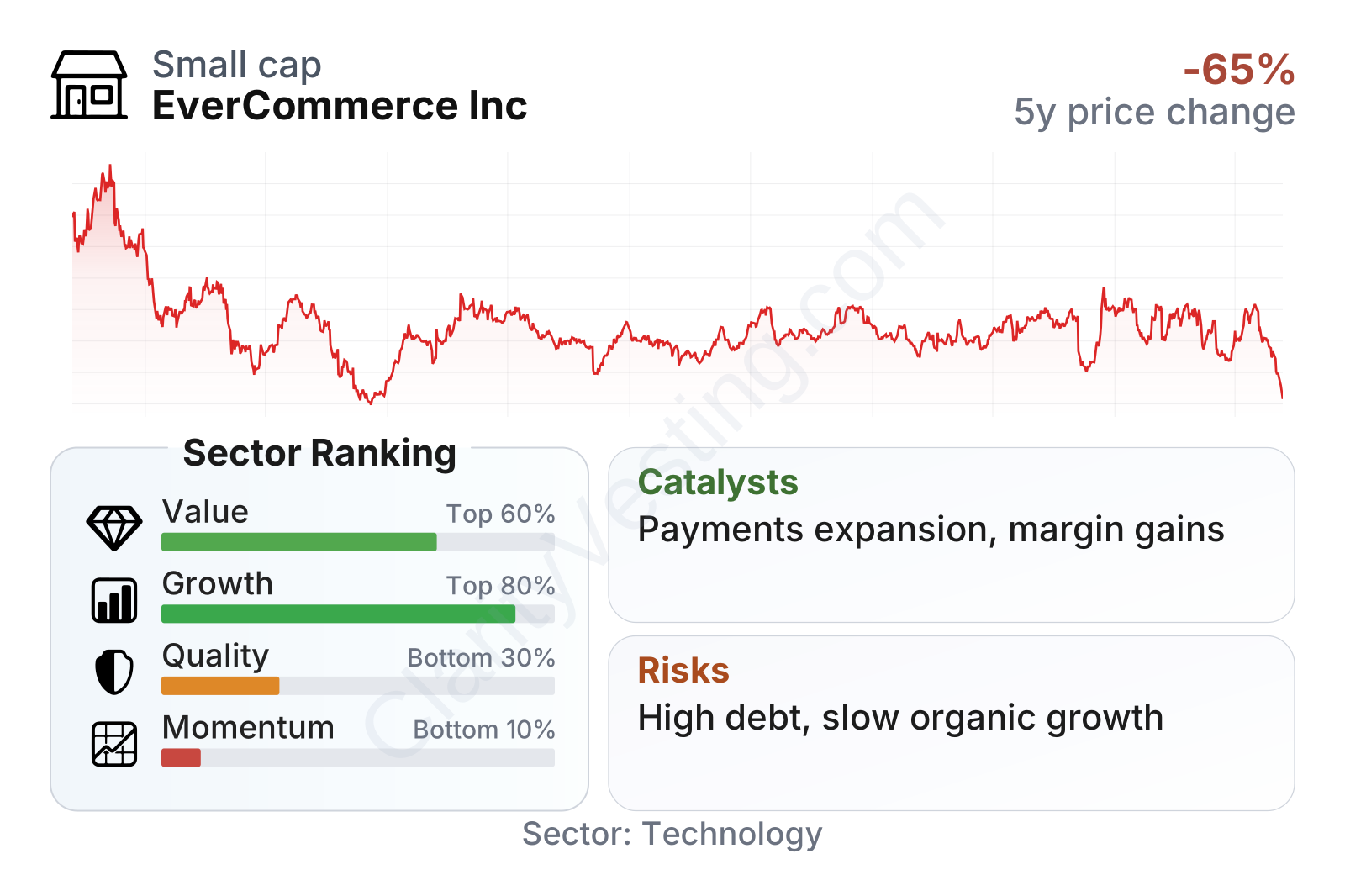
Stock Analysis · EverCommerce Inc (EVCM)

Overview

EverCommerce Inc is a software company focused on small and medium-sized service businesses. Instead of selling broad enterprise software to very large corporations, it builds and acquires specialized tools for businesses such as home service contractors, health and wellness providers, and other local service companies. Its products are meant to help these businesses attract customers, manage scheduling, process payments, handle marketing, and run day-to-day operations from one set of systems.

The business model is built around recurring software subscriptions plus payment-related revenue and other technology-enabled services. That mix matters because subscription revenue is usually steadier, while payments and service revenue can grow as customers process more transactions through the platform. EverCommerce has spent years assembling a portfolio of vertical software brands, so the company is not dependent on a single product.

Based on company disclosures, revenue is mainly generated from three broad streams, with software subscriptions generally representing the largest share, followed by payments and then marketing technology and other services. Exact mix can shift with divestitures and portfolio changes, but the business can be understood roughly as follows:

  • Subscription and transaction software revenue: the largest component, likely around half to somewhat more than half of revenue, coming from recurring fees for practice management, field service, customer engagement, and workflow tools.
  • Payments revenue: a substantial second pillar, roughly around one-quarter to one-third of revenue, generated when customers use embedded payment processing on EverCommerce platforms.
  • Marketing technology and other services: the smallest major category, roughly the remaining share, including lead generation, digital marketing, and related services.

One notable business trend is that EverCommerce has been reshaping its portfolio. Revenue grew steadily through 2024, but 2025 shows a lower total as the company narrowed its focus, while profitability improved meaningfully. That points to a strategy centered less on size at any cost and more on becoming a more efficient, cash-generating software platform.

The financial flow over the last several years shows a clear improvement in operating discipline. Revenue expanded strongly after the public listing period, but the more important change is that operating losses narrowed and eventually turned into positive operating income. Selling and administrative costs remain heavy, which is common for software groups serving fragmented local markets, yet the company has recently converted much more of its gross profit into operating earnings than it did a few years ago.

Key Figures

MetricValueSector
DateJul 18, 2026
Context
SectorTechnology
IndustrySoftware - Application
Market Cap $2.10B
Beta 0.94
Value
(Cheapness)
P/E Ratio 91.2331.76
FCF Yield 4.05%4.18%
EBIT / EV 2.48%2.56%
PEG 0.52
Growth
(Business expansion)
Revenue Growth 3.60%13.50%
RPS Growth (5Y CAGR) 6.29%8.57%
EPS Growth (5Y CAGR) -32.59%-21.87%
Margin Growth (5Y Trend) 21.47%0.41%
FCF Growth (5Y CAGR) 48.13%9.76%
Quality
(Business durability)
ROIC (Latest) 4.34%8.54%
ROIC (5Y Median) 0.01%8.12%
Net Debt / EBIT (Latest) 6.480.38
Net Debt / EBIT (5Y Median) 181.200.38
Operating Margin (Latest) 10.20%9.58%
Operating Margin (5Y Median) 0.04%8.25%
Debt to Equity (Latest) 73.14%33.52%
Profit Margin (Latest) 5.47%6.96%
Free Cash Flow (Latest) $85.06M
Momentum
(Price trend)
3Y Return +0.58%+30.91%
12M Return (excl. last month) -9.71%+28.90%
6M Return -2.98%+5.38%
Price vs. 200-Day MA +11.03%+7.61%
Better than sector median
Slightly worse than sector median
More than 20% worse than sector median

At a high level, EverCommerce looks mixed but improving. The company’s market value is in the small-cap range, which often means more room for business transformation but also more share-price volatility. On valuation metrics tied to cash generation, it screens better than many software peers, helped by solid free cash flow. On growth, the picture is more moderate: revenue growth is positive again, but slower than the sector median. Quality metrics are the weakest area, mainly because returns on capital remain modest and leverage is still elevated. Profitability trends, however, have improved sharply from the loss-making period that followed its IPO.

Growth

EverCommerce operates in a part of the software market that still has a long runway. Many service-based small businesses remain under-digitized compared with larger enterprises. Scheduling, billing, customer communication, digital marketing, and payment collection are increasingly moving into integrated software platforms, and providers that already serve niche industries can deepen relationships over time. That underlying sector backdrop is favorable because local service businesses usually need practical, workflow-based software rather than highly experimental technology.

The company’s strategy for future growth appears sensible if execution remains consistent. EverCommerce has been emphasizing focused verticals, cross-selling more products into existing customers, and embedding payments into core workflows. That can raise revenue per customer without relying only on signing up large numbers of new clients. It also creates a more durable platform because once scheduling, customer records, payments, and marketing tools all sit in one system, switching becomes harder.

Growth has clearly cooled from the very high levels seen in earlier years. After strong expansion in 2021 and 2022, growth decelerated, turned negative in parts of 2024 and late 2025, and then returned to low single digits most recently. That pattern suggests the company is no longer in a rapid land-grab phase. Instead, it is moving toward a more mature profile where portfolio pruning and margin improvement matter as much as headline sales growth.

Free cash flow is a brighter point. It rose substantially over the last several years before easing from a peak in the latest period, but it remains well above earlier levels. For a company in this size range, that is important because cash generation gives management more flexibility to invest in product development, reduce debt, or pursue selective acquisitions without depending heavily on new financing.

Recent company communications have also highlighted continued interest in streamlining the business around stronger vertical software assets and integrated payments. The main catalyst is not a single blockbuster event; it is the possibility that EverCommerce becomes a cleaner, more focused platform with steadier organic growth and better margins. If that continues, the market may increasingly judge the company on earnings and cash flow rather than on its earlier acquisition-heavy history.

Risks

The biggest risk is that EverCommerce is still in transition. A company can improve profitability by narrowing its portfolio, but that can also reduce revenue and create uncertainty about what the normalized growth rate really is. The recent pattern shows that sales momentum has been uneven, so there is still a question about how much durable organic growth remains once divestitures and restructuring effects are stripped out.

Competition is another key issue. EverCommerce is not the clear overall leader in business software; it competes across multiple niches. In field services and home services, it faces players such as ServiceTitan, Jobber, Housecall Pro, and other specialized software vendors. In health and wellness, there are practice-management and engagement competitors tailored to clinics, spas, fitness, and related businesses. In payments, it overlaps with integrated payment providers and broader platforms that are often larger and better capitalized. EverCommerce’s advantage is specialization across many service verticals rather than dominance in one giant category. That provides breadth, but it can also dilute brand strength compared with category leaders.

The company does have some competitive advantages. Its software is embedded in daily operations, which can support customer retention. The combination of workflow software, customer engagement tools, and payments can also create switching friction and raise the value of each client relationship. Still, these advantages are more practical than absolute. They do not create the kind of near-monopoly position seen in the strongest software franchises.

Leverage remains a meaningful financial risk. Debt to equity is around the low-70% range, more than double the sector median, and the trend has generally moved upward over the past few years. Net debt relative to EBIT is also high, which shows that the balance sheet still carries pressure despite better profitability. If growth softens again or interest costs stay elevated, that could limit strategic flexibility.

Margins tell a two-sided story. On one hand, profit margin has improved dramatically, moving from deep losses a few years ago to a positive mid-single-digit level recently. On the other hand, profitability still trails the sector median, which means the turnaround is real but not complete. The business is no longer in the same weak earnings position it once was, yet it also has not reached the efficiency level of stronger software peers.

There is no major public sign of a scandal or severe reputation event defining the current outlook. The more important risk is execution: whether management can simplify the portfolio, maintain customer retention, and keep improving margins without sacrificing too much revenue base along the way.

Valuation

Valuation depends heavily on which lens is used. On earnings, the stock looks expensive: the price-to-earnings ratio is roughly in the mid-60s, well above the software sector median near 30. That usually signals that the market is pricing in further profit improvement. Because the company only recently turned meaningfully profitable, the earnings multiple may overstate how expensive the shares truly are if margins continue rising from a still-developing base.

The recent drop in the earnings multiple from extremely high levels to a still-elevated range reflects that profits have improved faster than the share price. That is encouraging, but it does not automatically make the valuation cheap. The current level suggests the market is giving EverCommerce credit for its turnaround, even though revenue growth remains modest.

Cash-flow-based measures are more favorable. Free cash flow yield is above the sector median, and EBIT relative to enterprise value also compares reasonably well. That creates an unusual profile for a software company: expensive on earnings, but less demanding on cash generation. In other words, the stock price appears to reflect a business that is no longer distressed, yet not fully trusted either. The valuation seems broadly tied to the idea that EverCommerce can keep lifting margins and cash conversion even if top-line growth stays moderate.

That leaves the shares in a middle ground. The market is not valuing EverCommerce like a fast-growing software leader, but it is also not pricing it like a low-quality melting-ice-cube business. The current price appears justified only if the company can sustain positive earnings, preserve healthy free cash flow, and show that the streamlined portfolio can produce steadier organic growth than recent results imply.

Conclusion

EverCommerce stands out less for explosive expansion than for business repair. It serves attractive software niches tied to everyday service businesses, and that market still offers a long runway for digital adoption, recurring subscriptions, and embedded payments. Over the last several years, the company has made visible progress in turning gross profit into operating income and in generating meaningful free cash flow.

The challenge is that this progress comes with trade-offs. Revenue growth has slowed sharply from earlier levels, the company is not the clear leader in its categories, and leverage remains high for a software business. That combination makes EverCommerce more of an execution-and-discipline case than a straightforward growth case.

Overall, the company currently looks like a more credible business than its earlier loss-making profile suggested, but not yet a fully proven compounder. The central question is whether margin gains and cash generation can continue long enough to outweigh slower growth and a heavier balance sheet. At today’s valuation, the market seems to recognize the turnaround, while still waiting for stronger proof that EverCommerce can become a consistently higher-quality software platform.

Sources:

  • EverCommerce, Inc. — Annual Report on Form 10-K for the fiscal year ended December 31, 2025
  • EverCommerce, Inc. — Quarterly Report on Form 10-Q for the quarter ended March 31, 2026
  • SEC EDGAR — EverCommerce, Inc. filings database
  • EverCommerce Investor Relations — earnings releases and shareholder materials
  • EverCommerce Investor Relations — company overview and business descriptions
  • Wikipedia — EverCommerce basic company background

This article is for informational purposes only and does not constitute financial advice. Some content is AI-generated. See Disclaimer


Sign up for exclusive research and insights.

Unsubscribe anytime.
