Stock Analysis · Entravision Communications (EVC)
Overview
Entravision Communications is a media and advertising company with roots in Spanish-language broadcasting and a much larger international digital advertising business today. The company operates television and radio stations in the United States, but its biggest activity is now helping advertisers place campaigns across digital channels such as mobile, video, social, connected TV, and performance-based marketing. In recent years, Entravision has expanded beyond traditional media through acquisitions and partnerships, turning the business into a mix of legacy local media assets and global ad-tech and digital services operations.
Based on recent company filings, revenue is mainly generated from two broad areas:
- Advertising Technology & Services: approximately 75% to 85% of revenue in recent periods. This includes digital ad sales, media buying, campaign management, and technology-enabled marketing services provided to advertisers, agencies, publishers, and platforms across many countries.
- Media: approximately 15% to 25% of revenue. This includes television and radio advertising in U.S. local markets, along with retransmission consent revenue and other broadcasting-related income.
Within the media business, television generally contributes more than radio, while within digital operations the company is exposed to fast-moving categories such as mobile advertising, social commerce, and performance marketing. The broad direction is clear: Entravision is no longer primarily a broadcaster, even if its public identity still reflects that history.
The business mix also helps explain why revenue can look volatile. Traditional broadcasting tends to be influenced by local advertising cycles and political ad spending, while digital advertising can grow faster but often carries lower margins and greater dependence on large platform partners.
The long-term pattern shows a company that has rebuilt revenue after a major reset, but with profitability under pressure. Sales recovered strongly from 2023 through 2025, yet gross profit and operating income did not keep pace, which suggests that the newer mix is more volume-driven and less profitable than the older structure.
Key Figures
| Metric | Value | Sector ⓘ |
|---|---|---|
| Date | Sep 12, 2026 | |
| Context | ||
| Sector | Communication Services | |
| Industry | Advertising Agencies | |
| Market Cap ⓘ | $819.52M | |
| Beta ⓘ | 1.73 | |
Value (Cheapness) | ||
| P/E Ratio ⓘ | 444.00 | 18.61 |
| FCF Yield ⓘ | 6.59% | 13.68% |
| EBIT / EV ⓘ | 2.34% | 4.54% |
| PEG ⓘ | 6.43 | |
Growth (Business expansion) | ||
| Revenue Growth ⓘ | 126.20% | 5.40% |
| RPS Growth (5Y CAGR) ⓘ | -13.19% | 4.62% |
| EPS Growth (5Y CAGR) ⓘ | -18.31% | -18.01% |
| Margin Growth (5Y Trend) ⓘ | N/A | 1.10% |
| FCF Growth (5Y CAGR) ⓘ | -50.69% | 5.88% |
Quality (Business durability) | ||
| ROIC (Latest) ⓘ | -3.33% | 8.38% |
| ROIC (5Y Median) ⓘ | -4.21% | 8.32% |
| Net Debt / EBIT (Latest) ⓘ | 5.50 | 1.99 |
| Net Debt / EBIT (5Y Median) ⓘ | N/A | 2.94 |
| Operating Margin (Latest) ⓘ | 3.36% | 14.89% |
| Operating Margin (5Y Median) ⓘ | -8.32% | 12.96% |
| Debt to Equity (Latest) ⓘ | 246.86% | 59.59% |
| Profit Margin (Latest) ⓘ | 0.62% | 8.77% |
| Free Cash Flow (Latest) ⓘ | $54.01M | |
Momentum (Price trend) | ||
| 3Y Return ⓘ | +191.21% | +46.64% |
| 12M Return (excl. last month) ⓘ | +383.57% | +2.16% |
| 6M Return ⓘ | +197.67% | +5.05% |
| Price vs. 200-Day MA ⓘ | +62.53% | +2.88% |
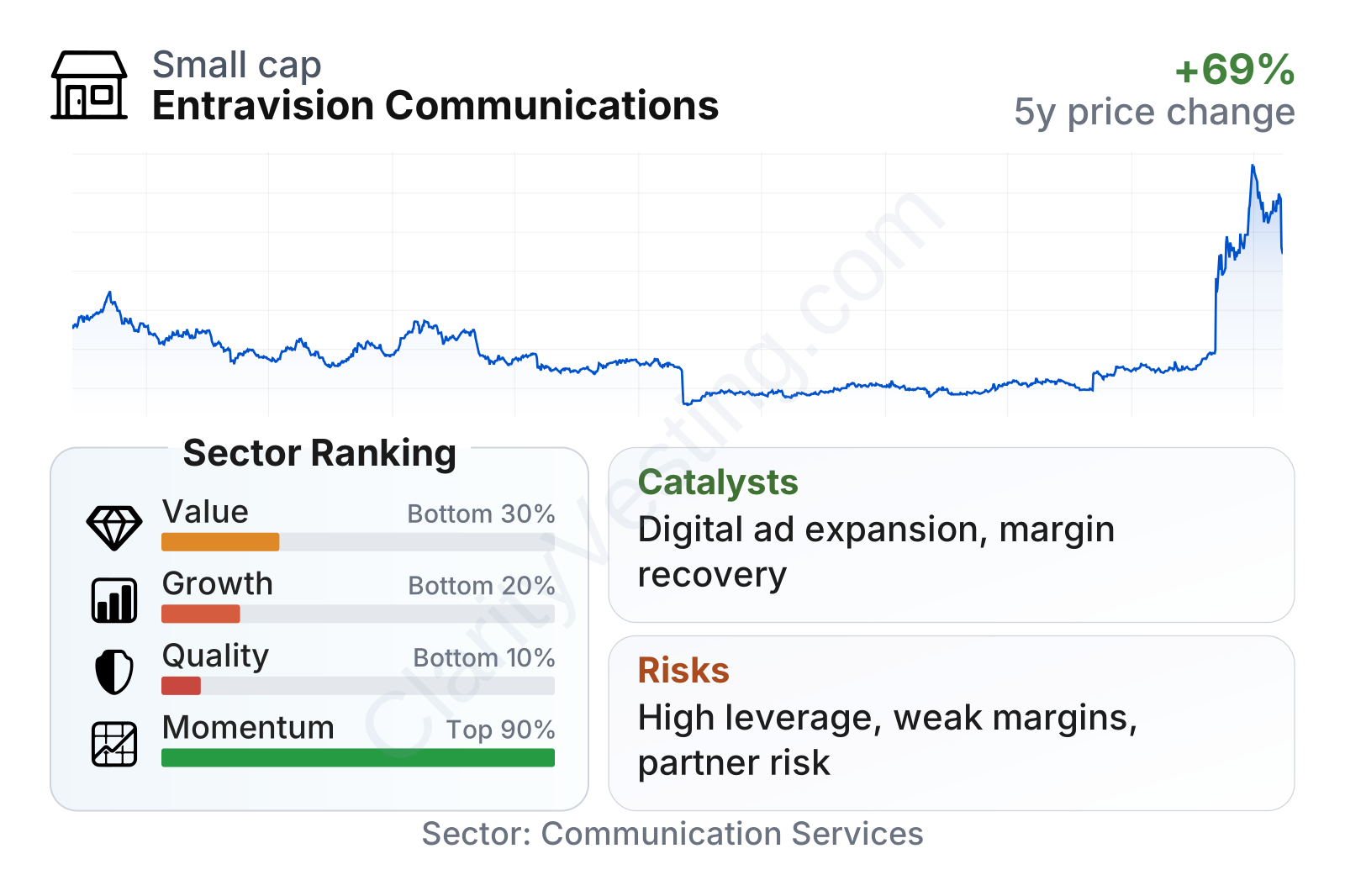
Entravision is a small-cap company with a high share-price sensitivity, reflected in a beta well above 1. The factor profile is unusual: price momentum is very strong, but value, growth quality, and business quality rank weakly against the broader Communication Services sector. In simple terms, the market has recently become much more optimistic about the shares even though the operating record remains fragile and leverage is elevated.
The sharp rise in the stock price during 2026 stands out against a much weaker multi-year operating history. That disconnect does not automatically mean the market is wrong, but it does mean recent enthusiasm has moved faster than the company’s underlying fundamentals.
Growth
Entravision operates in digital advertising, which is still a growth market over the long run. Advertisers continue shifting budgets toward measurable, performance-based, and programmatic channels, and this gives the company exposure to a structurally expanding part of the media landscape. That is the most important growth argument: the company participates in an industry with better long-term demand than traditional radio or local television.
Its strategy also makes sense on paper. Management has spent years reducing reliance on broadcasting and building a broader international digital platform. If Entravision can use its relationships, scale, and multicultural advertising expertise to win business across Latin America, Europe, Africa, and Asia-Pacific, that can create a larger addressable market than its legacy U.S. station footprint ever allowed.
Recent revenue growth has turned sharply positive again, with year-over-year gains far above the sector median. That is encouraging, but the broader history matters: the company has also gone through abrupt contractions, including major drops in 2023 and again around late 2024 to early 2025. For long-term analysis, this looks less like smooth expansion and more like a company still trying to prove that its new model can produce durable, repeatable growth.
Cash generation is a more constructive part of the picture. Free cash flow remains positive and has recovered from the low point seen in 2025, although it is still below earlier levels. Positive cash flow gives management more flexibility to service debt and continue investing in the business, but the five-year trend is still negative overall, so this is better viewed as stabilization rather than a completed turnaround.
A meaningful catalyst is the company’s digital-first repositioning itself. If higher revenue from ad-tech and services starts flowing through with better margins, the market could view Entravision less as a challenged broadcaster and more as a scaled digital advertising platform. Another catalyst is political advertising in election periods, which can temporarily strengthen the media segment, though that tends to be cyclical rather than structural.
Recent company updates have also highlighted continued focus on digital expansion, platform partnerships, and international reach. Those developments matter because Entravision’s future depends far more on execution in digital services than on mature U.S. broadcasting assets.
Risks
This article is for informational purposes only and does not constitute financial advice. Some content is AI-generated. See Disclaimer


