Stock Analysis · Eutelsat Communications SA (ETCMY)
Overview
Eutelsat Communications SA is a French satellite operator. Historically, it built its business around geostationary satellites that deliver television broadcasting, fixed data connectivity, government communications, and mobility services such as connectivity for maritime and aviation customers. The company’s profile changed materially after its combination with OneWeb, which added a low Earth orbit satellite network aimed at broadband connectivity with lower latency and broader flexibility for enterprise, government, telecom backhaul, and remote-area access.
In simple terms, Eutelsat now operates in two parts of the space connectivity market. One part is the traditional satellite business, which is mature and still important for cash generation, especially in video. The other part is the newer low Earth orbit broadband platform, which is positioned for future demand in secure and resilient connectivity.
Based on recent annual reporting, revenue still comes mainly from the legacy geostationary activities, while OneWeb is becoming a larger contributor as services scale. The broad mix can be summarized approximately as follows:
- Video broadcasting: still the largest source, roughly around one-third of revenue, driven by TV distribution to broadcasters and pay-TV platforms.
- Fixed Connectivity: roughly around one-quarter to one-third, including telecom backhaul, enterprise networks, and broadband infrastructure.
- Government Services: around one-fifth, supported by defense and public-sector capacity needs.
- Mobile Connectivity: around one-tenth, including maritime and aviation uses.
- OneWeb / LEO broadband and related services: a growing but still smaller share in reported group revenue, with strategic importance greater than its current weight.
The business model has one attractive feature for long-term analysis: satellite assets can support recurring service revenue over many years once capacity is in operation. The challenge is that these networks require heavy upfront investment, and returns depend on filling that capacity with customers fast enough.
The revenue base has stayed near the low-billion-euro range over recent years, but profitability has deteriorated sharply. Gross profit remains sizable, which suggests the core service engine still has economic value, yet operating costs, depreciation, integration costs, and financing burden have become much heavier. That gap between resilient revenue and weaker bottom-line performance is central to understanding the company today.
Key Figures
| Metric | Value | Sector ⓘ |
|---|---|---|
| Date | Sep 12, 2026 | |
| Context | ||
| Sector | Communication Services | |
| Industry | Telecom Services | |
| Market Cap ⓘ | $2.54B | |
| Beta ⓘ | 0.11 | |
Value (Cheapness) | ||
| P/E Ratio ⓘ | N/A | 18.61 |
| FCF Yield ⓘ | -6.49% | 13.68% |
| EBIT / EV ⓘ | N/A | 4.54% |
| PEG ⓘ | N/A | |
Growth (Business expansion) | ||
| Revenue Growth ⓘ | 1.10% | 5.40% |
| RPS Growth (5Y CAGR) ⓘ | -31.99% | 4.62% |
| EPS Growth (5Y CAGR) ⓘ | N/A | -18.01% |
| Margin Growth (5Y Trend) ⓘ | N/A | 1.10% |
| FCF Growth (5Y CAGR) ⓘ | N/A | 5.88% |
Quality (Business durability) | ||
| ROIC (Latest) ⓘ | -5.97% | 8.38% |
| ROIC (5Y Median) ⓘ | -0.88% | 8.32% |
| Net Debt / EBIT (Latest) ⓘ | N/A | 1.99 |
| Net Debt / EBIT (5Y Median) ⓘ | N/A | 2.94 |
| Operating Margin (Latest) ⓘ | -18.88% | 14.89% |
| Operating Margin (5Y Median) ⓘ | -5.42% | 12.96% |
| Debt to Equity (Latest) ⓘ | 87.52% | 59.59% |
| Profit Margin (Latest) ⓘ | -37.00% | 8.77% |
| Free Cash Flow (Latest) ⓘ | -$165.07M | |
Momentum (Price trend) | ||
| 3Y Return ⓘ | -57.55% | +46.64% |
| 12M Return (excl. last month) ⓘ | -15.08% | +2.16% |
| 6M Return ⓘ | -2.14% | +5.05% |
| Price vs. 200-Day MA ⓘ | -21.06% | +2.88% |
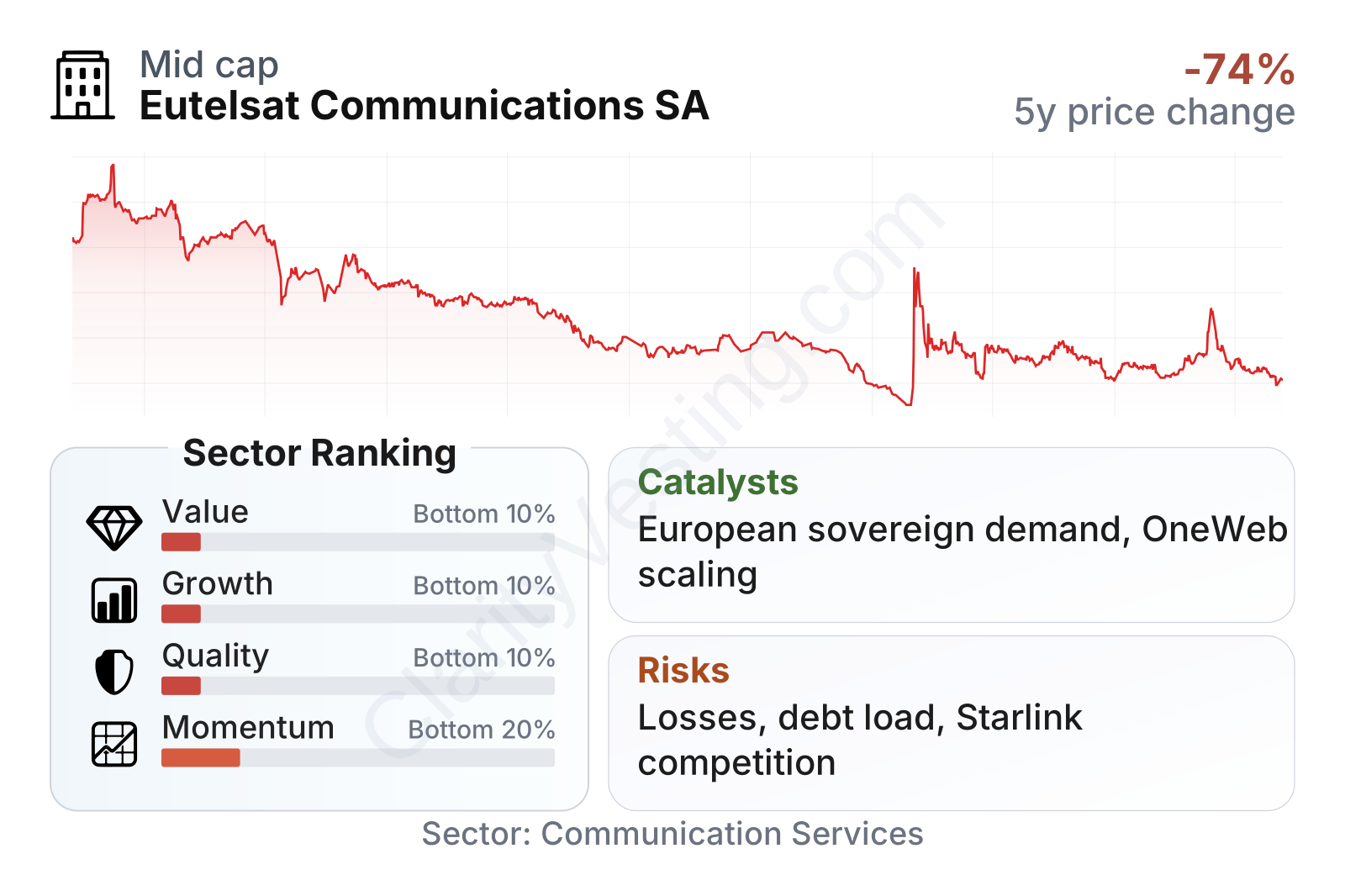
The overall profile is weak relative to the broader communication services sector. Growth ranks near the bottom of the peer group, value metrics are hard to read because earnings have turned negative, and quality indicators are pressured by losses and elevated leverage. One notable outlier is the very low beta, which means the stock has not moved in lockstep with the wider market, but that should not be confused with low business risk. The longer stock-price history also shows a steep decline over several years, interrupted by short rebounds rather than a durable recovery trend.
At roughly a few billion dollars in market value, Eutelsat is far smaller than the largest global satellite and connectivity platforms. That smaller size can make strategic wins more meaningful, but it also limits financial flexibility when the company is competing in a capital-intensive industry.
Growth
The sector itself has a real long-term growth angle. Demand for connectivity in remote areas, defense communications, network resilience, mobility, and sovereign digital infrastructure is rising. Governments and enterprises increasingly want backup networks that are independent from terrestrial infrastructure. This is particularly relevant in Europe, where secure communications and space autonomy have become more visible policy themes.
Eutelsat’s strategy makes sense on paper because it combines legacy geostationary infrastructure, which is useful for wide-area coverage and broadcast, with low Earth orbit capacity, which is better suited to modern broadband use cases. That dual-network approach can be valuable for customers that want a mix of reach, resilience, and lower latency. It also gives Eutelsat a clearer strategic identity than a pure legacy video satellite operator.
That said, the current revenue trend is not yet showing broad-based acceleration. Recent year-over-year revenue movement has been slightly negative, which is notably weaker than the sector median. This suggests the company is still in a transition period: mature businesses are either flat or shrinking, while the newer connectivity activities are not yet large enough to fully offset that pressure.
Cash generation has also become less comfortable. Free cash flow was positive in the recent trailing periods shown here, but the broader financial picture indicates that cash conversion is under strain as the group absorbs a large network buildout, integration needs, and financing costs. For a satellite operator, this matters because growth only becomes durable when customer additions start turning heavy infrastructure spending into repeatable cash returns.
A meaningful catalyst is Europe’s growing focus on independent space and communications capabilities. Eutelsat has frequently been discussed as a strategic European satellite infrastructure player because OneWeb gives it a low Earth orbit network that is already deployed, unlike many earlier-stage concepts. That can matter for defense, public-sector communications, and multi-orbit offerings for telecom operators.
Another potential opportunity is the expansion of enterprise and government demand for secure connectivity outside dense urban areas, including maritime routes, civil protection, and military use. The company does not need to dominate every segment for this to matter; a few large institutional contracts can materially improve utilization and visibility.
Risks
This article is for informational purposes only and does not constitute financial advice. Some content is AI-generated. See Disclaimer


