Stock Analysis · Eisai Co. Ltd (ESALF)
Overview
Eisai Co., Ltd. is a Japanese pharmaceutical company focused mainly on neurology and oncology. Its best-known growth asset is Leqembi, an Alzheimer’s disease treatment developed with Biogen. The company also sells established cancer medicines, epilepsy products, and other prescription drugs. Eisai’s business model is typical for a research-based drug maker: it spends heavily on drug discovery and clinical development, earns revenue from approved products, and then tries to extend growth through new launches, geographic expansion, and additional uses for existing medicines.
The largest revenue sources are product sales in major therapeutic areas, with neurology and oncology accounting for most of the business. Based on the latest annual disclosures and company materials, the mix is approximately:
- Neurology: about 45% to 50% — includes Alzheimer’s and epilepsy treatments such as Leqembi, Fycompa, and dementia-related products in some markets.
- Oncology: about 35% to 40% — mainly products such as Lenvima, Halaven, and other cancer therapies.
- Other pharmaceuticals and related business: about 10% to 20% — includes gastrointestinal and other specialty medicines, as well as smaller business lines depending on geography and reporting period.
Geographically, Japan remains a major profit base, but Eisai also depends on the United States, China, and other Asian markets for growth. One important nuance is that some headline momentum depends not only on products sold directly by Eisai, but also on collaboration economics such as profit sharing and milestone-related flows tied to partners.
Recent financial flow patterns show a business with high gross profit but also persistently heavy spending on research and commercial operations. Revenue has moved gradually higher over the last several years, while selling expenses have also increased as the company supports major launches, especially in Alzheimer’s disease.
The overall picture is a pharmaceutical company with solid revenue scale, strong commitment to innovation, and a cost structure that reflects the expensive process of developing and launching new specialty drugs.
Key Figures
| Metric | Value | Sector ⓘ |
|---|---|---|
| Date | Nov 21, 2026 | |
| Context | ||
| Sector | Healthcare | |
| Industry | Drug Manufacturers - Specialty & Generic | |
| Market Cap ⓘ | $9.32B | |
| Beta ⓘ | -0.15 | |
Value (Cheapness) | ||
| P/E Ratio ⓘ | 33.39 | 25.50 |
| P/B Ratio ⓘ | N/A | 4.14 |
| FCF Yield ⓘ | 3.41% | 2.68% |
| Dividend Yield ⓘ | 3.03% | 1.52% |
| EBIT / EV ⓘ | 3.87% | 2.99% |
| PEG ⓘ | 244,930.00 | |
Growth (Business expansion) | ||
| Revenue Growth ⓘ | 19.40% | 7.10% |
| RPS Growth (5Y CAGR) ⓘ | 2.81% | 8.61% |
| EPS Growth (5Y CAGR) ⓘ | -80.20% | -10.82% |
| BVPS Growth (5Y CAGR) ⓘ | 4.52% | 3.59% |
| Margin Growth (5Y Trend) ⓘ | -0.64% | -0.63% |
| FCF Growth (5Y CAGR) ⓘ | -12.00% | 1.59% |
| DPS Growth (5Y CAGR) ⓘ | 0.18% | 6.65% |
Quality (Business durability) | ||
| ROIC (Latest) ⓘ | N/A | 5.62% |
| ROA (Latest) ⓘ | 2.91% | 2.70% |
| ROIC (5Y Median) ⓘ | 4.93% | 4.51% |
| ROA (5Y Median) ⓘ | 3.34% | 1.78% |
| Net Debt / EBIT (Latest) ⓘ | -1.13 | 1.33 |
| Net Debt / EBIT (5Y Median) ⓘ | -2.26 | 2.00 |
| Net Debt / EBITDA (Latest) ⓘ | -0.67 | 0.99 |
| Net Debt / Assets ⓘ | -4.10% | 6.14% |
| EBITDA / Interest ⓘ | 13.15 | 9.65 |
| Operating Margin (Latest) ⓘ | 6.17% | 9.28% |
| Operating Margin (5Y Median) ⓘ | 7.43% | 7.24% |
| Debt to Equity (Latest) ⓘ | 28.43% | 28.47% |
| Profit Margin (Latest) ⓘ | 4.90% | 3.67% |
| Free Cash Flow (Latest) ⓘ | $317.81M | |
Momentum (Price trend) | ||
| 3Y Return ⓘ | -27.59% | +38.93% |
| 12M Return (excl. last month) ⓘ | +7.14% | +13.18% |
| 6M Return ⓘ | +16.83% | +10.51% |
| Price vs. 200-Day MA ⓘ | +16.44% | +3.72% |
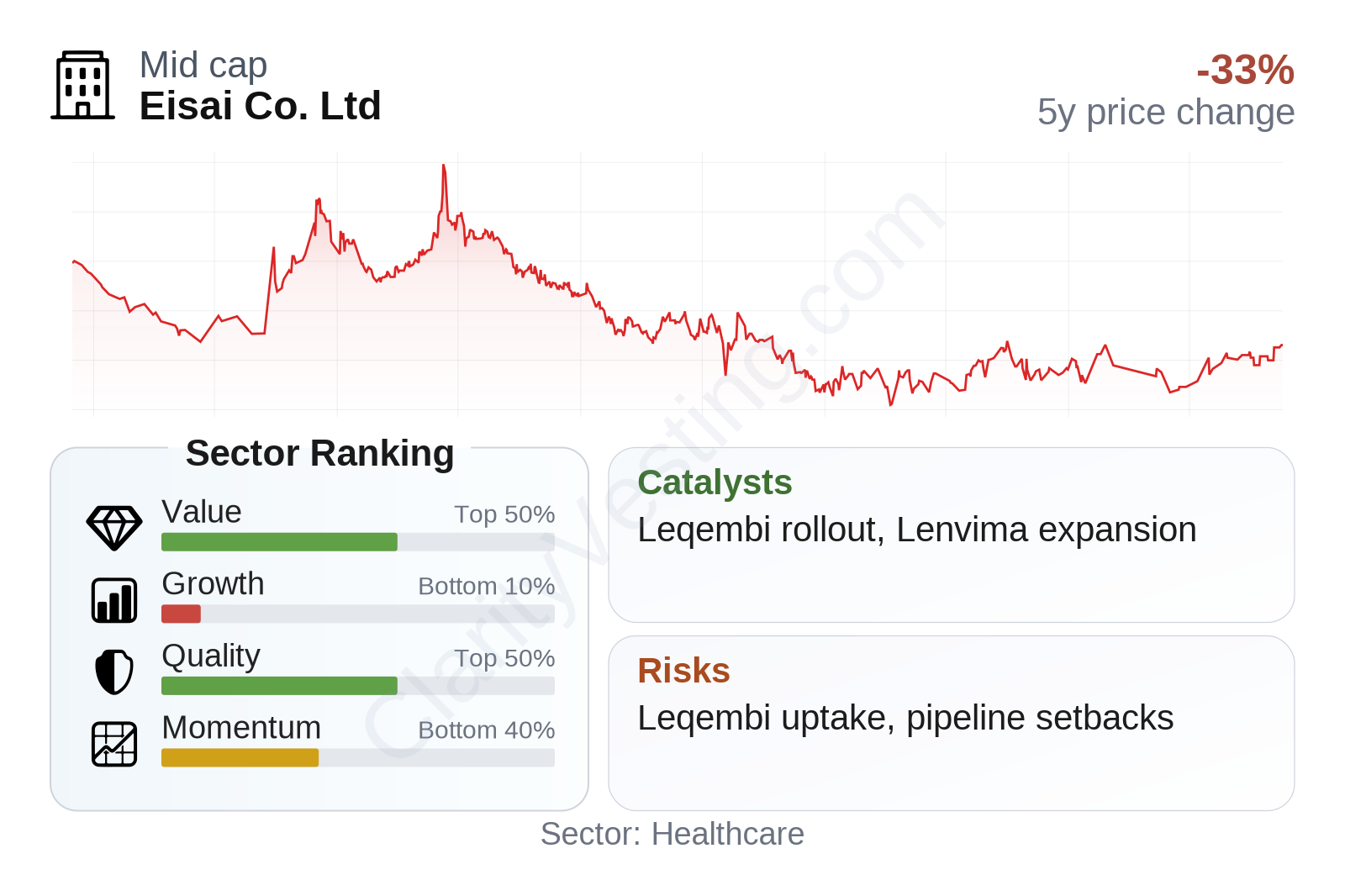
Eisai is a mid-sized healthcare company with a market value near $9 billion. On valuation measures, it sits around the better half of the sector overall, but not because it looks conventionally cheap. Its earnings multiple is above the sector median, while cash-flow-based measures and dividend yield look more supportive. Quality is respectable: profitability is modest but positive, returns on assets are roughly in line with the sector, and the balance sheet is stronger than many drug peers because net debt remains low. The weak spot is long-term growth consistency, with five-year earnings and free cash flow trends looking much softer than the recent rebound in revenue.
Growth
The company operates in areas with meaningful long-term demand, especially Alzheimer’s disease, oncology, and neurology. Among these, Alzheimer’s is the most important strategic growth opportunity. Aging populations in Japan, the United States, Europe, and other developed markets create a large and expanding patient pool. If disease-modifying Alzheimer’s therapies become more widely adopted, Eisai has exposure to one of the most commercially important shifts in neurology in years.
Eisai’s strategy is coherent. It has concentrated resources in a limited number of therapeutic fields rather than trying to compete broadly across all major disease categories. In practice, this means building around neuroscience and cancer, where it already has commercial infrastructure, regulatory experience, and scientific depth. That focus makes sense because drug development is expensive, and spreading capital too widely usually weakens execution.
Recent revenue growth has improved after a mixed period. The year-over-year trend shows uneven quarterly performance, which is common in pharmaceuticals because of launch timing, pricing, inventory movements, and partner-related accounting. Still, the latest readings are clearly above the sector median, suggesting that newer products are helping the top line even though the longer multi-year growth record remains modest.
The biggest catalyst is Leqembi. Eisai and Biogen have been working to expand market access, physician adoption, and reimbursement support. Progress in additional approvals, broader label use, more efficient diagnostic pathways, and easier treatment logistics could materially increase the drug’s commercial contribution over time. The company has also discussed subcutaneous maintenance dosing, which could make treatment more practical if regulators support it.
Oncology remains another growth pillar. Lenvima has been a major product for Eisai, supported by multiple approved indications and global partnerships. Even where growth is not explosive, oncology can still provide durable cash generation and help fund the neuroscience pipeline.
Cash generation has been volatile, moving from positive to negative and back to positive over the last several years. That pattern reflects the realities of a company investing heavily in research, launch activity, and global expansion. The recent recovery is encouraging because it suggests Eisai can still produce cash while supporting major pipeline and commercial efforts, but the swings also show that growth is not yet translating into consistently strong cash conversion.
A significant opportunity in recent years has been the broader recognition of Alzheimer’s disease as a treatable category rather than only a symptom-managed one. For Eisai, this creates a potential step-change rather than a routine product cycle. Very few companies have meaningful exposure to this exact transition.
Risks
This article is for informational purposes only and does not constitute financial advice. Some content is AI-generated. See Disclaimer