Stock Analysis · EPAM Systems Inc (EPAM)
Overview
EPAM Systems is a global technology services company that helps large organizations design, build, test, and run digital products and software systems. In simple terms, it is a consulting and engineering partner for companies that need modern apps, cloud platforms, data tools, artificial intelligence solutions, and better customer-facing digital experiences. Its work often combines business consulting, software development, experience design, and ongoing support.
The company primarily earns money by charging clients for professional services delivered by its engineers, designers, consultants, and other specialists. EPAM does not rely on one single software product. Instead, its business is built around long-term client relationships and project-based or managed-service contracts across many industries and regions.
Based on company filings, revenue is mainly organized by industry verticals rather than by individual products. The mix changes over time, but recent annual reporting shows a diversified base with no single industry dominating the whole company.
- Financial services: approximately 22% of revenue. This includes work for banks, payment companies, insurers, and capital markets clients.
- Software and hi-tech: approximately 19%. This covers software vendors, platform businesses, and technology companies needing product engineering.
- Business information and media: approximately 15%. This includes digital content, information services, and media-related platforms.
- Consumer: approximately 14%. This usually includes retail, consumer goods, travel, and hospitality-related digital work.
- Life sciences and healthcare: approximately 12%. This involves healthcare platforms, medical technology, and related digital transformation services.
- Emerging verticals: approximately 18%. This category includes a mix of industries such as manufacturing, education, energy, telecom, and others.
Geographically, EPAM has historically generated a large share of revenue from North America, with Europe also important. Its delivery model is global, meaning client work is performed through talent distributed across many countries. That model has been a key part of EPAM’s positioning for years, although geopolitical disruption has forced the company to reshape where that talent sits.
The broader financial picture shows a business that converts several billion dollars of annual revenue into solid operating profit and meaningful free cash flow, while carrying very little debt. At the same time, labor costs remain the main economic driver because this is a people-intensive service business.
Over the last several years, EPAM’s revenue base expanded materially, but profit conversion has become less efficient than at its peak. Cost of revenue has risen faster than gross profit in some periods, which reflects the pressure of hiring, wage inflation, delivery realignment, and changes in utilization after the company’s rapid expansion.
Key Figures
| Metric | Value | Sector ⓘ |
|---|---|---|
| Date | Sep 12, 2026 | |
| Context | ||
| Sector | Technology | |
| Industry | Information Technology Services | |
| Market Cap ⓘ | $6.08B | |
| Beta ⓘ | 1.38 | |
Value (Cheapness) | ||
| P/E Ratio ⓘ | 15.53 | 29.51 |
| FCF Yield ⓘ | 7.93% | 4.25% |
| EBIT / EV ⓘ | 10.41% | 2.85% |
| PEG ⓘ | 0.61 | |
Growth (Business expansion) | ||
| Revenue Growth ⓘ | 4.50% | 15.40% |
| RPS Growth (5Y CAGR) ⓘ | 11.13% | 8.56% |
| EPS Growth (5Y CAGR) ⓘ | -16.55% | -11.88% |
| Margin Growth (5Y Trend) ⓘ | -4.97% | 0.46% |
| FCF Growth (5Y CAGR) ⓘ | 7.38% | 9.80% |
Quality (Business durability) | ||
| ROIC (Latest) ⓘ | 11.01% | 9.44% |
| ROIC (5Y Median) ⓘ | 12.71% | 8.30% |
| Net Debt / EBIT (Latest) ⓘ | -1.16 | 0.54 |
| Net Debt / EBIT (5Y Median) ⓘ | -2.28 | 0.44 |
| Operating Margin (Latest) ⓘ | 9.77% | 9.58% |
| Operating Margin (5Y Median) ⓘ | 11.24% | 8.25% |
| Debt to Equity (Latest) ⓘ | 4.33% | 33.33% |
| Profit Margin (Latest) ⓘ | 7.15% | 7.14% |
| Free Cash Flow (Latest) ⓘ | $482.64M | |
Momentum (Price trend) | ||
| 3Y Return ⓘ | -55.14% | +45.48% |
| 12M Return (excl. last month) ⓘ | -34.42% | +23.48% |
| 6M Return ⓘ | -13.18% | +20.93% |
| Price vs. 200-Day MA ⓘ | -13.94% | +7.43% |
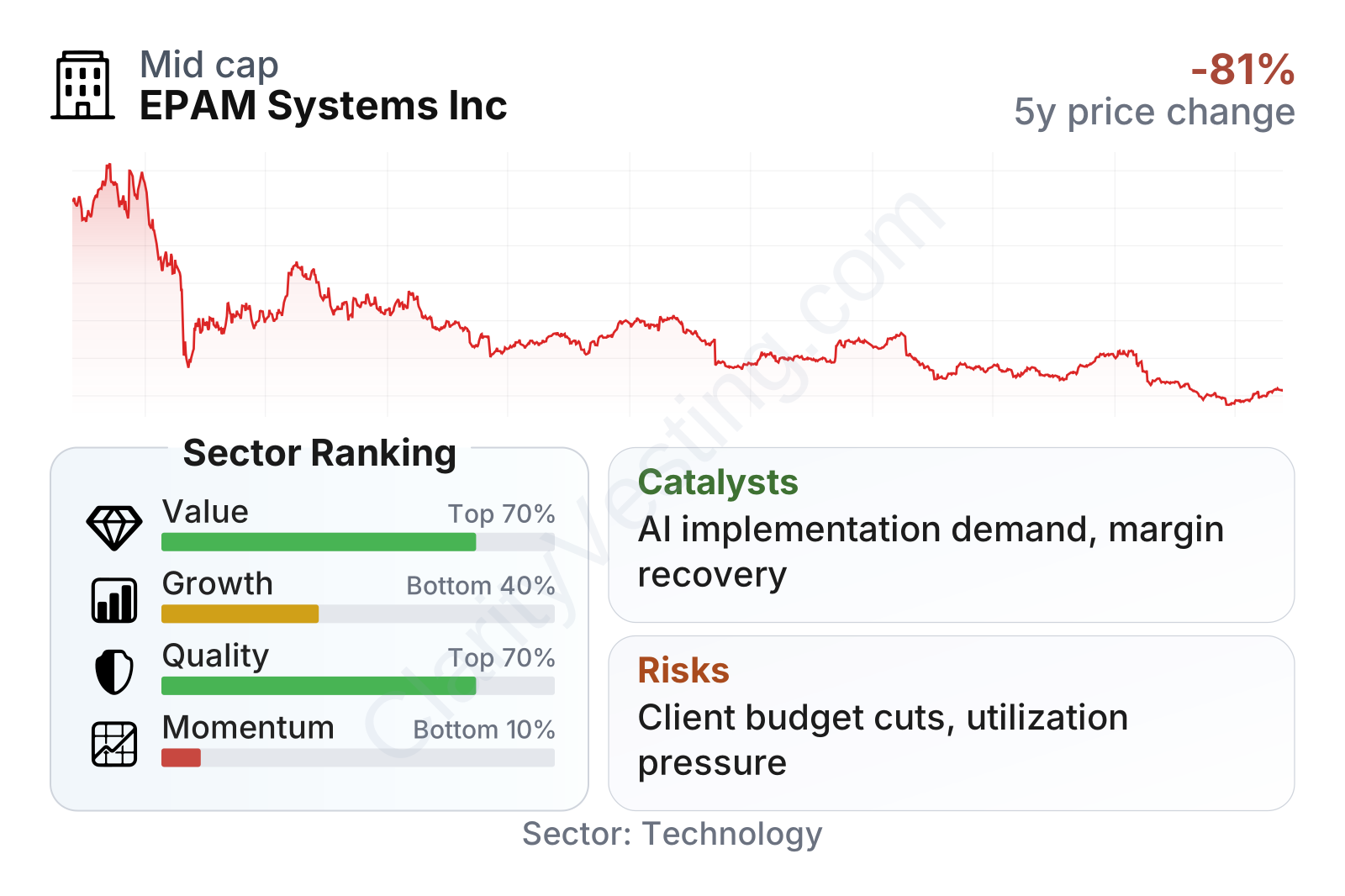
EPAM currently looks strongest on balance-sheet quality and valuation-based measures rather than on recent market performance. Profitability remains around the sector median to slightly above it, returns on invested capital are healthy, and leverage is unusually low for the industry. The weak point is recent growth and stock momentum: revenue is still growing, but at a much slower pace than the broader technology services group, and the share price has been under heavy pressure for an extended period.
Growth
EPAM operates in a sector with durable long-term demand. Companies across banking, healthcare, retail, media, and software continue to spend on cloud migration, app modernization, cybersecurity, data platforms, automation, and artificial intelligence. These are not one-time trends. They reflect a multi-year need for businesses to replace older systems and improve customer-facing digital tools.
EPAM’s strategy is aligned with that demand. The company focuses on high-value engineering and consulting work rather than basic outsourcing alone. That matters because clients increasingly want fewer vendors that can connect business strategy, product design, software development, and AI deployment in one project. EPAM has built its reputation around that integrated model.
The revenue trend shows two very different periods. After extremely strong expansion in 2021 and 2022, growth slowed sharply, turned negative during part of 2023 and 2024, and then recovered. More recently, growth returned to positive territory, but the pace has moderated again to the mid-single-digit range. That pattern suggests the company has moved past its deepest slowdown, though it has not yet re-established the much faster expansion rates seen earlier in the cycle.
A potential growth catalyst is artificial intelligence-related spending. EPAM has been expanding its capabilities around AI-enabled software development, data engineering, platform modernization, and enterprise transformation. For many corporate clients, AI projects still require basic groundwork such as cleaning data, upgrading infrastructure, and redesigning workflows. Those are exactly the kinds of complex implementation tasks that fit EPAM’s skill set.
Another important catalyst is delivery footprint diversification. After the disruption caused by Russia’s invasion of Ukraine, EPAM rapidly shifted personnel and expanded in other countries. That transition was painful, but if the company can fully normalize utilization and staffing in its new global network, it could support both steadier growth and better margins over time.
Cash generation has held up better than the market’s perception of the business. Free cash flow has stayed substantial, with some volatility, and recently improved from the prior year’s lower level. That is useful because it gives EPAM room to keep investing in talent, acquisitions, and AI capabilities without depending on heavy borrowing.
Recent company updates have also pointed to continued client interest in cost optimization, modernization programs, and selective digital transformation work. That is not the same as a broad spending boom, but it does suggest EPAM is still participating in areas where enterprises are spending with a clear return in mind.
Risks
This article is for informational purposes only and does not constitute financial advice. Some content is AI-generated. See Disclaimer


