Stock Analysis · Entegris Inc (ENTG)
Overview
Entegris is a supplier to the semiconductor industry. In simple terms, it makes the materials, components, and process solutions that help chip manufacturers keep production environments clean, control contamination, handle specialty chemicals, and improve manufacturing yields. Its products are used throughout semiconductor fabrication, especially in advanced logic, memory, and leading-edge process steps where tiny defects can ruin expensive wafers.
The company reports revenue through three main segments. Based on the latest annual mix disclosed in company filings, the business is spread across the following sources:
- Microcontamination Control: about 37% of revenue. This includes filtration, purification, and contamination-control products used to keep gases, liquids, and process environments extremely clean during chip manufacturing.
- Specialty Chemicals and Engineered Materials: about 35% of revenue. This segment includes high-purity chemicals, chemical delivery materials, deposition materials, and other advanced inputs used in semiconductor processing.
- Advanced Materials Handling: about 28% of revenue. This covers wafer carriers, shipping products, fluid handling, and related solutions that help move, protect, and manage sensitive semiconductor materials.
That mix matters because Entegris is not dependent on a single product line. It participates across several parts of the chip-production chain, which can make revenue more resilient than a narrowly focused supplier. At the same time, nearly all of its business is still tied to semiconductor capital spending and wafer production activity, so the company remains closely linked to the chip cycle.
The business has also become larger and broader through acquisitions, most notably CMC Materials, which expanded its position in consumables and process materials. This helped Entegris deepen relationships with major chipmakers, but it also added debt and raised the importance of execution.
Over the last several years, revenue climbed sharply through the acquisition period, while operating income stayed comparatively solid even during a softer semiconductor environment. A key pattern is that interest expense rose meaningfully after the large acquisition, which explains why net income has looked more pressured than operating profit.
Key Figures
| Metric | Value | Sector ⓘ |
|---|---|---|
| Date | Sep 12, 2026 | |
| Context | ||
| Sector | Technology | |
| Industry | Semiconductor Equipment & Materials | |
| Market Cap ⓘ | $20.93B | |
| Beta ⓘ | 1.36 | |
Value (Cheapness) | ||
| P/E Ratio ⓘ | 71.56 | 29.51 |
| FCF Yield ⓘ | 2.75% | 4.25% |
| EBIT / EV ⓘ | 2.14% | 2.85% |
| PEG ⓘ | 1.25 | |
Growth (Business expansion) | ||
| Revenue Growth ⓘ | 11.50% | 15.40% |
| RPS Growth (5Y CAGR) ⓘ | 5.69% | 8.56% |
| EPS Growth (5Y CAGR) ⓘ | -19.00% | -11.88% |
| Margin Growth (5Y Trend) ⓘ | -8.42% | 0.46% |
| FCF Growth (5Y CAGR) ⓘ | 20.20% | 9.80% |
Quality (Business durability) | ||
| ROIC (Latest) ⓘ | 6.47% | 9.44% |
| ROIC (5Y Median) ⓘ | 7.39% | 8.30% |
| Net Debt / EBIT (Latest) ⓘ | 5.98 | 0.54 |
| Net Debt / EBIT (5Y Median) ⓘ | 7.78 | 0.44 |
| Operating Margin (Latest) ⓘ | 16.13% | 9.58% |
| Operating Margin (5Y Median) ⓘ | 14.22% | 8.25% |
| Debt to Equity (Latest) ⓘ | 85.66% | 33.33% |
| Profit Margin (Latest) ⓘ | 9.19% | 7.14% |
| Free Cash Flow (Latest) ⓘ | $575.20M | |
Momentum (Price trend) | ||
| 3Y Return ⓘ | +50.67% | +45.48% |
| 12M Return (excl. last month) ⓘ | +112.77% | +23.48% |
| 6M Return ⓘ | +27.83% | +20.93% |
| Price vs. 200-Day MA ⓘ | +10.20% | +7.43% |
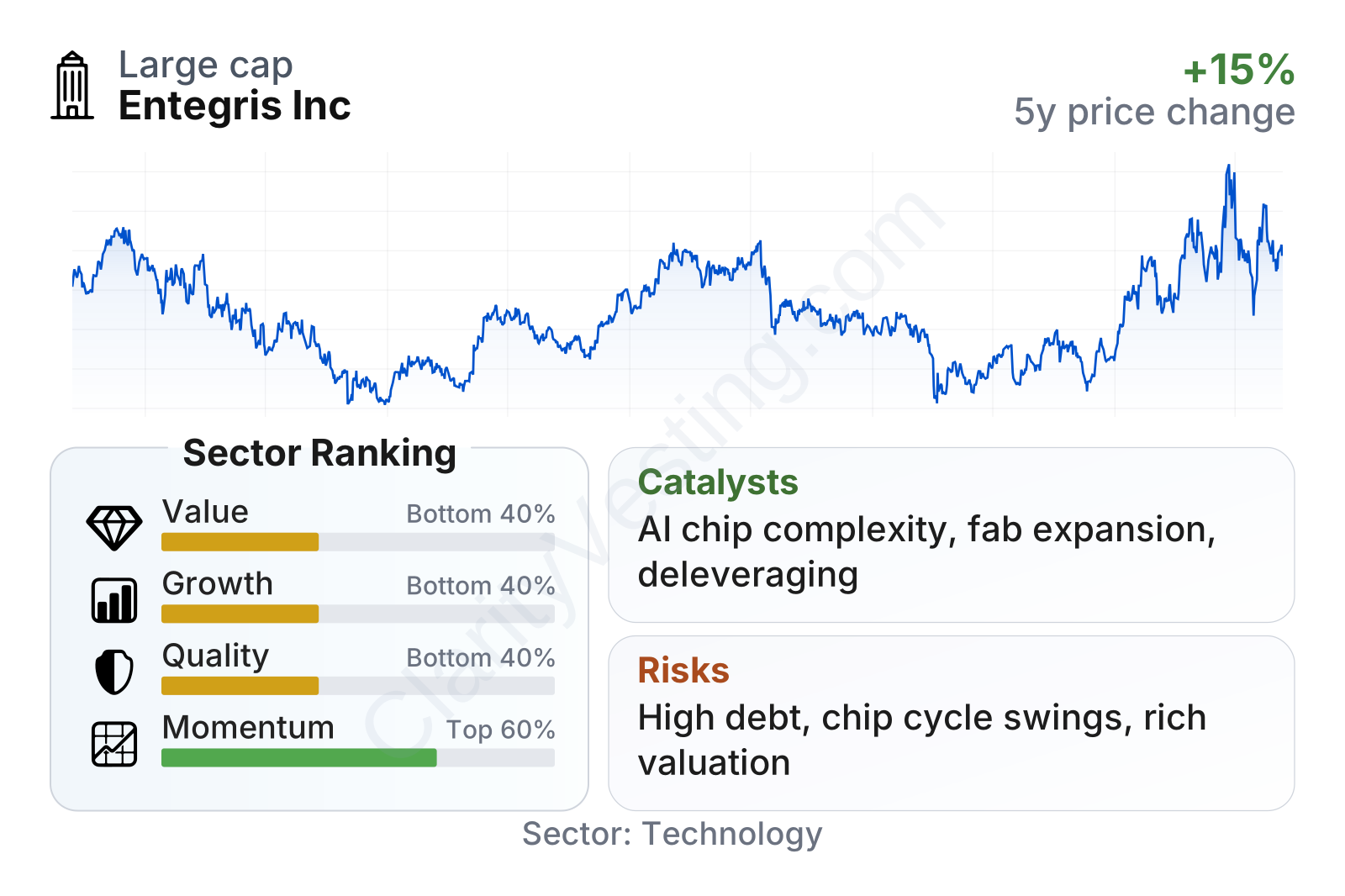
Entegris is a large semiconductor materials company with above-average share-price volatility, which is common in cyclical technology suppliers. The overall profile is mixed: profitability is better than many industry peers, but leverage is much higher than normal for the sector, and recent growth metrics still trail stronger parts of the semiconductor ecosystem. The stock’s recent momentum has been strong, while valuation measures sit on the expensive side.
Growth
Entegris operates in a sector with long-term structural growth. Semiconductor content continues to expand in data centers, artificial intelligence infrastructure, industrial automation, autos, smartphones, and connected devices. As chips become more complex and manufacturing tolerances get tighter, contamination control and high-purity materials become more important, not less. That industry direction supports Entegris because its products are tied to process precision rather than only to one end market.
The company’s strategy also makes industrial sense. Instead of selling only capital equipment, Entegris has a strong presence in consumables, filters, specialty materials, and handling products that are repeatedly used in production. That can create recurring demand once tools and processes are qualified by customers. In advanced semiconductor manufacturing, changing suppliers can be difficult because materials and components often need long qualification cycles, which can strengthen customer stickiness.
Revenue growth has been uneven, reflecting the normal boom-and-bust pattern of the semiconductor industry. After a very strong expansion phase around 2022 and early 2023, the business moved through a period of contraction and then returned to positive year-over-year growth in the most recent periods. The latest growth rate is back in positive double digits, which suggests that end-market conditions have improved, even if the company’s broader growth score still sits below the sector median.
Cash generation has improved much more clearly than earnings-per-share trends. Free cash flow moved from negative territory in 2023 to a much stronger level by 2026, showing that operations and capital discipline have recovered. That is especially important for Entegris because stronger cash flow gives the company more room to reduce debt, invest in manufacturing capacity, and fund research and development.
One important catalyst is continued investment in leading-edge semiconductor manufacturing, especially where process complexity is rising. Entegris has repeatedly emphasized exposure to advanced nodes, high-bandwidth memory-related demand, and other technology transitions that require tighter contamination control and more sophisticated materials. Another potential opportunity comes from geographic expansion of chip manufacturing, including new fab construction in the United States and other regions supported by industrial policy. More fabs generally mean more demand for the kinds of products Entegris sells, although the timing can be uneven.
Recent company communications have also pointed to improving demand conditions in parts of the semiconductor market after a prolonged digestion phase. That does not guarantee a straight line upward, but it supports the case that Entegris is participating in a recovery cycle rather than operating in a structurally stagnant niche.
Risks
This article is for informational purposes only and does not constitute financial advice. Some content is AI-generated. See Disclaimer