Stock Analysis · Enphase Energy Inc (ENPH)
Overview
Enphase Energy is a solar energy technology company best known for its microinverters, small devices installed behind individual solar panels that convert direct current into usable alternating current. Over time, the company has expanded beyond this core product into a broader home energy platform that includes battery storage, software, monitoring, EV charging, and energy management tools. Its focus is mainly residential solar, where homeowners and installers look for systems that are easier to design, monitor, and maintain.
The business makes most of its money from solar hardware, with storage and related services adding smaller but growing contributions. Based on company disclosures, revenue is still concentrated in a few product families.
- Microinverter-based solar systems: approximately 70% to 80% of revenue in recent periods. This includes microinverters and associated components sold into residential solar installations.
- Battery storage systems: approximately 15% to 25%. This includes the IQ Battery line used to store solar energy for later use, backup power, and time-of-use optimization.
- Accessories, software, communications, and other products: approximately 5% to 10%. This includes monitoring, load control, EV charging, and other balance-of-system offerings tied to Enphase’s home energy ecosystem.
- Geographic mix: the United States remains the largest market, while Europe has also been meaningful, though demand there has been more volatile as installers worked through elevated inventory.
What stands out is that Enphase is not simply selling one device. It is trying to become the control layer for residential solar and home energy, with installers and homeowners using one integrated system rather than separate products from multiple vendors.
The long-term picture shows a business that scaled rapidly through 2022 and 2023, then went through a sharp reset in 2024 as industry demand slowed. Even after that downturn, gross profit remained substantial, which suggests the company still has pricing power and product differentiation, although lower revenue has put pressure on earnings.
Key Figures
| Metric | Value | Sector ⓘ |
|---|---|---|
| Date | Sep 12, 2026 | |
| Context | ||
| Sector | Technology | |
| Industry | Solar | |
| Market Cap ⓘ | $4.80B | |
| Beta ⓘ | 1.64 | |
Value (Cheapness) | ||
| P/E Ratio ⓘ | 36.35 | 29.51 |
| FCF Yield ⓘ | 3.18% | 4.25% |
| EBIT / EV ⓘ | 3.08% | 2.85% |
| PEG ⓘ | 0.79 | |
Growth (Business expansion) | ||
| Revenue Growth ⓘ | -19.60% | 15.40% |
| RPS Growth (5Y CAGR) ⓘ | 3.08% | 8.56% |
| EPS Growth (5Y CAGR) ⓘ | -43.96% | -11.88% |
| Margin Growth (5Y Trend) ⓘ | 2.19% | 0.46% |
| FCF Growth (5Y CAGR) ⓘ | -24.78% | 9.80% |
Quality (Business durability) | ||
| ROIC (Latest) ⓘ | 5.92% | 9.44% |
| ROIC (5Y Median) ⓘ | 21.57% | 8.30% |
| Net Debt / EBIT (Latest) ⓘ | 0.60 | 0.54 |
| Net Debt / EBIT (5Y Median) ⓘ | 3.68 | 0.44 |
| Operating Margin (Latest) ⓘ | 10.48% | 9.58% |
| Operating Margin (5Y Median) ⓘ | 14.21% | 8.25% |
| Debt to Equity (Latest) ⓘ | 51.90% | 33.33% |
| Profit Margin (Latest) ⓘ | 10.09% | 7.14% |
| Free Cash Flow (Latest) ⓘ | $152.63M | |
Momentum (Price trend) | ||
| 3Y Return ⓘ | -70.53% | +45.48% |
| 12M Return (excl. last month) ⓘ | +21.48% | +23.48% |
| 6M Return ⓘ | -14.67% | +20.93% |
| Price vs. 200-Day MA ⓘ | -11.23% | +7.43% |
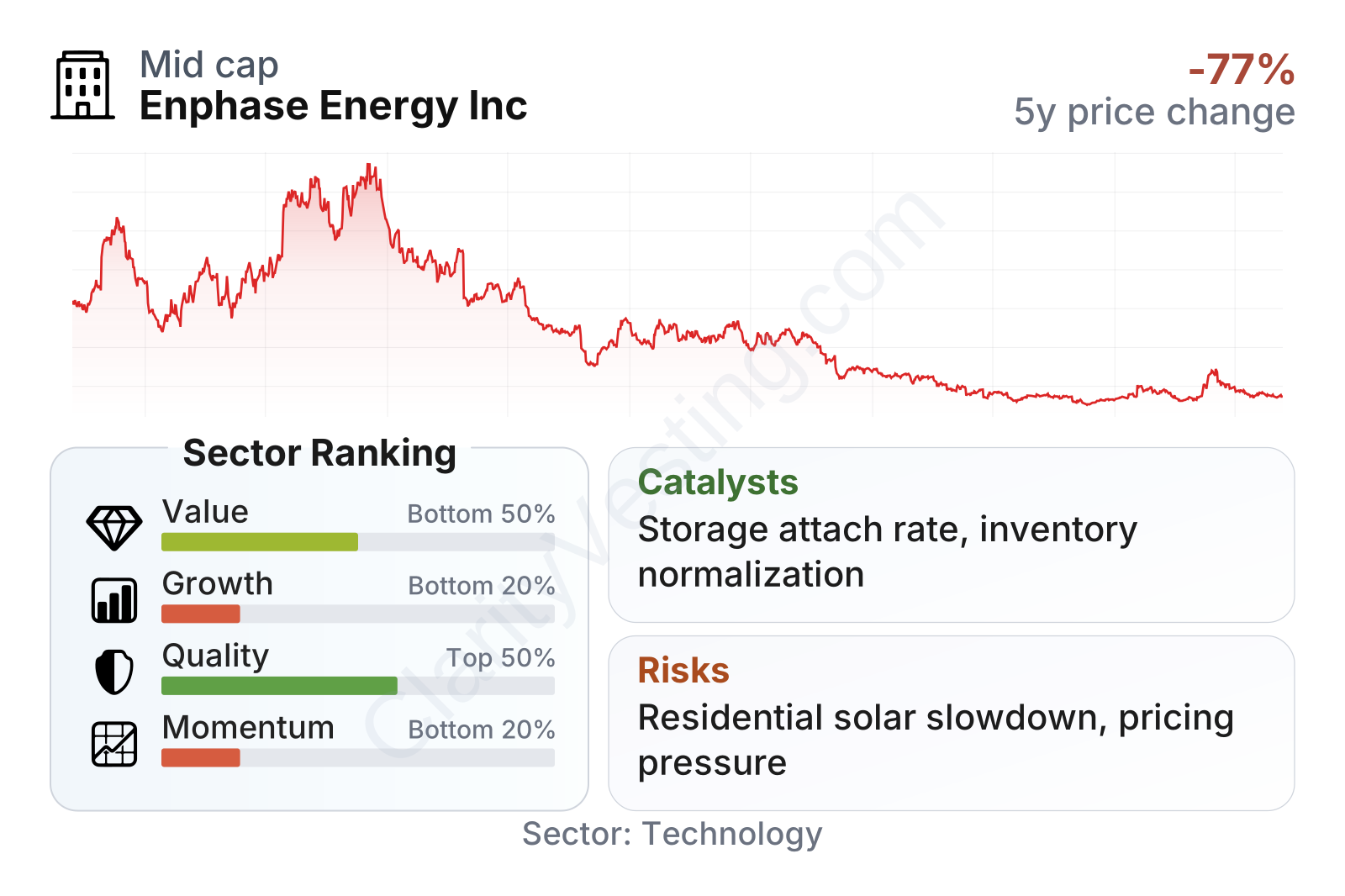
Enphase is now a mid-sized company with above-average share price volatility, which is common in solar and clean-energy equipment. The overall profile is mixed: quality remains decent, with profit margin and operating margin still ahead of the sector median, but growth and momentum rank weakly after the industry slowdown. Value measures do not point to a clear bargain, as the earnings multiple is still somewhat above the sector median while free cash flow yield is below it.
The stock price history reflects that change in perception very clearly. After trading at much higher levels during the solar boom, the shares have fallen sharply over the last three years. That decline has reduced valuation from extreme levels, but it has not fully erased the market’s expectation that Enphase can eventually recover to stronger earnings.
Growth
Enphase operates in a sector with strong long-term structural support. Residential solar, battery storage, electrification of the home, and grid modernization are all backed by long-duration trends: rising electricity prices in many regions, demand for backup power, interest in energy independence, and policy support for cleaner energy systems. That does not mean growth is smooth every year, but it does mean the underlying market opportunity is still meaningful.
Its strategy for future expansion is logical. Instead of relying only on solar conversion hardware, the company is building a bundled home energy platform. That can increase revenue per home and make installer relationships stickier. A homeowner who starts with microinverters may later add batteries, software controls, load management, and EV charging. This “expand within the home” model is one of Enphase’s strongest strategic arguments.
Recent revenue trends, however, show that the business is still in the middle of a recovery rather than a clean acceleration. Growth turned deeply negative after the post-2022 industry boom cooled, then improved for a period before slipping back into contraction in the latest readings. That pattern points to uneven demand, especially as distributors and installers continue adjusting inventory and end-market conditions remain soft in some regions.
Cash generation tells a similar story. Enphase remains free-cash-flow positive, which is important, but trailing cash flow is much lower than the peaks reached during stronger market conditions. For a long-term analysis, this matters because it shows the company is still financially productive even during a down cycle, yet it also shows how sensitive results are to volume changes.
Several catalysts could support a better medium-term backdrop. Storage attachment rates are rising across residential solar markets, which plays directly into Enphase’s cross-selling model. The company has also continued launching new IQ products and expanding manufacturing and supply-chain flexibility. In the United States, policy support for distributed energy and domestic energy systems remains a favorable backdrop. A normalization of channel inventory in the U.S. and Europe would also be meaningful because Enphase’s revenue has been heavily affected by installer and distributor destocking rather than only end-customer demand.
Recent company communications have continued to emphasize new product introductions, expanding installer tools, and growth in home energy management capabilities. Those developments are not a guarantee of near-term acceleration, but they fit well with the company’s attempt to capture more value from each residential installation.
Risks
This article is for informational purposes only and does not constitute financial advice. Some content is AI-generated. See Disclaimer


