Stock Analysis · Enhanced Group Inc (ENHA)
Overview
Enhanced Group Inc, which trades under the symbol ENHA, appears to be an early-stage packaged foods company in the Consumer Defensive sector. Based on its public filings and company disclosures, the business is still in a development phase rather than operating as a mature food manufacturer with established recurring sales. That distinction matters for long-term analysis because packaged foods is usually seen as a steady industry, but ENHA currently does not show the revenue profile that investors often expect from that category.
The clearest takeaway from recent public financial reporting is that the company has not yet built meaningful reported revenue. In the latest available annual figures, reported revenue was effectively 0, while operating expenses and net losses rose materially. That suggests the company is still spending on corporate operations, business development, and infrastructure ahead of commercial scale, or that its operating platform remains limited relative to its public market valuation.
Because reported revenue is effectively absent in the latest annual period, there is no reliable way to rank meaningful revenue streams by size. A practical summary is therefore:
- Product and operating revenue: approximately 0% of reported annual revenue because total reported revenue was effectively 0 in the latest annual period.
- Other recurring business lines: no material disclosed revenue base visible in the latest annual reporting.
- Non-operating sources: losses dominate the income statement, so the current picture is driven more by expenses and financing context than by sales generation.
This makes ENHA unusual for a public packaged foods company. The business may still have strategic ambitions in branded food products, but at this stage the financial statements point to a company that has not yet converted that concept into visible operating scale.
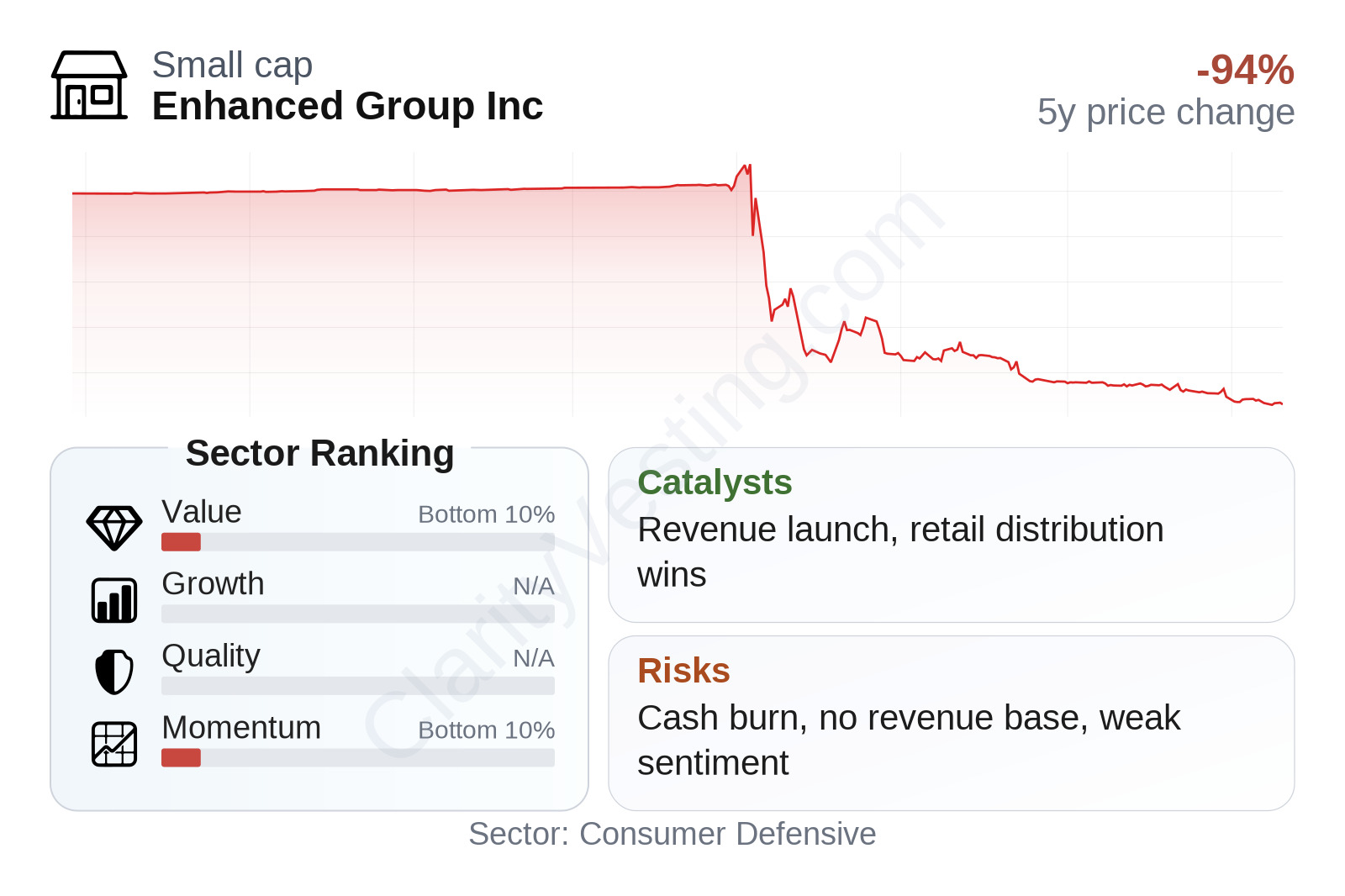
The operating picture has become more challenging over the last year. Annual operating expenses expanded sharply, with selling, general and administrative costs representing a large share of the loss structure. In plain terms, the company spent much more on overhead and operating activity while reported sales remained negligible, which widened losses instead of showing progress toward self-funded growth.
Key Figures
| Metric | Value | Sector ⓘ |
|---|---|---|
| Date | Nov 21, 2026 | |
| Context | ||
| Sector | Consumer Defensive | |
| Industry | Packaged Foods | |
| Market Cap ⓘ | $1.60B | |
| Beta ⓘ | N/A | |
Value (Cheapness) | ||
| P/E Ratio ⓘ | N/A | 18.64 |
| P/B Ratio ⓘ | 9.50 | 2.51 |
| FCF Yield ⓘ | -4.38% | 7.02% |
| Dividend Yield ⓘ | N/A | 2.67% |
| EBIT / EV ⓘ | N/A | 7.77% |
| PEG ⓘ | N/A | |
Growth (Business expansion) | ||
| Revenue Growth ⓘ | N/A | 3.80% |
| RPS Growth (5Y CAGR) ⓘ | N/A | 6.10% |
| EPS Growth (5Y CAGR) ⓘ | N/A | -10.36% |
| BVPS Growth (5Y CAGR) ⓘ | N/A | 3.04% |
| Margin Growth (5Y Trend) ⓘ | N/A | -0.21% |
| FCF Growth (5Y CAGR) ⓘ | N/A | 5.25% |
| DPS Growth (5Y CAGR) ⓘ | N/A | 5.88% |
Quality (Business durability) | ||
| ROIC (Latest) ⓘ | N/A | 11.80% |
| ROA (Latest) ⓘ | -299.94% | 6.20% |
| ROIC (5Y Median) ⓘ | N/A | 10.51% |
| ROA (5Y Median) ⓘ | N/A | 5.41% |
| Net Debt / EBIT (Latest) ⓘ | N/A | 1.88 |
| Net Debt / EBIT (5Y Median) ⓘ | N/A | 2.32 |
| Net Debt / EBITDA (Latest) ⓘ | N/A | 1.29 |
| Net Debt / Assets ⓘ | -34.57% | 20.02% |
| EBITDA / Interest ⓘ | N/A | 9.62 |
| Operating Margin (Latest) ⓘ | N/A | 9.06% |
| Operating Margin (5Y Median) ⓘ | N/A | 9.57% |
| Debt to Equity (Latest) ⓘ | N/A | 67.45% |
| Profit Margin (Latest) ⓘ | N/A | 5.43% |
| Free Cash Flow (Latest) ⓘ | -$70.02M | |
Momentum (Price trend) | ||
| 3Y Return ⓘ | -93.86% | +17.50% |
| 12M Return (excl. last month) ⓘ | -88.26% | +3.34% |
| 6M Return ⓘ | -89.37% | +2.78% |
| Price vs. 200-Day MA ⓘ | -87.37% | +3.79% |
The key metrics point to a difficult financial profile. On valuation measures, ENHA ranks in the bottom tier of its sector, which is largely explained by a combination of negative free cash flow, weak profitability, and a price-to-book ratio far above the sector median. In other words, the stock is not screening as cheap on current fundamentals despite a severe share price decline.
Profitability is also well below normal sector standards. Return on assets is deeply negative, profit margin is effectively 0%, and free cash flow remains negative. At the same time, the balance sheet appears less constrained by debt than many peers, with net debt below zero relative to assets, indicating the company may currently hold more cash than debt. That is one of the few clearly favorable financial points, although cash strength alone does not offset a lack of operating revenue.
Market performance has been especially weak. The shares have fallen dramatically over the past year, over the past six months, and over the past three years, placing momentum in the bottom 10% of the sector. The price trend suggests the market has sharply reset expectations around the company’s prospects, execution, or valuation.
Growth
The broader packaged foods sector is usually considered defensive rather than fast-growing. Demand for food products tends to be stable, but growth often depends on brand strength, distribution reach, pricing power, and the ability to launch products that gain shelf space. For ENHA, that means the sector itself offers a potentially durable backdrop, but the company still has to prove it can participate in that demand in a meaningful way.
If ENHA is attempting to build a branded food platform, the long-term logic is understandable: once a food brand gains retail placement and repeat purchases, revenue can become sticky and easier to scale. However, the current numbers do not yet show that transition. Revenue growth is effectively 0% because the company has not established a visible sales base. As a result, future growth depends less on normal industry expansion and more on whether management can move from concept to commercialization.
The most relevant potential catalysts are therefore company-specific rather than sector-wide. These would include a first meaningful revenue ramp, a product rollout with measurable distribution, partnerships with retailers or distributors, or any evidence that operating expenses are beginning to translate into actual sales. Without those signs, the growth case remains largely theoretical.
Recent share-price behavior also suggests that any new development would need to be significant to change market perception. For a company at this stage, future opportunity is tied to execution milestones, not simply to being in the food industry.
Risks
This article is for informational purposes only and does not constitute financial advice. Some content is AI-generated. See Disclaimer