Stock Analysis · Enagas SA (ENGGY)
Overview
Enagás is a Spanish energy infrastructure company focused mainly on natural gas transportation, regasification, storage, and system operation. In practical terms, it owns and manages pipelines and liquefied natural gas terminals that help move gas from import points to industrial users, power plants, and local distribution networks. It also has a growing role in energy transition infrastructure, especially hydrogen-related projects and selected international energy assets.
The business is still centered on regulated gas infrastructure in Spain, which is important because regulated activities usually provide more predictable revenue than commodity-exposed energy businesses. Enagás does not primarily make money by producing gas or speculating on energy prices. Instead, it earns from providing access to critical infrastructure and from operating that network under regulatory frameworks.
Based on the company’s reporting structure and recent annual disclosures, Enagás’ revenue and earnings base can be understood broadly as follows:
- Regulated gas transmission and system operation in Spain: approximately 50% to 60% of the business base. This includes high-pressure gas pipelines, network operation, and technical management of the Spanish gas system.
- LNG infrastructure and storage: approximately 15% to 25%. This covers regasification terminals and underground storage-related activities tied to the Spanish gas network.
- International affiliates and equity-accounted investments: approximately 20% to 30% of profit contribution rather than reported revenue. These stakes include infrastructure assets outside Spain, so they matter more for net income and cash received than for top-line sales.
- New energy and other activities: currently a small share of present revenue, but strategically relevant. This includes hydrogen backbone development, decarbonization infrastructure, and innovation projects.
One important point for long-term readers is that Enagás’ accounting revenue does not tell the full economic picture because part of the group’s value comes from investees and regulated returns. That makes cash generation, debt control, and regulatory visibility at least as important as simple sales growth.
Over the last several years, the income profile shows a relatively stable revenue base around the €1.0 billion range, but with much more volatility in operating profit and net income. The sharp weakness in 2024 was followed by a recovery in 2025, suggesting that one-off items had a meaningful effect rather than a collapse in the underlying network business.
The business model remains highly cash-oriented and infrastructure-heavy: direct operating costs are fairly limited compared with revenue, while financing costs and non-recurring adjustments can have a large effect on bottom-line profit.
Key Figures
| Metric | Value | Sector ⓘ |
|---|---|---|
| Date | Nov 21, 2026 | |
| Context | ||
| Sector | Utilities | |
| Industry | Utilities - Regulated Gas | |
| Market Cap ⓘ | $5.07B | |
| Beta ⓘ | 0.28 | |
Value (Cheapness) | ||
| P/E Ratio ⓘ | 12.02 | 17.21 |
| P/B Ratio ⓘ | N/A | 1.97 |
| FCF Yield ⓘ | 1.93% | -0.81% |
| Dividend Yield ⓘ | 5.92% | 3.67% |
| EBIT / EV ⓘ | 2.76% | 5.78% |
| PEG ⓘ | 16.25 | |
Growth (Business expansion) | ||
| Revenue Growth ⓘ | -9.10% | 8.30% |
| RPS Growth (5Y CAGR) ⓘ | -16.37% | 3.61% |
| EPS Growth (5Y CAGR) ⓘ | -12.04% | -2.03% |
| BVPS Growth (5Y CAGR) ⓘ | -22.12% | 4.29% |
| Margin Growth (5Y Trend) ⓘ | -37.45% | 3.68% |
| FCF Growth (5Y CAGR) ⓘ | -35.06% | -8.99% |
| DPS Growth (5Y CAGR) ⓘ | -27.20% | 4.70% |
Quality (Business durability) | ||
| ROIC (Latest) ⓘ | 2.64% | 6.37% |
| ROA (Latest) ⓘ | 2.97% | 3.14% |
| ROIC (5Y Median) ⓘ | 4.50% | 5.97% |
| ROA (5Y Median) ⓘ | 3.90% | 2.74% |
| Net Debt / EBIT (Latest) ⓘ | 13.09 | 7.15 |
| Net Debt / EBIT (5Y Median) ⓘ | 6.40 | 7.25 |
| Net Debt / EBITDA (Latest) ⓘ | 5.52 | 4.42 |
| Net Debt / Assets ⓘ | 36.50% | 38.03% |
| EBITDA / Interest ⓘ | 9.09 | 4.57 |
| Operating Margin (Latest) ⓘ | 22.14% | 20.06% |
| Operating Margin (5Y Median) ⓘ | 59.22% | 19.99% |
| Debt to Equity (Latest) ⓘ | 132.64% | 137.61% |
| Profit Margin (Latest) ⓘ | 30.14% | 10.90% |
| Free Cash Flow (Latest) ⓘ | $97.88M | |
Momentum (Price trend) | ||
| 3Y Return ⓘ | +40.93% | +47.60% |
| 12M Return (excl. last month) ⓘ | +21.35% | +6.07% |
| 6M Return ⓘ | +3.16% | 0.00% |
| Price vs. 200-Day MA ⓘ | +4.74% | +1.40% |
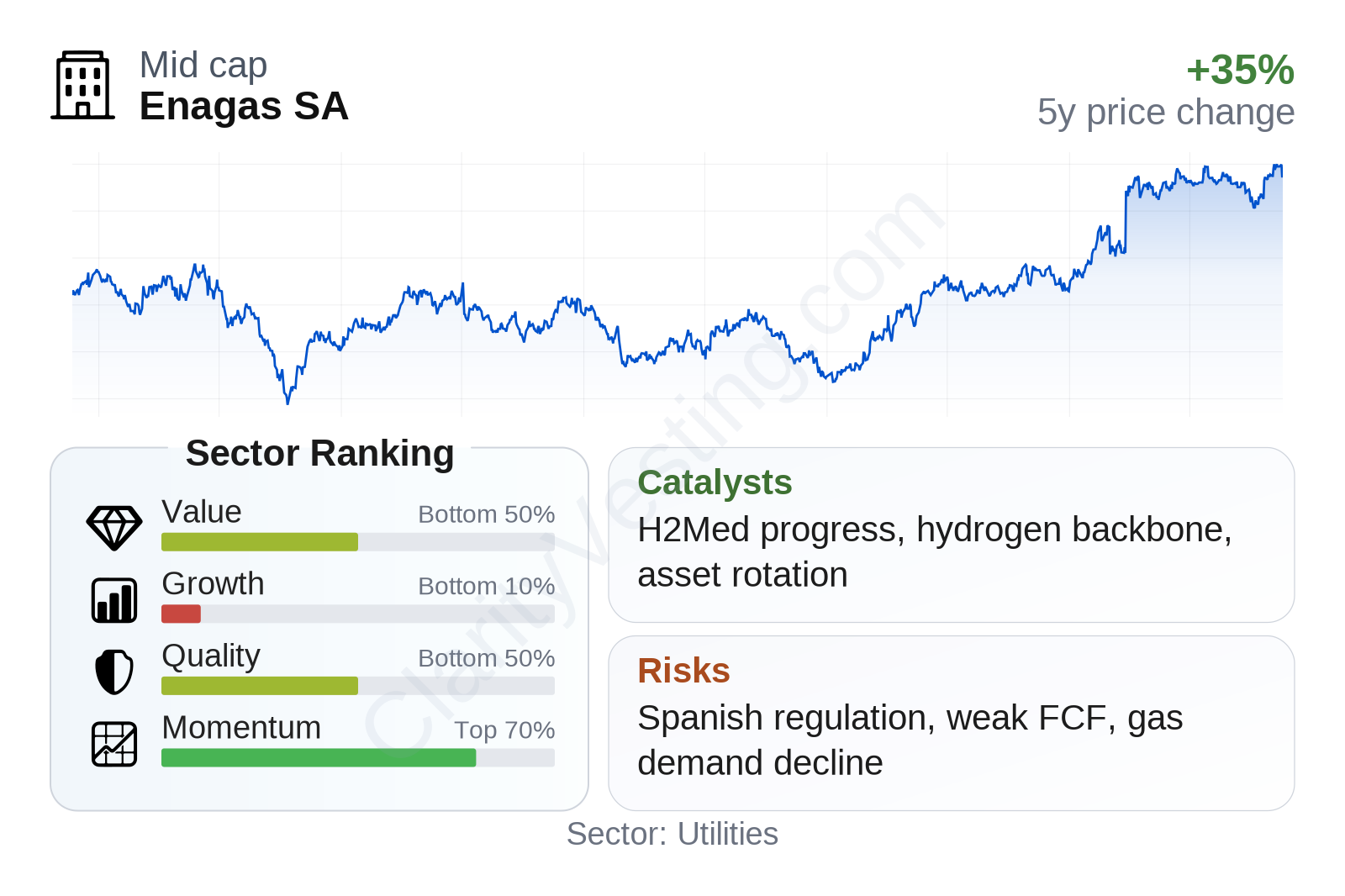
Enagás stands out as a mid-sized regulated utility with a very low-beta share price, which fits the profile of a defensive infrastructure operator. On valuation, the earnings multiple sits below the sector median, while the dividend yield is clearly above it. That makes the stock look income-oriented rather than growth-driven. The weaker point is growth: most multi-year growth measures trail the sector by a wide margin, reflecting a mature domestic asset base and a difficult 2024. Quality is mixed rather than weak across the board: leverage is meaningful, but interest coverage is solid and current profitability remains above many sector peers after the rebound.
The stock chart also shows a notable recovery from late 2024 into 2026. That recent strength suggests the market has become more comfortable with the company’s earnings normalization, balance-sheet trajectory, and strategic positioning in future energy infrastructure.
Growth
Enagás operates in a sector with two very different growth profiles. Traditional regulated natural gas infrastructure in Western Europe is generally a low-growth business. Demand is mature, regulation is tight, and expansion opportunities are limited. On that basis alone, Enagás would look more like a stability vehicle than a compounding growth company.
However, the long-term picture is more nuanced because the company is trying to reposition itself around decarbonization infrastructure. Its strategy centers on hydrogen transport networks, cross-border interconnections, and the reuse or adaptation of existing gas expertise for lower-carbon energy systems. This is a logical extension of what Enagás already does well: operating large-scale energy networks with regulatory oversight and high technical barriers to entry.
In Spain and the broader European Union, hydrogen has become an important infrastructure theme. Enagás has been involved in major hydrogen corridor initiatives, including projects linked to Spain’s role as a potential renewable hydrogen hub for Europe. If these projects move from planning to execution with regulatory and funding support, they could provide a new investment runway beyond the mature gas grid.
That said, historical growth has been weak. Revenue per share has declined materially over the last five years, which reflects both business maturity and the impact of exceptional periods. This confirms that Enagás is not currently delivering organic growth in the way faster-expanding utilities or renewable developers might.
Free cash flow is another area to watch closely. The longer-term trend has moved down sharply from earlier stronger levels, even though infrastructure utilities often prioritize stability over rapid expansion. A decline of that size matters because future growth projects, debt reduction, and dividends all compete for the same pool of cash. For Enagás, the strategic case depends less on headline revenue growth and more on converting regulated and affiliate earnings into dependable cash while preparing for hydrogen-related investment opportunities.
A meaningful catalyst is the company’s role in European energy security and interconnection planning. Europe’s push to diversify energy routes and build cleaner infrastructure increases the strategic relevance of operators with established networks, permitting experience, and government-level relationships. Recent company communications have also emphasized progress in hydrogen backbone planning and disciplined asset rotation, both of which support the idea of gradual repositioning rather than aggressive transformation.
Risks
This article is for informational purposes only and does not constitute financial advice. Some content is AI-generated. See Disclaimer