Stock Analysis · EFG International AG (EFGXY)
Overview
EFG International AG is a Swiss private banking group focused on wealth management. In simple terms, it helps wealthy individuals and families manage their money through investment advice, portfolio management, lending, custody, and broader private banking services. The company operates internationally, but its business model is centered on advising clients and earning fees and banking income from the assets they place with the group.
Its revenue mix is mainly driven by recurring wealth management fees and banking-related income, with the exact split moving from year to year depending on markets, interest rates, and client activity. Based on the company’s reporting structure and recent annual disclosures, the main sources of income can be summarized as follows:
- Net banking and commission income: the largest contributor, typically around 45% to 55% of total operating income. This includes recurring advisory fees, portfolio management fees, brokerage commissions, and other charges linked to client assets and transactions.
- Net interest income: typically around 30% to 40%. This comes from lending to clients, treasury activity, and the spread the bank earns between interest received and interest paid.
- Other income, including trading and treasury-related items: generally around 10% to 20%. This can include foreign exchange, trading-related revenue, and other banking services.
Geographically, EFG is diversified across Europe, Asia Pacific, the Americas, and the Middle East, with Switzerland remaining a key operating base. That matters because private banking often depends on trust, local relationship managers, and cross-border wealth flows rather than mass-market scale.
The business is relatively straightforward: attract client assets, retain advisers who manage relationships, grow assets under management, and convert those assets into recurring fees and lending income. For a long-term view, the most important operating indicators are therefore client asset growth, net new assets, profitability, and capital strength.
The overall trend points to rising revenue and improving operating profit over the last several years, with net income also moving higher. Expenses have increased as the firm continues investing in people and platform capabilities, but the broader direction has still been positive.
Key Figures
| Metric | Value | Sector ⓘ |
|---|---|---|
| Date | Nov 14, 2026 | |
| Context | ||
| Sector | Financial Services | |
| Industry | Banks - Diversified | |
| Market Cap ⓘ | $6.13B | |
| Beta ⓘ | 0.12 | |
Value (Cheapness) | ||
| P/E Ratio ⓘ | 18.87 | 12.38 |
| P/B Ratio ⓘ | N/A | 1.54 |
| FCF Yield ⓘ | -36.66% | 8.62% |
| Dividend Yield ⓘ | 3.98% | 2.91% |
| EBIT / EV ⓘ | -3.61% | 8.22% |
| PEG ⓘ | N/A | |
Growth (Business expansion) | ||
| Revenue Growth ⓘ | 7.20% | 7.00% |
| RPS Growth (5Y CAGR) ⓘ | 19.38% | 12.30% |
| EPS Growth (5Y CAGR) ⓘ | 18.76% | -0.81% |
| BVPS Growth (5Y CAGR) ⓘ | 2.31% | 4.87% |
| Margin Growth (5Y Trend) ⓘ | -4.29% | -4.00% |
| FCF Growth (5Y CAGR) ⓘ | N/A | 4.68% |
| DPS Growth (5Y CAGR) ⓘ | 20.18% | 8.77% |
Quality (Business durability) | ||
| ROIC (Latest) ⓘ | -4.44% | 9.69% |
| ROE (Latest) ⓘ | 31.82% | 14.05% |
| ROA (Latest) ⓘ | 1.80% | 1.58% |
| ROIC (5Y Median) ⓘ | 10.08% | 7.79% |
| ROE (5Y Median) ⓘ | 13.64% | 12.05% |
| ROA (5Y Median) ⓘ | 0.74% | 1.28% |
| Net Debt / EBIT (Latest) ⓘ | N/A | 0.97 |
| Net Debt / EBIT (5Y Median) ⓘ | -20.99 | 0.73 |
| Net Debt / EBITDA (Latest) ⓘ | -136.39 | 0.75 |
| Operating Margin (Latest) ⓘ | -3.02% | 23.57% |
| Operating Margin (5Y Median) ⓘ | 19.51% | 24.30% |
| Debt to Equity (Latest) ⓘ | 191.38% | 59.34% |
| Profit Margin (Latest) ⓘ | 16.82% | 26.53% |
| Free Cash Flow (Latest) ⓘ | -$2.25B | |
Momentum (Price trend) | ||
| 3Y Return ⓘ | +107.36% | +85.82% |
| 12M Return (excl. last month) ⓘ | +28.80% | +16.88% |
| 6M Return ⓘ | -12.34% | +8.29% |
| Price vs. 200-Day MA ⓘ | -8.35% | +5.17% |
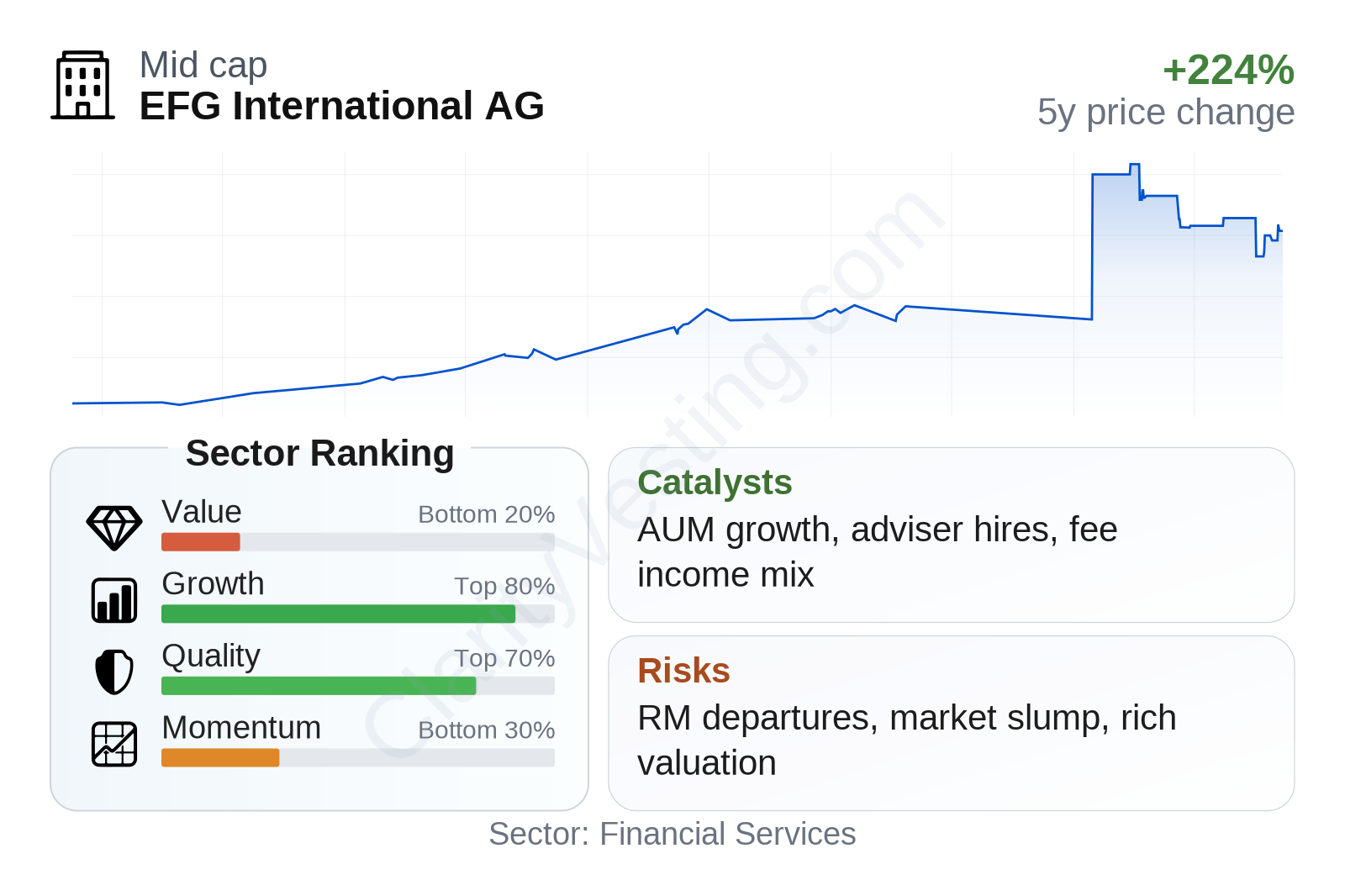
EFG stands out as a mid-sized listed wealth manager with unusually strong profitability on equity and a low-share-volatility profile, but the current valuation is rich compared with much of the banking sector. Growth and quality metrics are generally favorable, especially over a five-year view, while recent momentum has cooled after a strong run over the prior year.
The stock’s beta is very low, which suggests it has moved less aggressively than the broader market. That does not remove business risk, but it can indicate a steadier trading pattern. Dividend yield is above the sector median, while return on equity is far ahead of the typical peer. On the other hand, the price-to-earnings and price-to-book multiples are both well above sector norms, so the market is already assigning a premium to the franchise.
Growth
EFG operates in a part of financial services that still has structural growth potential. Global private wealth has continued to expand over time, especially in regions with entrepreneurial wealth creation, family-owned businesses, and cross-border asset needs. Wealth management also tends to be more attractive than traditional banking because fee income can be more recurring and capital-light when client assets grow steadily.
EFG’s strategy is coherent for that environment. The group focuses on private banking rather than trying to compete as a universal bank. It has also used selective acquisitions and hiring of relationship managers to expand client reach. In wealth management, adviser productivity and retention matter a great deal, because client relationships often follow the adviser. A firm that can keep top bankers while adding new teams can grow assets faster than the industry.
Recent financial progress supports that view. Over five years, revenue per share and earnings per share have grown much faster than the median company in the sector, while dividend growth has also been strong. Year-over-year revenue growth is positive, even if not exceptional compared with the broader sector. That combination suggests EFG has not relied only on a one-year rate tailwind; it has also improved its earnings base over time.
The earnings trend remains constructive, with EPS moving higher in the latest annual period. That is encouraging because for wealth managers, sustained earnings growth usually reflects a mix of higher client assets, disciplined costs, and resilient fee generation.
Book value per share has also trended upward in recent years, although at a slower pace than earnings. For a bank, that matters because book value reflects the underlying capital base supporting the business. The slower growth here suggests that while profitability is strong, part of the shareholder return profile has also been flowing out through dividends rather than simply building balance-sheet value.
A meaningful catalyst is the continued normalization of wealthy clients moving assets toward large, regulated institutions after years of market volatility and banking stress in parts of the industry. That environment can favor firms with an established private banking brand, international booking centers, and a reputation for personalized service. Another catalyst is any sustained increase in assets under management from market appreciation, since rising asset values usually feed directly into fee income without requiring equivalent cost growth.
Recent company communications have also emphasized disciplined capital returns, continued client asset gathering, and operating efficiency targets. For a long-term perspective, those are more important than short-term trading gains because they shape how much earnings can compound over time.
Risks
This article is for informational purposes only and does not constitute financial advice. Some content is AI-generated. See Disclaimer