Stock Analysis · Euronet Worldwide Inc (EEFT)
Overview
Euronet Worldwide is a global payments company that helps move money in several everyday ways. Its businesses include ATMs and cash distribution, digital money transfers, and payment software used by banks, retailers, and other financial institutions. In simple terms, Euronet sits behind many transactions that consumers may not notice: withdrawing cash while traveling, sending remittances abroad, or using payment systems operated by a bank or merchant.
The company reports three main operating segments, and recent annual reporting shows revenue is spread across all three rather than depending on a single activity. Based on the latest annual mix, the main sources of revenue are approximately:
- Money Transfer – about 37%: cross-border consumer transfers, including digital remittances and transfers through agent networks. This segment includes the Ria and Xe brands.
- Electronic Funds Transfer (EFT Processing) – about 36%: ATM outsourcing, ATM ownership and operation, point-of-sale and card services, payment processing, and related network services for banks and merchants.
- epay – about 27%: prepaid mobile airtime, gift cards, digital content, and other branded payment products distributed through retail and digital channels.
This mix matters because it gives Euronet exposure to different payment habits at the same time: cash access, digital remittances, and prepaid or digital retail payments. It also means the company is not a pure software company despite its sector label; it is better understood as a diversified transaction and payment infrastructure business with a large international footprint.
Over the last several years, revenue and operating income have generally moved upward, while net income has improved much more than in the immediate post-pandemic period. One unusual shift is the sharp jump in reported gross profit in 2025, which likely reflects a change in revenue presentation or mix rather than a sudden transformation in the economics of the entire business. The broader takeaway is still favorable: the company has been expanding scale and holding onto a meaningful portion of that growth at the operating level.
Key Figures
| Metric | Value | Sector ⓘ |
|---|---|---|
| Date | Sep 12, 2026 | |
| Context | ||
| Sector | Technology | |
| Industry | Software - Infrastructure | |
| Market Cap ⓘ | $2.75B | |
| Beta ⓘ | 0.83 | |
Value (Cheapness) | ||
| P/E Ratio ⓘ | 11.23 | 29.51 |
| FCF Yield ⓘ | 3.45% | 4.25% |
| EBIT / EV ⓘ | 16.00% | 2.85% |
| PEG ⓘ | 0.46 | |
Growth (Business expansion) | ||
| Revenue Growth ⓘ | 3.20% | 15.40% |
| RPS Growth (5Y CAGR) ⓘ | 13.45% | 8.56% |
| EPS Growth (5Y CAGR) ⓘ | -13.47% | -11.88% |
| Margin Growth (5Y Trend) ⓘ | 6.75% | 0.46% |
| FCF Growth (5Y CAGR) ⓘ | 6.92% | 9.80% |
Quality (Business durability) | ||
| ROIC (Latest) ⓘ | 9.07% | 9.44% |
| ROIC (5Y Median) ⓘ | 11.48% | 8.30% |
| Net Debt / EBIT (Latest) ⓘ | 3.08 | 0.54 |
| Net Debt / EBIT (5Y Median) ⓘ | 0.33 | 0.44 |
| Operating Margin (Latest) ⓘ | 11.95% | 9.58% |
| Operating Margin (5Y Median) ⓘ | 12.36% | 8.25% |
| Debt to Equity (Latest) ⓘ | 228.22% | 33.33% |
| Profit Margin (Latest) ⓘ | 6.59% | 7.14% |
| Free Cash Flow (Latest) ⓘ | $94.90M | |
Momentum (Price trend) | ||
| 3Y Return ⓘ | -13.04% | +45.48% |
| 12M Return (excl. last month) ⓘ | -25.03% | +23.48% |
| 6M Return ⓘ | -0.39% | +20.93% |
| Price vs. 200-Day MA ⓘ | -0.14% | +7.43% |
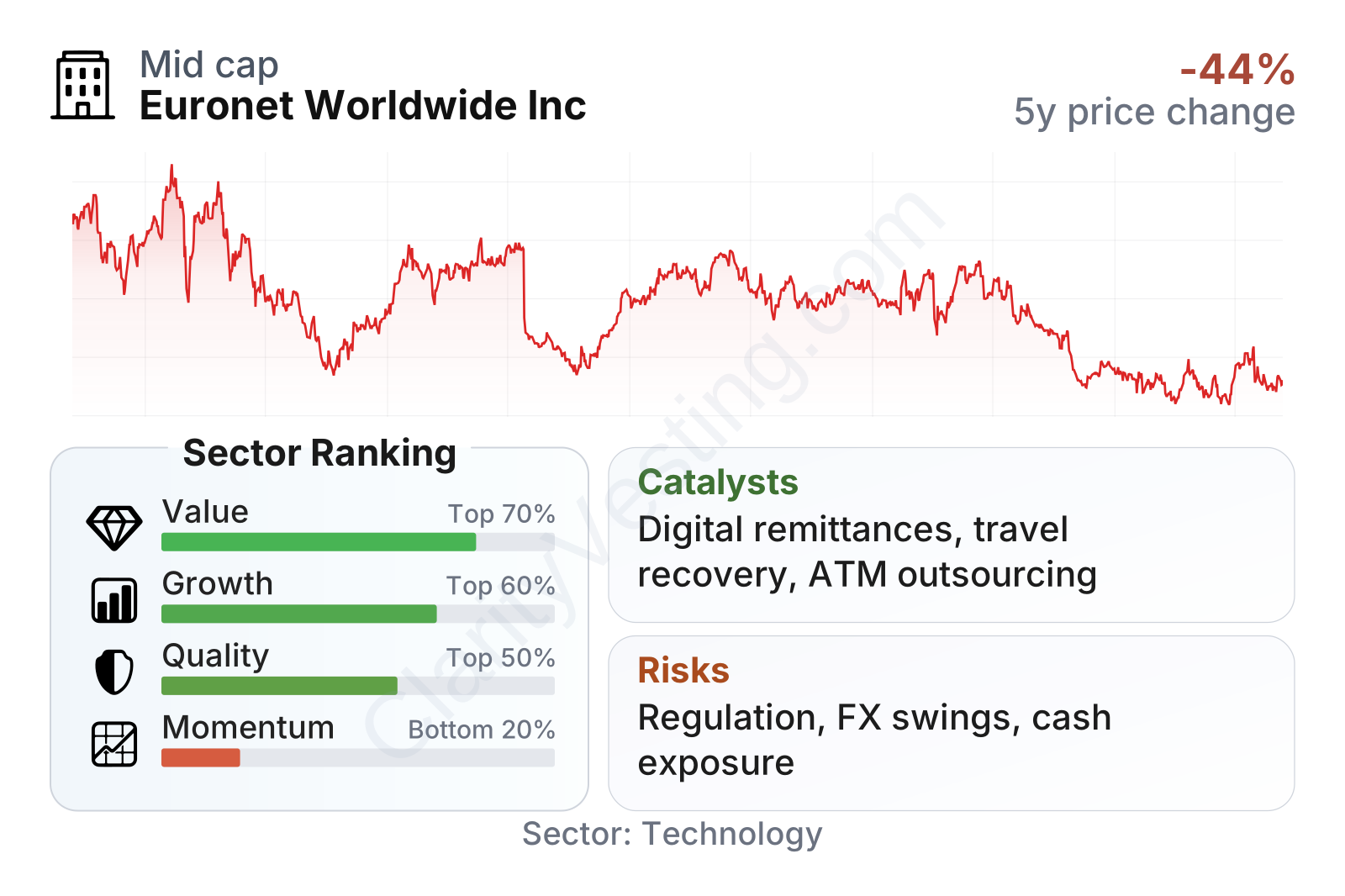
Euronet is a mid-sized company with a stock that has been volatile over the last few years and remains well below its 2021-2022 highs. The operating profile is stronger than the recent share-price trend suggests. Profitability and return on invested capital are above many sector peers, and free cash flow generation remains solid. The valuation metrics also stand out: earnings multiple, free cash flow yield, and enterprise-value-based earnings yield all screen much cheaper than the sector median. The weaker area is momentum, where the stock has underperformed both recently and over a multi-year period.
Growth
Euronet operates in parts of the payments industry that still have room to grow over the long term. Cross-border money movement, digital remittances, outsourced bank technology, and branded digital payment distribution are all supported by structural trends such as migration, e-commerce, international travel, and the continued modernization of financial services. These are not narrow niche markets; they are large and recurring transaction categories that can expand with volume even when individual transaction values fluctuate.
The company’s strategy also makes practical sense. Rather than relying on one payment method, Euronet combines physical access points, software connections, retail distribution, and digital channels. That gives it multiple ways to win business. A bank can outsource ATM or payment infrastructure, a retailer can use epay distribution, and consumers can send money through Ria or Xe. This broad network can create cross-selling opportunities and support expansion in regions where payment systems remain fragmented.
Revenue growth has moderated from the stronger rebound period seen after the pandemic, but the longer pattern still points to expansion. The latest year-over-year pace is modest at roughly 3%, which is below the broader technology sector median, yet the five-year revenue-per-share growth rate remains comfortably above that median. That combination suggests a company that is still growing, but at a more measured pace than many software names. For a payments infrastructure business with meaningful exposure to cash and remittance flows, that slower pace is not necessarily a sign of weakness by itself.
Cash generation is an important part of the growth case because it gives the company flexibility. Trailing free cash flow remains positive and sizeable, although it has come down sharply from the unusually strong levels reached in prior periods. This decline deserves monitoring, but the business is still producing cash at a level that compares well with its market value. If Euronet can stabilize working capital and keep transaction volumes rising, that cash can support technology investment, acquisitions, debt management, and share repurchases.
One of the clearest recent opportunities is the continued digitalization of remittances. Euronet’s money transfer business has been working to move more activity toward digital channels while keeping its physical network relevant. Another ongoing catalyst is international travel, which supports ATM and foreign cash withdrawal activity in many markets. The company has also continued expanding software and processing capabilities for financial institutions, which can deepen customer relationships and increase recurring transaction volume over time.
Risks
This article is for informational purposes only and does not constitute financial advice. Some content is AI-generated. See Disclaimer


