Stock Analysis · eBay Inc (EBAY)
Overview
eBay Inc. operates one of the world’s best-known online marketplaces, connecting buyers and sellers across a wide range of categories such as collectibles, luxury goods, refurbished products, auto parts, fashion, and electronics. Unlike a traditional retailer, eBay generally does not own most of the inventory sold on its platform. Its role is mainly to provide the digital marketplace, payment-related services, advertising tools, seller software, and trust features that help transactions happen.
The business model is relatively asset-light. eBay earns most of its money by taking a fee when items are listed or sold, and by selling advertising placements and related services to merchants. The company has also been focusing on higher-value categories where authenticity, trust, and specialized tools matter more, including sneakers, watches, handbags, trading cards, and vehicle parts.
Based on recent annual reporting, eBay’s revenue is concentrated in a few core streams:
- Transaction revenue: about 72% to 74% of total revenue. This includes final value fees and other charges tied to completed marketplace activity.
- Marketing services and other revenue: about 26% to 28%. This mainly includes on-platform advertising products, promoted listings, and various seller services.
- Geographic mix: the United States remains the largest single market, while international operations across Europe and other regions make up a substantial share of the rest of the business.
Over the last several years, the financial profile has shown a high gross margin structure typical of platform businesses. Revenue has grown modestly overall, but profitability has been more volatile because eBay’s net income can be affected by investment gains and losses, accounting revaluations, and portfolio-related items. Operating income and cash generation have been steadier than headline earnings suggest.
The long-term picture is that eBay remains a large, mature marketplace with strong gross profit generation. Revenue has gradually moved higher again after the post-pandemic reset, while research and product spending has stayed meaningful as the company invests in tools, trust features, and category-specific experiences.
Key Figures
| Metric | Value | Sector ⓘ |
|---|---|---|
| Date | Sep 12, 2026 | |
| Context | ||
| Sector | Consumer Cyclical | |
| Industry | Internet Retail | |
| Market Cap ⓘ | $47.95B | |
| Beta ⓘ | 1.34 | |
Value (Cheapness) | ||
| P/E Ratio ⓘ | 22.64 | 17.10 |
| FCF Yield ⓘ | 5.07% | 8.53% |
| EBIT / EV ⓘ | 5.40% | 6.46% |
| PEG ⓘ | 1.50 | |
Growth (Business expansion) | ||
| Revenue Growth ⓘ | 14.80% | 5.75% |
| RPS Growth (5Y CAGR) ⓘ | 10.85% | 9.14% |
| EPS Growth (5Y CAGR) ⓘ | -9.40% | -18.21% |
| Margin Growth (5Y Trend) ⓘ | 16.60% | -0.23% |
| FCF Growth (5Y CAGR) ⓘ | -6.92% | 4.91% |
Quality (Business durability) | ||
| ROIC (Latest) ⓘ | 21.21% | 12.61% |
| ROIC (5Y Median) ⓘ | 16.52% | 10.72% |
| Net Debt / EBIT (Latest) ⓘ | 1.77 | 2.10 |
| Net Debt / EBIT (5Y Median) ⓘ | 2.08 | 2.32 |
| Operating Margin (Latest) ⓘ | 22.72% | 9.25% |
| Operating Margin (5Y Median) ⓘ | 23.00% | 9.64% |
| Debt to Equity (Latest) ⓘ | 152.84% | 75.78% |
| Profit Margin (Latest) ⓘ | 18.57% | 5.33% |
| Free Cash Flow (Latest) ⓘ | $2.43B | |
Momentum (Price trend) | ||
| 3Y Return ⓘ | +160.27% | +14.53% |
| 12M Return (excl. last month) ⓘ | +6.76% | +3.08% |
| 6M Return ⓘ | +20.42% | +0.55% |
| Price vs. 200-Day MA ⓘ | +9.29% | -0.54% |
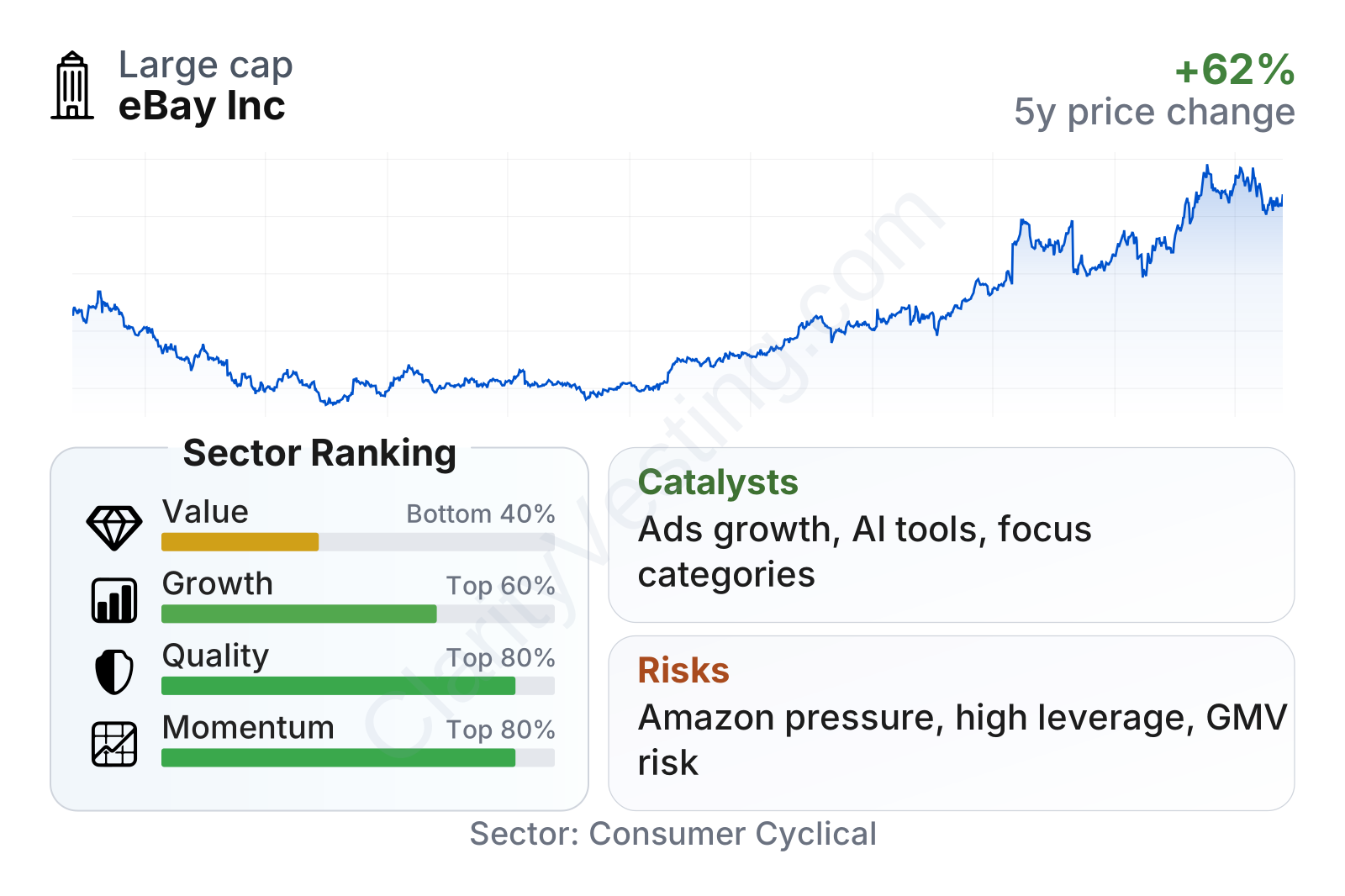
eBay is a large-cap internet retail company with above-average share price volatility, as shown by a beta above 1. On the operating side, the company stands out more for quality and profitability than for deep value. Its return on invested capital is strong relative to the sector, operating margins are well above the industry median, and net debt relative to EBIT remains manageable despite a higher debt-to-equity ratio.
The factor mix is important here. Growth has improved recently and ranks slightly above the sector overall, while valuation metrics look less compelling after the stock’s strong run. Momentum is very strong, reflecting a major re-rating over the last year and over a multi-year period.
Growth
eBay operates in e-commerce, which remains a structurally growing area of retail, but its position is different from broad online merchants chasing total sales volume. The company is leaning into niches where curation, trust, product uniqueness, and enthusiast demand matter more than ultra-fast delivery. That strategy is logical for a mature platform because it does not need to win every online shopping category; it needs to defend and deepen the ones where its marketplace format is most useful.
Management’s strategy has centered on a few themes: growing focus categories, expanding advertising, improving seller tools, and using artificial intelligence to simplify listing and discovery. These initiatives can support growth without requiring the same capital intensity as logistics-heavy competitors. Advertising is especially important because it can lift revenue per transaction even if overall merchandise growth stays moderate.
Recent revenue trends show that eBay has moved from contraction in 2022 to a clearer recovery. Year-over-year growth accelerated through 2025 and remained solid into 2026, with recent growth rates in the low- to mid-teens. That is a notable change for a business often seen as mature. Over a five-year view, revenue per share has also grown faster than the sector median, helped by buybacks and better monetization.
Cash generation remains one of the more attractive parts of the profile. Free cash flow has stayed comfortably positive in recent years, generally in the range of roughly $1.7 billion to $2.1 billion on a trailing basis, even though it has not followed a straight upward line. That gives eBay room to fund technology investment, acquisitions, debt service, and shareholder returns while preserving flexibility.
Recent company updates have also pointed to product improvements around AI-powered listing tools, personalization, and category experiences. For a marketplace with millions of listings, even small improvements in search relevance, seller productivity, and conversion can have meaningful cumulative effects. Another potential catalyst is continued expansion in enthusiast and parts-related categories, where buyers often prioritize selection and authenticity over speed alone.
Risks
This article is for informational purposes only and does not constitute financial advice. Some content is AI-generated. See Disclaimer