Stock Analysis · Brinker International Inc (EAT)
Overview
Brinker International is a restaurant company best known for Chili’s Grill & Bar. It also owns Maggiano’s Little Italy and operates a smaller virtual brand presence tied to its kitchen network. Its business is straightforward: it earns money by serving food and drinks in company-operated restaurants, collecting franchise and royalty income from locations run by partners, and generating related menu and beverage sales.
The company’s revenue mix is heavily concentrated in Chili’s, which makes Brinker a focused restaurant operator rather than a diversified food group. Based on recent company reporting, the business is approximately split as follows:
- Chili’s company sales: about 91% to 93% of total revenue. This includes food and beverage sales from company-owned Chili’s restaurants in the U.S.
- Maggiano’s company sales: about 6% to 8% of total revenue. This comes from dine-in, banquet, catering, and takeout sales at company-owned Maggiano’s locations.
- Franchise and other revenue: about 1% to 2% of total revenue. This includes franchise fees, royalties, and other restaurant-related income.
That concentration matters. Chili’s is clearly the engine of the company, and recent results suggest that the brand has become much stronger operationally. Over the last few years, Brinker has not just grown revenue; it has also expanded gross profit and operating income at a faster pace, which points to better restaurant-level efficiency and stronger traffic or pricing mix.
The business flow has improved noticeably since 2024: revenue has climbed, gross profit has widened, operating income has accelerated faster than sales, and interest expense has moved lower more recently. That combination suggests the company’s turnaround has come from both stronger customer demand and tighter cost discipline.
Key Figures
| Metric | Value | Sector ⓘ |
|---|---|---|
| Date | Sep 12, 2026 | |
| Context | ||
| Sector | Consumer Cyclical | |
| Industry | Restaurants | |
| Market Cap ⓘ | $8.87B | |
| Beta ⓘ | 1.26 | |
Value (Cheapness) | ||
| P/E Ratio ⓘ | 19.57 | 17.10 |
| FCF Yield ⓘ | 6.28% | 8.53% |
| EBIT / EV ⓘ | 5.84% | 6.46% |
| PEG ⓘ | 1.52 | |
Growth (Business expansion) | ||
| Revenue Growth ⓘ | 5.10% | 5.75% |
| RPS Growth (5Y CAGR) ⓘ | 11.65% | 9.14% |
| EPS Growth (5Y CAGR) ⓘ | 36.31% | -18.21% |
| Margin Growth (5Y Trend) ⓘ | 6.46% | -0.23% |
| FCF Growth (5Y CAGR) ⓘ | 52.94% | 4.91% |
Quality (Business durability) | ||
| ROIC (Latest) ⓘ | 67.96% | 12.61% |
| ROIC (5Y Median) ⓘ | 26.30% | 10.72% |
| Net Debt / EBIT (Latest) ⓘ | 2.65 | 2.10 |
| Net Debt / EBIT (5Y Median) ⓘ | 8.41 | 2.32 |
| Operating Margin (Latest) ⓘ | 10.70% | 9.25% |
| Operating Margin (5Y Median) ⓘ | 5.21% | 9.64% |
| Debt to Equity (Latest) ⓘ | 395.76% | 75.78% |
| Profit Margin (Latest) ⓘ | 8.39% | 5.33% |
| Free Cash Flow (Latest) ⓘ | $557.50M | |
Momentum (Price trend) | ||
| 3Y Return ⓘ | +580.84% | +14.53% |
| 12M Return (excl. last month) ⓘ | +58.76% | +3.08% |
| 6M Return ⓘ | +53.22% | +0.55% |
| Price vs. 200-Day MA ⓘ | +28.39% | -0.54% |
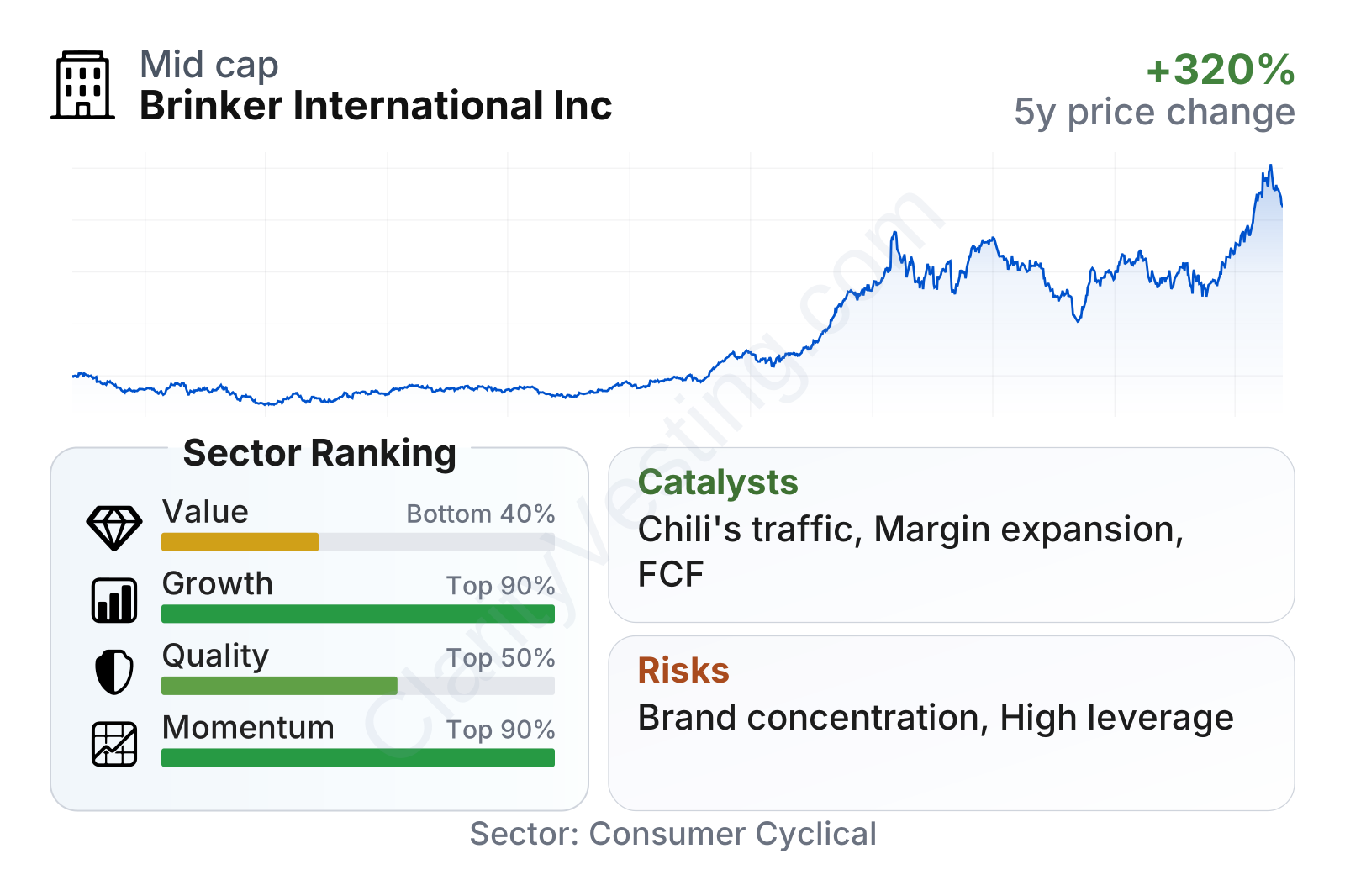
Brinker stands out most on growth and recent market momentum. Revenue growth has moderated from the unusually strong rebound phase, but its multi-year earnings and free cash flow expansion remain well ahead of many restaurant peers. Profitability is also better than the sector median, while leverage is still a weaker point. On valuation factors, the stock does not screen as particularly cheap versus the broader restaurant group.
The share price performance over the last two years has been exceptionally strong for a company of this size. That usually reflects a market re-rating: investors are giving the company more credit for improved margins, stronger execution, and a more durable Chili’s recovery than they did previously.
Growth
The restaurant sector is mature, but it still offers room for growth when a brand improves relevance, value perception, and operating execution. Brinker’s recent progress shows that even in a slow-growth industry, a restaurant chain can expand meaningfully by winning more traffic, improving menu economics, and increasing sales per location. That is especially true in casual dining, where a strong national brand can recover market share if competitors remain uneven.
Brinker’s strategy appears coherent for this stage of the cycle. The company has been emphasizing menu simplification, better labor execution, stronger kitchen productivity, and value-oriented offerings at Chili’s. It has also leaned into digital ordering and off-premise occasions, which matter because restaurant demand is no longer centered only on traditional dine-in traffic. A simpler, more efficient operating model can support margins even if industry demand becomes less predictable.
Sales growth has cooled from the very high levels seen during the strongest part of the comeback, but it remains positive. That matters because the latest phase looks less like a reopening effect and more like an operating improvement. Brinker is now growing from a much higher base than it was a few years ago, which makes continued expansion more credible.
Cash generation is one of the clearest positive signals in the current profile. Free cash flow has risen sharply over the last few years and is now in a much stronger range than in 2022 and 2023. For a restaurant operator, that creates flexibility: it can support debt reduction, remodels, technology spending, and shareholder returns without depending as heavily on external financing.
A meaningful catalyst is the continued strength of Chili’s. Because the brand represents well above 90% of revenue, even modest gains in guest traffic, same-store sales, or margins can have an outsized effect on company-wide earnings. Another growth support is the company’s improved margin structure, which means incremental sales are converting into profit more efficiently than before. If this persists, earnings can keep rising faster than revenue.
Recent company updates have also highlighted operational momentum at Chili’s, including strong comparable restaurant sales and traffic trends. For long-term analysis, the key point is not any single quarter, but the pattern: Brinker has recently shown that it can grow customer demand while also improving restaurant economics, which is a stronger signal than growth driven only by price increases.
Risks
This article is for informational purposes only and does not constitute financial advice. Some content is AI-generated. See Disclaimer


