Stock Analysis · DXC Technology Co (DXC)
Overview
DXC Technology is an IT services company that helps large organizations run and modernize important technology systems. Its work typically includes managing cloud environments, supporting business applications, handling cybersecurity, analyzing data, automating operations, and maintaining older core systems that many governments, banks, insurers, and industrial groups still rely on. In simple terms, DXC sits between clients and their complex technology estates, taking responsibility for keeping essential digital infrastructure working while also helping customers upgrade it over time.
Based on the company’s recent annual reporting structure, DXC’s revenue mainly comes from two large operating segments.
- Global Business Services (approximately 53% of revenue) — consulting and engineering-oriented services such as analytics, application services, cloud and security, insurance software and process services, and other business transformation work.
- Global Infrastructure Services (approximately 47% of revenue) — IT outsourcing and operational support, including cloud and infrastructure management, workplace support, security operations, and services tied to large-scale enterprise technology environments.
DXC also serves a broad mix of industries, with meaningful exposure to public sector, insurance, healthcare, banking and capital markets, manufacturing, and travel. That diversification reduces reliance on any single client group, but it also means growth depends on execution across many mature enterprise service lines rather than on one fast-expanding product category.
The business profile has changed noticeably in recent years. Revenue has steadily declined from the levels seen earlier in the decade, while profitability has been uneven. Even so, the company still produces sizable cash flow relative to its current stock market value, which is why it continues to attract attention despite weak momentum in the underlying business.
The revenue and cost flow shows a clear pattern: total revenue has been shrinking for several years, and the biggest challenge recently has been pressure on gross profit rather than just overhead. DXC has reduced some operating expenses over time, but the drop in revenue and the swing in gross profit have limited the benefit, leaving net income thin and less predictable.
Key Figures
| Metric | Value | Sector ⓘ |
|---|---|---|
| Date | Sep 12, 2026 | |
| Context | ||
| Sector | Technology | |
| Industry | Information Technology Services | |
| Market Cap ⓘ | $1.76B | |
| Beta ⓘ | 0.80 | |
Value (Cheapness) | ||
| P/E Ratio ⓘ | 14.72 | 29.51 |
| FCF Yield ⓘ | 70.98% | 4.25% |
| EBIT / EV ⓘ | 10.92% | 2.85% |
| PEG ⓘ | 0.49 | |
Growth (Business expansion) | ||
| Revenue Growth ⓘ | -5.10% | 15.40% |
| RPS Growth (5Y CAGR) ⓘ | 2.66% | 8.56% |
| EPS Growth (5Y CAGR) ⓘ | -48.56% | -11.88% |
| Margin Growth (5Y Trend) ⓘ | -4.05% | 0.46% |
| FCF Growth (5Y CAGR) ⓘ | -4.53% | 9.80% |
Quality (Business durability) | ||
| ROIC (Latest) ⓘ | 0.32% | 9.44% |
| ROIC (5Y Median) ⓘ | 5.90% | 8.30% |
| Net Debt / EBIT (Latest) ⓘ | 5.12 | 0.54 |
| Net Debt / EBIT (5Y Median) ⓘ | 3.89 | 0.44 |
| Operating Margin (Latest) ⓘ | 3.47% | 9.58% |
| Operating Margin (5Y Median) ⓘ | 4.22% | 8.25% |
| Debt to Equity (Latest) ⓘ | 136.54% | 33.33% |
| Profit Margin (Latest) ⓘ | 0.99% | 7.14% |
| Free Cash Flow (Latest) ⓘ | $1.25B | |
Momentum (Price trend) | ||
| 3Y Return ⓘ | -44.19% | +45.48% |
| 12M Return (excl. last month) ⓘ | -19.46% | +23.48% |
| 6M Return ⓘ | -4.61% | +20.93% |
| Price vs. 200-Day MA ⓘ | -4.10% | +7.43% |
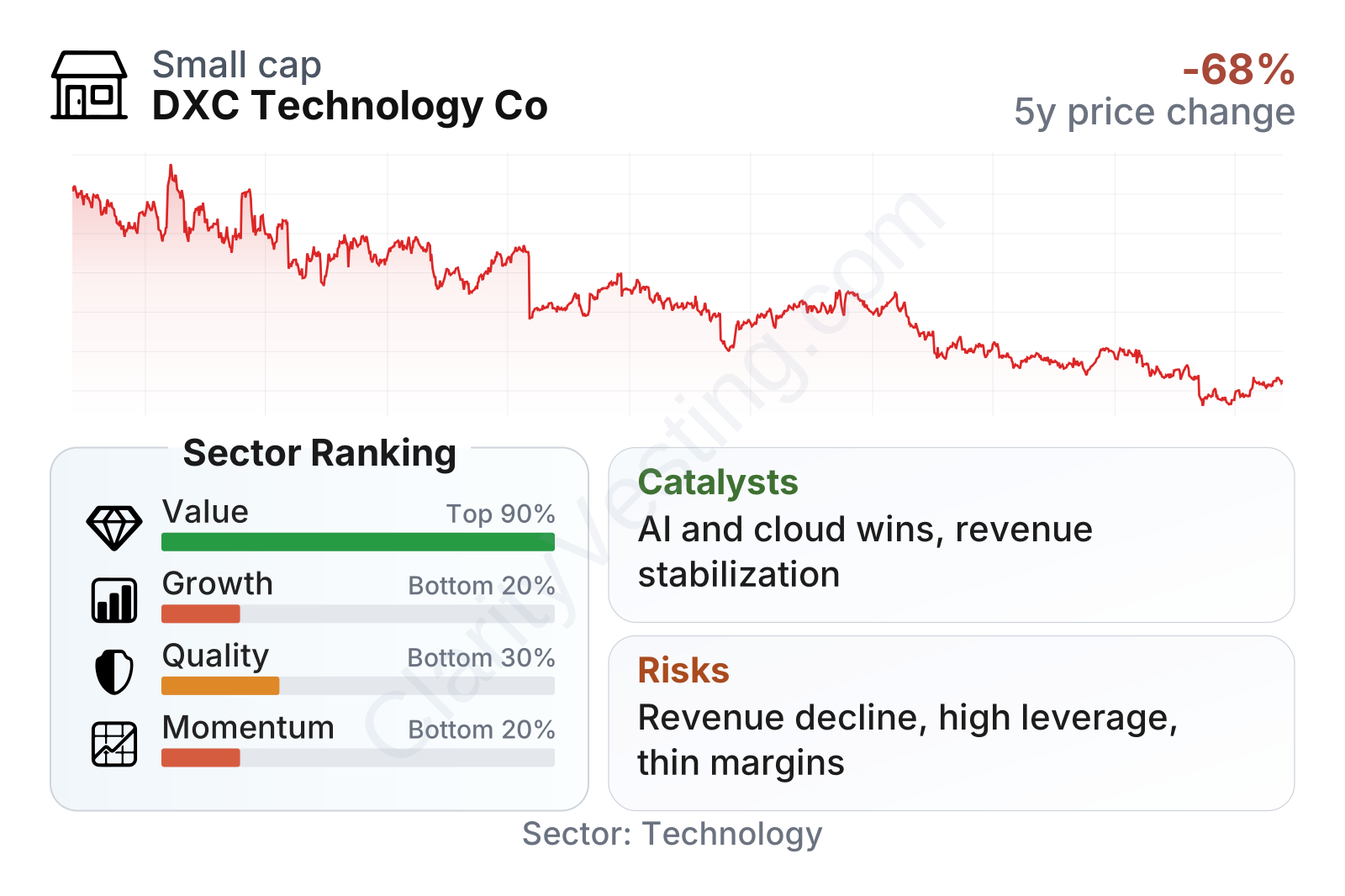
DXC is now a relatively small public company by large-cap technology standards, and its recent share-price trend has been weak over short, medium, and multi-year periods. The metrics table paints a mixed picture. On valuation, the stock screens as inexpensive versus the broader technology services group, with a lower earnings multiple and unusually high free-cash-flow yield. But that cheapness is paired with weak growth, low profitability, and a balance sheet that carries much more leverage than the sector norm. In short, the market is assigning a discounted valuation because the company’s operating quality and growth profile have lagged peers.
Growth
DXC operates in a sector that should have long-term demand. Companies and governments continue to spend on cloud migration, cybersecurity, AI-enabled automation, data modernization, and the simplification of complex IT environments. Those themes are real and durable. The problem is that DXC’s position within this market is not centered on the fastest-growing areas alone; a large part of its business is tied to mature outsourcing and infrastructure support activities, where pricing pressure and contract runoff can offset gains elsewhere.
Management’s strategy has focused on simplifying operations, improving delivery, protecting margins, reducing lower-value work, and shifting the mix toward applications, cloud, security, and industry-specific solutions. Conceptually, that strategy makes sense. Clients increasingly want fewer vendors, measurable cost savings, and help connecting old systems to newer digital tools. DXC already has relationships with large enterprises that could support this transition if execution improves.
The main issue is that the company has not yet translated that strategy into sustained top-line expansion. Revenue has been negative year over year for most periods shown, with only brief stabilization. That places DXC behind the broader technology sector, where many peers have been growing materially faster.
One encouraging point is cash generation. Free cash flow has remained above the billion-dollar level for several years, even while revenue has trended lower. That suggests the company still has a meaningful installed base, disciplined capital spending, and contracts that can convert into cash even when accounting profits are under pressure. If DXC can stabilize revenue while preserving that cash profile, the earnings picture could improve more quickly than sales alone might suggest.
Recent company communications have emphasized expansion in areas such as cloud, security, infrastructure modernization, and AI-related services, along with partnerships with major technology platforms. Those partnerships matter because many customers prefer service providers that can implement tools from large ecosystem leaders rather than develop everything internally. For DXC, the opportunity is less about creating a breakthrough product and more about winning a larger role in complex enterprise transformation programs.
Risks
This article is for informational purposes only and does not constitute financial advice. Some content is AI-generated. See Disclaimer


