Stock Analysis · DoubleVerify Holdings Inc (DV)
Stock Analysis · DoubleVerify Holdings Inc (DV)

Overview

DoubleVerify Holdings Inc. is a digital advertising software company. In simple terms, it helps brands, advertising agencies, and online publishers check whether an ad was actually seen by a real person, whether it appeared in a suitable environment, and whether the placement matched what the advertiser paid for. Its services are used across websites, mobile apps, connected TV, social platforms, and other digital channels.

The business sits in an important part of the online advertising chain: measurement and verification. As advertising spending keeps moving toward automated and data-driven buying, many marketers want an independent third party to confirm that campaigns are effective and safe for brand reputation. DoubleVerify’s products cover media quality, fraud detection, viewability, brand suitability, and campaign performance analytics.

Based on company disclosures, revenue is mainly generated from software and analytics services tied to digital ad measurement. A simple way to think about the mix is:

  • Verification and measurement services: the largest source of revenue, including viewability, fraud, brand suitability, and campaign quality checks across open web, apps, and connected TV.
  • Activation and performance solutions: tools that help advertisers optimize campaigns using DoubleVerify’s data, a meaningful but smaller contribution than core verification.
  • Publisher and platform-related services: smaller revenue streams tied to helping sell-side partners and digital platforms improve transparency and monetization.

DoubleVerify does not usually break out a detailed percentage split in the simple form many readers may want, but public filings make clear that advertiser-focused measurement and verification remains the core economic engine. Another useful point is customer concentration: large global brands, major agencies, and major digital platforms matter a lot to the business, which creates both scale benefits and dependence on a relatively concentrated ecosystem.

The broader financial profile shows a software-like model with high gross margins, but also heavy ongoing spending on product development and sales. Revenue has grown strongly over the last several years, while profitability has been more uneven because the company continues to invest in technology and market expansion.

Over the past several years, revenue and gross profit have expanded steadily, which supports the appeal of the model. At the same time, research and development spending has risen sharply, showing that management is still prioritizing product depth and platform coverage rather than maximizing short-term earnings.

Key Figures

MetricValueSector
DateJul 18, 2026
Context
SectorCommunication Services
IndustryAdvertising Agencies
Market Cap $1.81B
Beta 0.96
Value
(Cheapness)
P/E Ratio 35.7619.52
FCF Yield 7.45%12.73%
EBIT / EV 5.14%4.37%
PEG 0.72
Growth
(Business expansion)
Revenue Growth 9.60%6.10%
RPS Growth (5Y CAGR) 21.65%5.02%
EPS Growth (5Y CAGR) -13.30%-26.68%
Margin Growth (5Y Trend) 3.17%0.79%
FCF Growth (5Y CAGR) 23.86%5.18%
Quality
(Business durability)
ROIC (Latest) 5.09%8.74%
ROIC (5Y Median) 5.24%8.07%
Net Debt / EBIT (Latest) -0.882.09
Net Debt / EBIT (5Y Median) -2.313.02
Operating Margin (Latest) 11.67%15.46%
Operating Margin (5Y Median) 13.32%13.17%
Debt to Equity (Latest) 8.84%59.09%
Profit Margin (Latest) 7.16%9.11%
Free Cash Flow (Latest) $134.91M
Momentum
(Price trend)
3Y Return -72.17%+36.38%
12M Return (excl. last month) -27.68%+8.16%
6M Return +8.14%+2.31%
Price vs. 200-Day MA +7.83%+1.57%
Better than sector median
Slightly worse than sector median
More than 20% worse than sector median

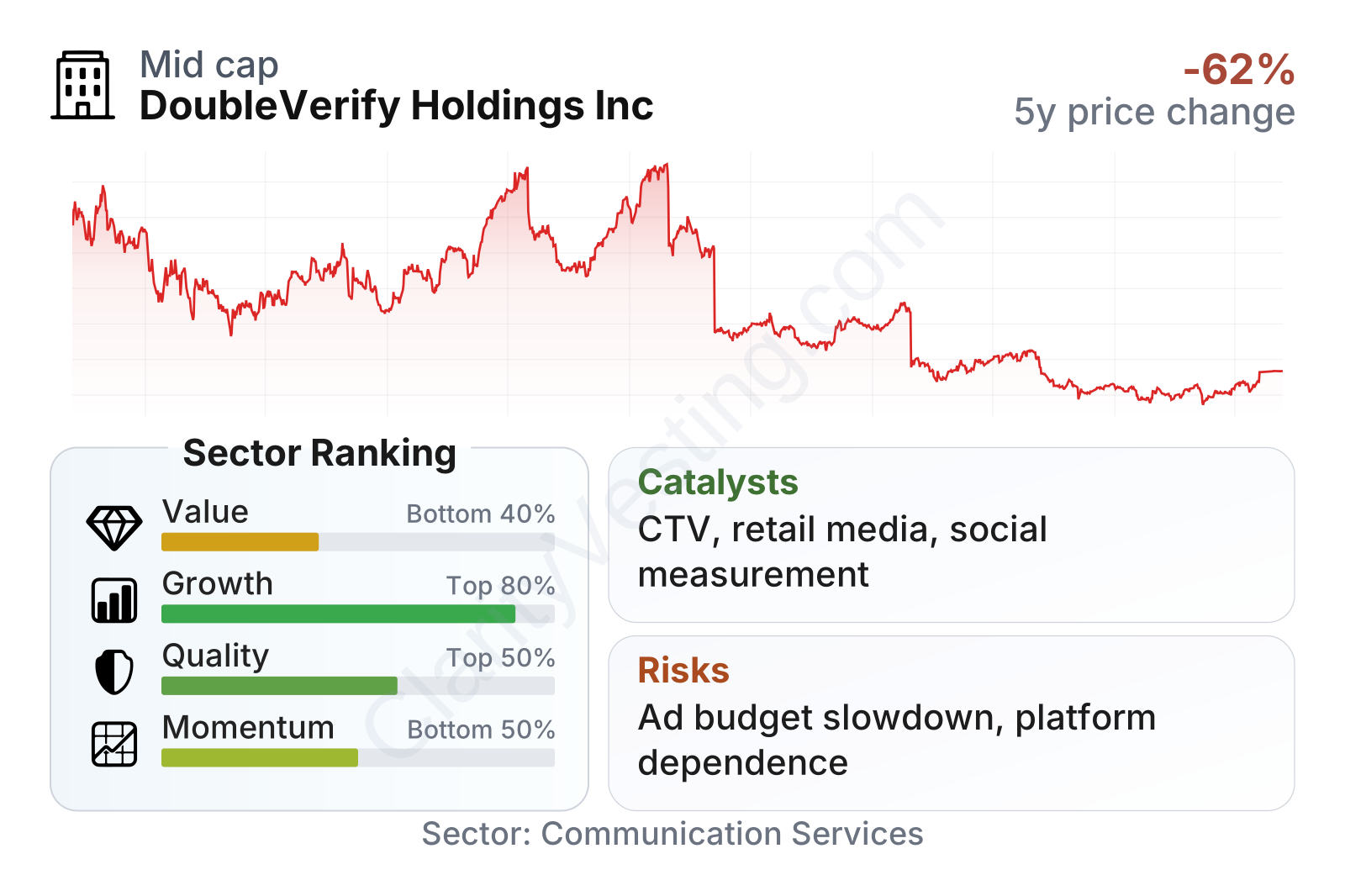
DoubleVerify currently sits in a mixed position. Growth metrics are relatively strong versus much of the sector, helped by solid revenue expansion and a strong multiyear increase in revenue per share and free cash flow. Balance-sheet quality also stands out because debt is low and net cash remains a support. On the other hand, valuation is not especially cheap on earnings, margins are below many sector peers, and stock momentum has been weak for a prolonged period. With a market value around $1.6 billion and a beta close to 1, the shares behave more like a typical mid-cap than a defensive stock.

Growth

DoubleVerify operates in a sector that still has room to expand over the long run. Digital advertising continues to take share from traditional media, and within digital, areas such as connected TV, retail media, social video, and programmatic buying all create more need for independent measurement. As ad budgets become more automated, marketers need proof that impressions are valid, visible, and appearing next to suitable content. That structural trend remains favorable for companies like DoubleVerify.

The company’s strategy also makes sense in that context. Management has continued to invest in product development, platform integrations, and international reach. The rising spend on research and development suggests a push to keep up with changes in where ads appear and how they are bought. This matters because the ad market changes quickly: if verification tools fail to keep pace with new formats such as streaming TV, short-form video, commerce media, or AI-driven ad buying, customers can shift elsewhere.

Growth has clearly slowed from the very high rates seen a few years ago, but it is still positive and remains above the sector median. That profile suggests DoubleVerify is no longer in an early hypergrowth phase, yet it still appears to be gaining business in an industry where trust, measurement, and optimization remain relevant.

Free cash flow has improved substantially over the longer term and remains strong in absolute terms, even if the most recent reading is a little below the prior peak. That is important because it shows the business is not relying purely on accounting profits; it is also converting revenue into cash that can support product investment, acquisitions, and balance-sheet resilience.

A meaningful catalyst is the continued expansion of advertising on connected TV and large digital platforms, where independent verification can become more valuable as spending scales. Another catalyst is the increasing demand for brand safety and fraud prevention as generative AI, synthetic content, and more fragmented media environments make campaign oversight harder. If DoubleVerify keeps broadening its measurement coverage across platforms and formats, that can support further growth even if the overall ad market grows at a moderate pace.

Recent company communications have also emphasized product expansion tied to performance measurement and platform partnerships. The most important opportunity is not simply more ad spending in general, but more ad spending in places where independent verification is harder to do and therefore more valuable once established.

Risks

The biggest risk is competitive pressure. DoubleVerify operates in a crowded and strategically important area of ad tech. Major competitors include Integral Ad Science, as well as large platform-owned measurement tools and other advertising technology vendors that offer overlapping services. In some parts of the market, customers may prefer independent specialists; in other parts, they may rely on tools built directly into the platform where ads run. That can pressure pricing, customer retention, and growth.

DoubleVerify does have real competitive advantages. It has scale, established relationships with major advertisers and agencies, a recognized independent verification brand, and broad coverage across multiple channels. Those strengths help explain why it has been able to maintain growth and strong gross profitability. Still, it is not unchallenged. It is one of the key independent players, but calling it the uncontested leader would be too strong given the presence of Integral Ad Science and the influence of major ad platforms.

Financial risk is relatively contained. Debt to equity is low, far below the sector median, which gives the company flexibility if the advertising cycle weakens. That is a positive contrast with many firms in communications and ad tech that carry heavier balance-sheet obligations.

The main concern is not leverage but profitability pressure. Profit margin remains positive and slightly above the sector median at the latest point, yet it is well below the company’s own stronger levels from prior periods. That suggests execution has become more demanding as growth has moderated and spending on technology and go-to-market efforts has stayed elevated.

There is also platform dependence risk. DoubleVerify’s products rely on integrations with large digital ecosystems. Changes in policies, data access, privacy rules, technical standards, or measurement frameworks by major platforms can reduce visibility or make services harder to deliver. In digital advertising, power is concentrated in a handful of very large gatekeepers, and independent vendors must continually adapt.

Another risk is cyclicality. Even though verification is a useful service, ad budgets are still sensitive to economic conditions. If marketers cut spending, campaign volumes can weaken and slow revenue growth. In addition, if more measurement becomes bundled inside larger ad-buying platforms, independent providers may find some categories harder to monetize.

No major public red flag suggests a reputational crisis or balance-sheet stress at this stage, but the sharp multiyear decline in the stock price shows that the market has become more skeptical about the pace and durability of future expansion. That makes execution risk especially important over the next few reporting periods.

Valuation

DoubleVerify’s valuation looks cheaper than its own history, but not plainly cheap on current earnings. The share price has fallen dramatically from earlier highs, yet the earnings multiple is still above the sector median. That means the market is no longer pricing the company like a premium high-growth favorite, but it also has not moved into obvious bargain territory relative to today’s profit base.

The earnings multiple has come down substantially over time, reflecting weaker sentiment and slower growth expectations. Even so, it still sits above typical sector levels. That premium is easier to justify when considering the company’s clean balance sheet, recurring demand for verification, and above-median growth profile. It is harder to justify when focusing on margin compression, weak stock momentum, and rising competitive intensity.

A useful way to frame valuation here is that the market appears to be weighing two conflicting realities. On one side, DoubleVerify remains a scalable digital measurement platform in a relevant niche with good cash generation and long-term structural demand. On the other side, the business is no longer growing at the very high rates once expected, and its profitability metrics do not currently support an aggressive multiple without renewed operating leverage.

So the current price seems to reflect a reset rather than a clear discount. It implies that future upside in valuation would likely need to come from better execution, stronger platform expansion, or a clearer return to faster profitable growth, rather than from multiple expansion alone.

Conclusion

DoubleVerify remains an interesting company because it operates in a part of digital advertising that solves a real and persistent problem: proving that marketing dollars are being spent effectively and safely. The business has built a meaningful position, continues to grow faster than much of its sector, produces solid free cash flow, and carries very little financial leverage. Those are important strengths for a long-term business assessment.

The challenge is that the market now expects more proof. Growth has slowed from earlier years, margins have come under pressure, and competition remains intense in ad measurement and verification. The stock’s long decline suggests investors have moved from rewarding the company’s category position to demanding clearer evidence of durable advantage and stronger earnings conversion.

Overall, DoubleVerify looks more like a capable but still debated platform than a straightforward compounder at this stage. Its financial foundation is sound and the industry backdrop is still supportive, but the valuation context and recent operating trends indicate that future results will need to do the heavy lifting. The company’s long-term appeal depends less on the size of the ad market alone and more on whether it can turn its relevance in verification into stronger, more consistent profitability as the ecosystem evolves.

Sources:

  • DoubleVerify Holdings, Inc. — Annual Report on Form 10-K for fiscal year 2025
  • DoubleVerify Holdings, Inc. — Quarterly Report on Form 10-Q for quarter ended March 31, 2026
  • DoubleVerify Investor Relations — Earnings releases and shareholder materials
  • SEC EDGAR — DoubleVerify Holdings, Inc. filings
  • DoubleVerify Holdings, Inc. — Company website and product materials
  • Wikipedia — DoubleVerify basic company background

This article is for informational purposes only and does not constitute financial advice. Some content is AI-generated. See Disclaimer


Sign up for exclusive research and insights.

Unsubscribe anytime.
