Stock Analysis · Descartes Systems Group Inc (DSGX)
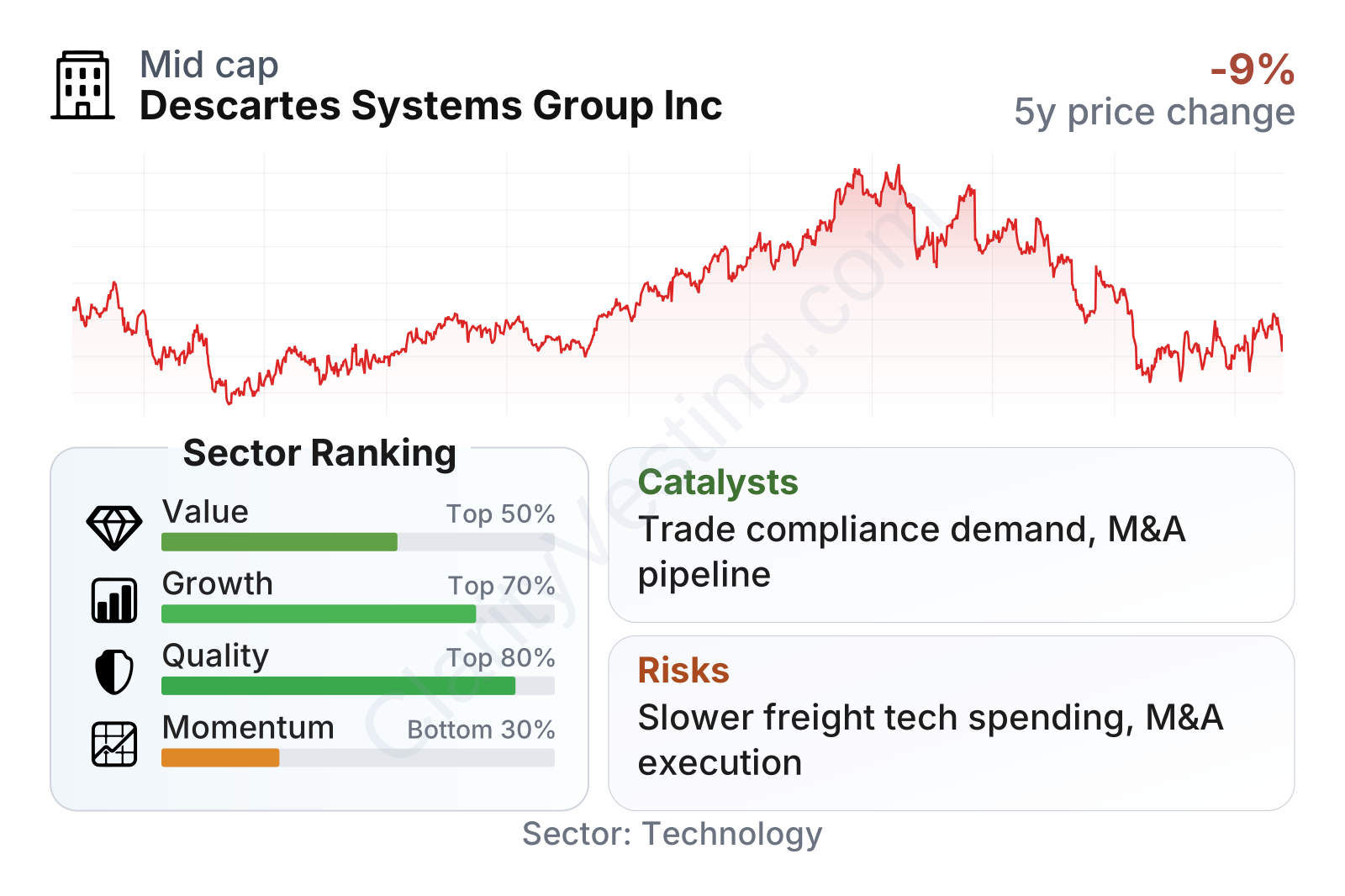
Stock Analysis · Descartes Systems Group Inc (DSGX)

Overview

Descartes Systems Group is a software company focused on global logistics. In simple terms, it helps businesses move goods, share shipping information, manage customs and trade compliance, plan routes, and coordinate deliveries across complex supply chains. Its customers include manufacturers, retailers, distributors, freight brokers, carriers, logistics providers, and government-related trade participants. The company’s role is important because global trade depends on many different parties exchanging accurate information quickly, and Descartes provides the software network that helps make that possible.

The business model is largely based on software and services that are embedded in day-to-day operations. That matters because logistics software can become difficult to replace once it is connected to shipping workflows, transportation partners, customs filings, and customer systems. Descartes has also expanded over time through acquisitions, adding tools in areas such as transportation management, customs compliance, e-commerce fulfillment, route planning, and supply chain visibility.

Revenue is mainly generated from recurring software access and related services. Public disclosures point to a business mix that is still centered on subscription-like and transaction-oriented activity, with a smaller contribution from professional services and other non-recurring work. At a high level, the revenue mix can be understood as follows:

  • Services revenues from software subscriptions, transaction fees, and ongoing access to logistics platforms: the clear majority of total revenue, roughly 85% to 90%.
  • Professional services and implementation work: a smaller share, roughly 10% to 15%.

Another notable feature is the economics of the model. Over the last several years, revenue has climbed steadily while operating income and net income have risen faster, showing that the company has been scaling efficiently. Gross profit remains high for a software business, while spending on research, development, sales, and administration has increased at a slower pace than total revenue overall.

The operating picture shows a business that has been growing without sacrificing profitability. Revenue has moved up strongly over the last five fiscal years, and earnings have expanded even faster, which is consistent with a software platform benefiting from recurring demand and disciplined cost control.

Key Figures

MetricValueSector
DateJul 18, 2026
Context
SectorTechnology
IndustrySoftware - Application
Market Cap $6.50B
Beta 0.19
Value
(Cheapness)
P/E Ratio 35.4731.76
FCF Yield 4.35%4.18%
EBIT / EV 3.81%2.56%
PEG 1.49
Growth
(Business expansion)
Revenue Growth 14.70%13.50%
RPS Growth (5Y CAGR) 14.63%8.57%
EPS Growth (5Y CAGR) -21.54%-21.87%
Margin Growth (5Y Trend) 8.22%0.41%
FCF Growth (5Y CAGR) 11.65%9.76%
Quality
(Business durability)
ROIC (Latest) 11.17%8.54%
ROIC (5Y Median) 10.06%8.12%
Net Debt / EBIT (Latest) -1.570.38
Net Debt / EBIT (5Y Median) -1.980.38
Operating Margin (Latest) 31.10%9.58%
Operating Margin (5Y Median) 27.28%8.25%
Debt to Equity (Latest) 0.50%33.52%
Profit Margin (Latest) 23.35%6.96%
Free Cash Flow (Latest) $282.71M
Momentum
(Price trend)
3Y Return -8.21%+30.91%
12M Return (excl. last month) -28.67%+28.90%
6M Return -16.27%+5.38%
Price vs. 200-Day MA -5.01%+7.61%
Better than sector median
Slightly worse than sector median
More than 20% worse than sector median

Descartes stands out for business quality more than for recent share-price momentum. The company’s profitability, returns on invested capital, and balance sheet are all stronger than much of the software sector, while revenue growth has remained above the industry midpoint. The main weak spot in the snapshot is market performance: the stock has lagged over the last year and over longer periods, even though the underlying business has kept producing cash and maintaining healthy margins. With a market value around the mid-single-digit billions and a very low beta, the stock has historically been less volatile than many technology names.

Growth

Descartes operates in a part of the software market that benefits from long-term structural demand. Global commerce is becoming more digital, more regulated, and more dependent on real-time coordination. Companies increasingly need tools for customs compliance, transportation planning, shipment visibility, e-commerce logistics, and route optimization. Those needs do not disappear when economic conditions soften; if anything, supply chain complexity often makes digital tools more important.

The company’s strategy is coherent for this environment. It combines a large logistics network, recurring software revenue, and targeted acquisitions that broaden the product set and customer base. That approach can support growth in two ways: first, by adding new modules to existing customers; second, by acquiring niche platforms that fit into the broader logistics ecosystem. This is a well-established pattern for Descartes, and it has helped the business expand into more specialized logistics and compliance workflows over time.

Revenue growth has not been perfectly linear, but it has remained consistently positive and has recently re-accelerated into the mid-teens range. That is a constructive sign because it suggests the company is still finding new demand despite its already meaningful scale. Over a five-year view, revenue per share growth has also been noticeably better than the typical company in its sector.

Cash generation strengthens the growth case. Free cash flow has risen steadily from year to year and now sits comfortably above earlier levels, which gives the company flexibility to invest internally, pursue acquisitions, or simply preserve financial resilience. Importantly, this growth in cash flow has come alongside strong operating margins rather than at their expense.

Recent company updates have continued to emphasize acquisitions and product expansion in areas tied to supply chain execution, trade compliance, and last-mile logistics. Those categories remain attractive because they address practical, high-value problems for customers: avoiding customs mistakes, improving fleet efficiency, managing delivery complexity, and reducing transportation friction. A meaningful catalyst for Descartes is that logistics software is often adopted module by module, creating room for cross-selling once a customer is inside the network.

Risks

The biggest business risk is that Descartes serves customers whose shipping activity can be influenced by trade volumes, industrial demand, and general economic conditions. Even though the company has a recurring software base, weaker freight markets or slower global trade can still reduce transaction volumes and delay software spending decisions. For a company tied to logistics flows, that sensitivity never fully disappears.

A second risk is acquisition execution. Descartes has built part of its expansion through purchases of smaller companies and technologies. That can work well, but it also creates the possibility of integration issues, overlapping products, slower-than-expected synergies, or paying too much for growth. For a serial acquirer, discipline matters as much as strategy.

Competition is another important factor. Descartes is not the only company serving transportation management, customs software, route optimization, and supply chain visibility. Rivals can come from large enterprise software vendors, specialized logistics software firms, and privately held niche providers. Depending on the product area, competitors may include firms such as WiseTech Global, Manhattan Associates, Trimble in transportation workflows, E2open in supply chain connectivity, SAP and Oracle in broader enterprise logistics, and project44 or FourKites in visibility-related services. Descartes is not the universal leader across all of these categories, but it is a recognized specialist with a strong position in logistics-centric software and network-based trade tools.

Its competitive advantages are real. The company benefits from deep integration into customer operations, a wide logistics network, a broad set of adjacent products, and a long operating history in a specialized field. Those features can create switching costs and support customer retention. Just as important, Descartes appears financially stronger than many peers because it carries almost no balance-sheet leverage and produces healthy margins.

The balance sheet is a major source of resilience. Debt to equity is near zero, far below the typical software company, and net debt relative to earnings is actually negative, meaning cash exceeds debt. That lowers financial risk and gives management room to act during downturns or acquisition opportunities.

Profitability is also a strength, but it creates its own challenge: high margins can attract competition. Descartes’ profit margin has been consistently well above the sector median and has trended upward, showing strong execution. The risk is less about current weakness and more about whether the company can defend that level of profitability as rivals invest in similar logistics capabilities.

There is no widely recognized recent public event suggesting a major scandal, governance breakdown, or reputational crisis. The more relevant near-term risk is operational: if growth slows while the valuation still reflects a premium software multiple, market expectations can reset quickly, as seen in the stock’s recent weakness.

Valuation

Descartes does not look like a low-multiple stock in absolute terms, but it also does not look as stretched as it did in prior years. The earnings multiple has come down sharply from very elevated historical levels and now sits only moderately above the sector median. That shift matters because the company still combines above-median growth with unusually strong margins, high cash generation, and minimal leverage.

The valuation picture is therefore mixed, but understandable. On one hand, a price-to-earnings ratio in the low-30s is not cheap for a company exposed to freight and trade activity. On the other hand, Descartes is not a typical cyclical logistics company; it is a software platform with recurring revenue, strong returns on capital, and a clean balance sheet. The current multiple seems to reflect that distinction. In other words, the stock still carries a quality premium, but that premium is much less extreme than it used to be.

Whether the current price looks demanding depends mainly on the durability of double-digit growth and the company’s ability to keep converting revenue into cash. Given its margins, acquisition record, and niche positioning, the present valuation appears easier to justify than during the period when the stock traded at much higher earnings multiples. It is still not an obviously discounted situation, but it is no longer pricing in the same level of optimism seen several years ago.

Conclusion

Descartes Systems Group is a specialized logistics software company with an attractive long-term profile: recurring revenue, strong margins, steady cash generation, and an exceptionally conservative balance sheet. The business sits in a useful niche where regulation, supply chain complexity, and the need for real-time coordination continue to support demand. That combination gives the company a sturdier foundation than many software names that depend on faster-moving or less essential spending.

The main challenges are not hard to identify. Growth still depends partly on trade activity and on management’s ability to keep integrating acquisitions successfully. Competition is broad, and the company is not the dominant force in every product category it touches. Even so, its financial profile suggests a disciplined operator with real staying power rather than a fragile growth company.

The stock’s recent weakness has changed the conversation around valuation. Descartes still trades at a premium to the average software company, but that premium is tied to unusually strong profitability, low financial risk, and a business model that has scaled well over time. Overall, the company currently looks more like a high-quality compounder facing normal execution questions than an overextended technology name relying on aggressive assumptions.

Sources:

  • Descartes Systems Group Inc. — Annual Report on Form 10-K for fiscal year ended January 31, 2026
  • Descartes Systems Group Inc. — Quarterly Reports on Form 10-Q filed in 2026
  • SEC EDGAR — Descartes Systems Group Inc. filings database
  • Descartes Systems Group Investor Relations — Earnings press releases and acquisition announcements published in 2026
  • Descartes Systems Group Investor Relations — Company-hosted earnings call materials and presentations
  • Wikipedia — Descartes Systems Group basic company background

This article is for informational purposes only and does not constitute financial advice. Some content is AI-generated. See Disclaimer
Sign up for exclusive research and insights.

Unsubscribe anytime.