Stock Analysis · Darden Restaurants Inc (DRI)
Overview
Darden Restaurants is one of the largest full-service restaurant companies in the United States. It owns a portfolio of well-known dining brands that serve different customer needs, from casual family meals to higher-end occasions. Its best-known banners include Olive Garden, LongHorn Steakhouse, Cheddar’s Scratch Kitchen, Yard House, Ruth’s Chris Steak House, The Capital Grille, Chuy’s, Seasons 52, Eddie V’s, Bahama Breeze, and a smaller group of specialty concepts.
The business model is straightforward: Darden operates restaurants, serves food and beverages, and earns revenue primarily from company-owned locations. Unlike many restaurant groups that rely heavily on franchising, Darden is much more exposed to direct restaurant operations. That makes revenue more sensitive to traffic, pricing, labor, and food costs, but it also gives the company more control over quality, menus, staffing, and guest experience.
Based on recent annual reporting, revenue is heavily concentrated in a few major brands, with Olive Garden clearly the largest contributor. Approximate revenue mix can be summarized as follows:
- Olive Garden: roughly 37% to 39%
- LongHorn Steakhouse: roughly 22% to 24%
- Fine dining: roughly 12% to 14% combined, mainly Ruth’s Chris, The Capital Grille, and Eddie V’s
- Other business dining brands: roughly 20% to 23% combined, including Cheddar’s, Yard House, Chuy’s, and Seasons 52
- Franchise and other revenue: small, typically low single digits
This mix matters because it shows both concentration and diversification. Olive Garden and LongHorn provide scale and broad consumer reach, while the smaller brands help Darden participate in different spending occasions and price points.
The company’s recent financial progression points to a business that has been expanding sales while preserving strong earnings conversion. Revenue has moved up materially over the last several years, and operating income and net income have followed, even as interest expense has also risen.
The broad trend is favorable: sales, operating profit, and net income have all grown over time, showing that expansion has not come only from opening more restaurants but also from maintaining solid profitability. One point to watch is higher interest expense, which reflects a more leveraged balance sheet than many peers.
Key Figures
| Metric | Value | Sector ⓘ |
|---|---|---|
| Date | Sep 12, 2026 | |
| Context | ||
| Sector | Consumer Cyclical | |
| Industry | Restaurants | |
| Market Cap ⓘ | $23.83B | |
| Beta ⓘ | 0.59 | |
Value (Cheapness) | ||
| P/E Ratio ⓘ | 20.10 | 17.10 |
| FCF Yield ⓘ | 4.70% | 8.53% |
| EBIT / EV ⓘ | 5.99% | 6.46% |
| PEG ⓘ | 1.85 | |
Growth (Business expansion) | ||
| Revenue Growth ⓘ | 13.70% | 5.75% |
| RPS Growth (5Y CAGR) ⓘ | 11.33% | 9.14% |
| EPS Growth (5Y CAGR) ⓘ | 9.41% | -18.21% |
| Margin Growth (5Y Trend) ⓘ | 1.36% | -0.23% |
| FCF Growth (5Y CAGR) ⓘ | 6.90% | 4.91% |
Quality (Business durability) | ||
| ROIC (Latest) ⓘ | 34.01% | 12.61% |
| ROIC (5Y Median) ⓘ | 33.81% | 10.72% |
| Net Debt / EBIT (Latest) ⓘ | 3.28 | 2.10 |
| Net Debt / EBIT (5Y Median) ⓘ | 3.84 | 2.32 |
| Operating Margin (Latest) ⓘ | 13.45% | 9.25% |
| Operating Margin (5Y Median) ⓘ | 11.58% | 9.64% |
| Debt to Equity (Latest) ⓘ | 274.23% | 75.78% |
| Profit Margin (Latest) ⓘ | 9.13% | 5.33% |
| Free Cash Flow (Latest) ⓘ | $1.12B | |
Momentum (Price trend) | ||
| 3Y Return ⓘ | +54.56% | +14.53% |
| 12M Return (excl. last month) ⓘ | +14.51% | +3.08% |
| 6M Return ⓘ | +7.45% | +0.55% |
| Price vs. 200-Day MA ⓘ | +5.00% | -0.54% |
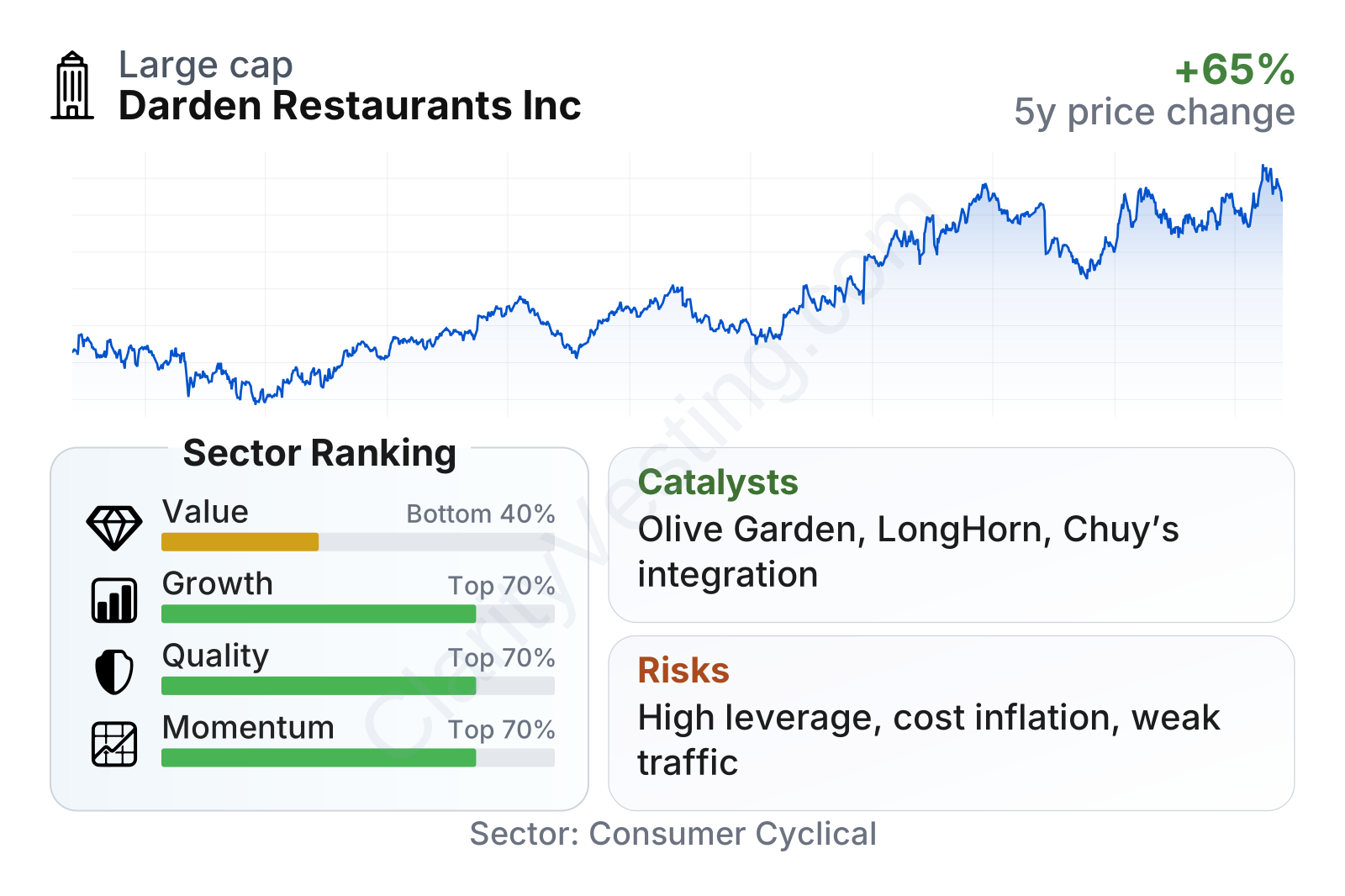
Darden combines large scale with relatively steady share-price behavior. Its market value sits around the mid-$20 billions, making it one of the larger names in the restaurant space, while its beta below 1 suggests the stock has historically moved less sharply than the broader market. On the operating side, profitability and returns on capital stand out as clear strengths, with margins and ROIC comfortably above many peers. Growth is also respectable rather than spectacular, supported by steady revenue expansion and a good multi-year earnings record. The weaker area is valuation: the earnings multiple is somewhat above the sector median, while free cash flow yield is less generous than many restaurant stocks, implying the market already recognizes much of Darden’s quality.
Growth
The restaurant industry is not a high-growth sector in the way software or semiconductors can be, but full-service dining remains a large and durable category. Over long periods, growth usually comes from a mix of menu pricing, same-restaurant sales gains, new openings, acquisitions, digital ordering improvements, and brand share gains. Darden is positioned to benefit from that pattern because it owns several established brands with national recognition and has enough scale to invest in supply chain, marketing, and technology.
Its strategy for future expansion is sensible. Olive Garden and LongHorn remain the main engines, giving Darden two large concepts with room for operational improvement and selective unit growth. At the same time, acquisitions have added new earnings streams. The purchase of Ruth’s Chris brought a stronger foothold in fine dining, and the more recent addition of Chuy’s expands exposure to Tex-Mex, a category where Darden previously had less presence. This approach is not based on chasing trendy concepts; it is based on buying or operating brands that already have proven customer demand.
Revenue growth has cooled from the post-pandemic rebound period, which is normal, but it has remained healthy in more recent periods and recently reaccelerated into the low-teens range year over year. That is notably stronger than the broader sector median and suggests Darden is still taking share or benefiting from a combination of new units, acquisitions, and pricing power.
Cash generation has also been encouraging. Free cash flow has moved higher over time and recently stepped up sharply, rising from around the $1 billion area to well above that level. For a restaurant operator, that matters because free cash flow supports new restaurant development, debt service, acquisitions, and shareholder distributions without requiring constant external financing.
A meaningful catalyst is Darden’s ability to use scale better than smaller rivals. Large restaurant chains can negotiate food purchasing more efficiently, spread advertising and technology costs over a bigger base, and move staff and operational best practices across brands. Another catalyst is industry fragmentation: many independent restaurants and smaller chains do not have the same purchasing power or digital capabilities, which can gradually push more customer spending toward larger operators.
Recent company updates have also highlighted continued new restaurant development, integration work around acquired brands, and ongoing efforts to improve guest experience and throughput. None of these is transformational on its own, but together they support a realistic path for incremental growth rather than relying on a single high-risk bet.
Risks
This article is for informational purposes only and does not constitute financial advice. Some content is AI-generated. See Disclaimer