Stock Analysis · Daqo New Energy Corp (DQ)
Overview
Daqo New Energy Corp is a China-based manufacturer of high-purity polysilicon, a core raw material used to make solar wafers, solar cells, and ultimately solar panels. In simple terms, the company sits near the beginning of the solar power supply chain: it does not mainly sell finished solar panels to households or businesses, but instead supplies the ultra-pure silicon material that downstream solar manufacturers need.
The business is highly concentrated. Based on the company’s recent annual reporting, revenue comes overwhelmingly from the sale of polysilicon to solar industry customers, with a much smaller contribution from by-products and other ancillary items.
- Polysilicon sales: approximately 95% to 99% of revenue. This includes high-purity polysilicon used mainly for mono-crystalline solar products.
- By-products and other revenue: approximately 1% to 5% of revenue. This can include items such as photovoltaic wafer products, hydrogen, and other industrial by-products depending on the period.
Daqo’s economics are therefore driven mainly by two things: the volume of polysilicon it sells and the market price of polysilicon. That makes the company easy to understand at a high level, but also unusually exposed to swings in supply and demand. The financial flow over the last several years shows a dramatic cycle: revenue and profits surged in 2022, then weakened sharply as polysilicon prices fell and industry oversupply pushed margins into negative territory.
The visual summary highlights how quickly the business moved from exceptional profitability in 2022 to operating losses in 2024 and 2025. The biggest change was not overhead growth, but the collapse in gross profit as selling prices dropped below the level that had supported earlier earnings.
Key Figures
| Metric | Value | Sector ⓘ |
|---|---|---|
| Date | Sep 12, 2026 | |
| Context | ||
| Sector | Technology | |
| Industry | Semiconductor Equipment & Materials | |
| Market Cap ⓘ | $925.67M | |
| Beta ⓘ | 0.66 | |
Value (Cheapness) | ||
| P/E Ratio ⓘ | N/A | 29.51 |
| FCF Yield ⓘ | -28.25% | 4.25% |
| EBIT / EV ⓘ | -44.40% | 2.85% |
| PEG ⓘ | 0.17 | |
Growth (Business expansion) | ||
| Revenue Growth ⓘ | -16.70% | 15.40% |
| RPS Growth (5Y CAGR) ⓘ | -18.08% | 8.56% |
| EPS Growth (5Y CAGR) ⓘ | N/A | -11.88% |
| Margin Growth (5Y Trend) ⓘ | -98.26% | 0.46% |
| FCF Growth (5Y CAGR) ⓘ | N/A | 9.80% |
Quality (Business durability) | ||
| ROIC (Latest) ⓘ | N/A | 9.44% |
| ROIC (5Y Median) ⓘ | 13.59% | 8.30% |
| Net Debt / EBIT (Latest) ⓘ | N/A | 0.54 |
| Net Debt / EBIT (5Y Median) ⓘ | -1.15 | 0.44 |
| Operating Margin (Latest) ⓘ | -48.35% | 9.58% |
| Operating Margin (5Y Median) ⓘ | 35.47% | 8.25% |
| Debt to Equity (Latest) ⓘ | N/A | 33.33% |
| Profit Margin (Latest) ⓘ | -34.50% | 7.14% |
| Free Cash Flow (Latest) ⓘ | -$261.52M | |
Momentum (Price trend) | ||
| 3Y Return ⓘ | -63.13% | +45.48% |
| 12M Return (excl. last month) ⓘ | -48.65% | +23.48% |
| 6M Return ⓘ | -42.88% | +20.93% |
| Price vs. 200-Day MA ⓘ | -36.05% | +7.43% |
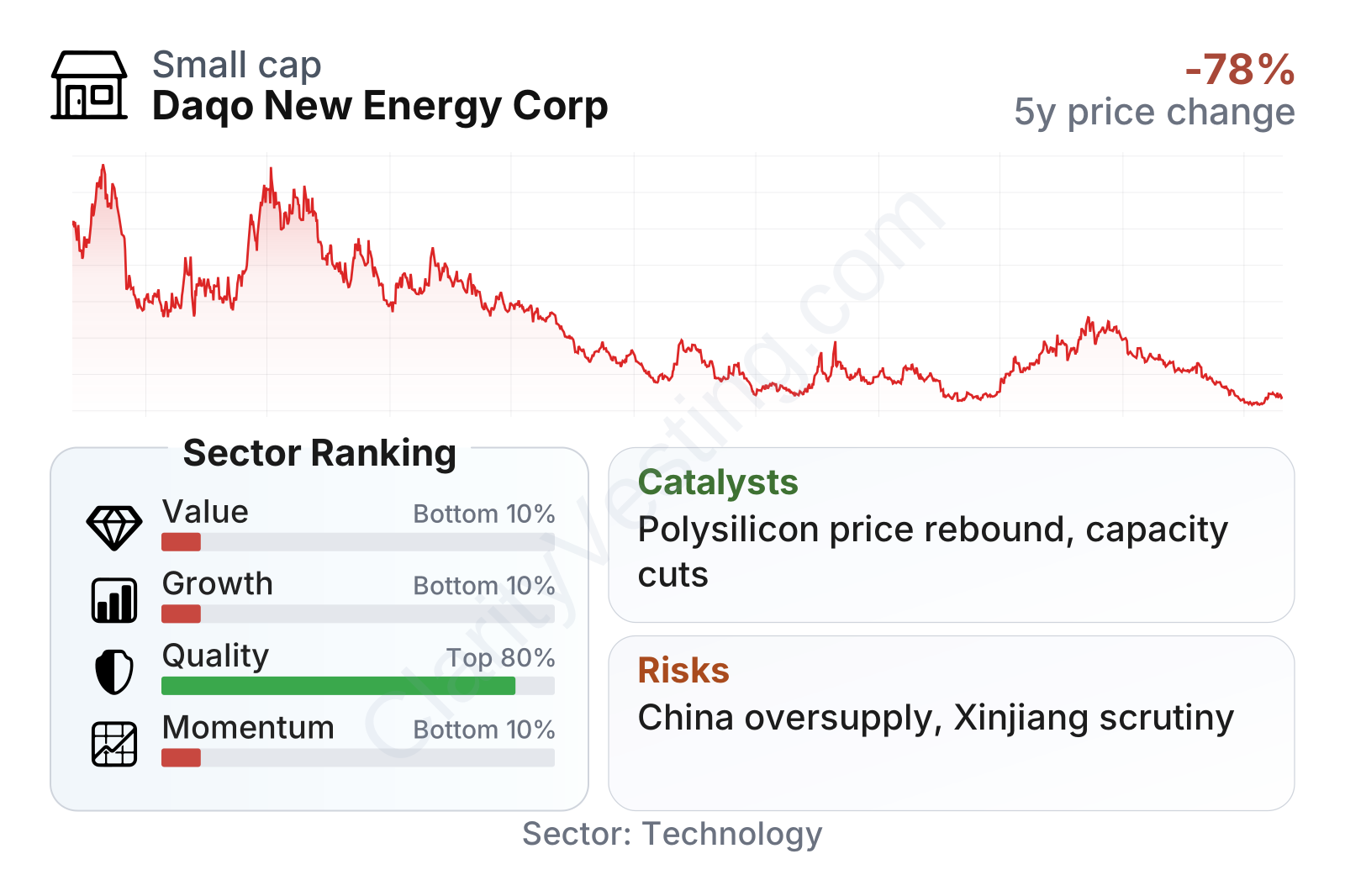
Daqo is now a relatively small public company by market value and its recent factor profile is weak overall. Value, growth, and momentum rank near the bottom of the broader technology sector, while balance-sheet quality remains much better than average. That combination usually points to a company under heavy earnings pressure rather than one facing a debt crisis. The share price history also reflects that pattern: after peaking during the solar upcycle, the stock has fallen sharply as profitability reversed.
Growth
The long-term industry backdrop is still attractive. Solar power remains one of the world’s most important sources of new electricity generation, and demand for solar installations continues to expand across China, the United States, Europe, the Middle East, and emerging markets. That supports long-run need for upstream materials such as polysilicon. In that sense, Daqo operates in a sector with real structural growth.
The problem is that long-term demand growth does not automatically translate into near-term growth for a polysilicon producer. This part of the solar chain has gone through a severe oversupply phase, especially in China, where many manufacturers expanded aggressively. As a result, Daqo’s recent results have been shaped more by pricing pressure than by end-market demand.
Revenue growth has been deeply volatile. After explosive expansion during the peak pricing period in 2021 and 2022, sales then contracted sharply for several consecutive quarters. There was a brief stabilization later on, but the broader picture is still one of a company trying to work through an industry downturn rather than one enjoying smooth expansion.
Daqo’s strategy for future growth is still logical in industrial terms. Management has focused on scale, production efficiency, and high-purity output, which are the right levers in a commodity-like materials business. If weaker producers reduce output and industry supply becomes more rational, low-cost and operationally disciplined manufacturers can regain profitability faster than higher-cost rivals.
Cash generation, however, shows how demanding this phase has become. Free cash flow was very strong at the top of the cycle, then turned negative as prices dropped and profitability deteriorated. The recent improvement from the worst point is encouraging, but the company is still not back to self-funding strength on a sustained basis.
A meaningful catalyst would be any durable recovery in polysilicon pricing, especially if it comes from capacity cuts across the Chinese solar materials industry. Another important opportunity is Daqo’s ability to preserve production discipline and maintain cost competitiveness while the market resets. Recent company communications have also emphasized cash preservation, operational efficiency, and selective capital spending, which is consistent with surviving the downturn and being positioned for a later rebound.
Risks
This article is for informational purposes only and does not constitute financial advice. Some content is AI-generated. See Disclaimer


