Stock Analysis · Amdocs Ltd (DOX)
Overview
Amdocs Ltd is a software and services company focused mainly on communications providers such as telecom and cable operators. Its products help large service providers run essential business functions: billing customers, managing subscriptions, handling customer care, operating networks, launching digital services, and increasingly automating work with cloud and artificial intelligence tools. In simple terms, Amdocs sells the systems that help telecom companies charge correctly, serve customers, and modernize old technology.
The business model is largely based on long-term contracts, recurring software and managed-services relationships, and large transformation projects. Amdocs has historically been strongest in telecom, but it has also been expanding its cloud, media, and enterprise-related capabilities through internal development and acquisitions.
Based on company reporting, revenue is primarily organized by customer geography rather than by narrow product line, which limits precision on product-by-product percentages. The clearest reliable split is geographic, while the operating mix can be described more broadly as follows:
- North America: approximately 65% to 70% of revenue in recent years. This is the company’s largest market and includes major telecom and cable customers in the United States and Canada.
- Europe: approximately 15% to 20% of revenue. This includes software, services, and modernization work for European communications providers.
- Rest of the world: approximately 15% to 20% of revenue, including Asia-Pacific, Latin America, and other international markets.
From an operating perspective, Amdocs generates most of its revenue from a mix of software licenses and subscriptions, implementation projects, testing and integration, and managed services. The common theme is that customers depend on Amdocs for mission-critical systems, which tends to support sticky relationships and repeat business.
The financial profile shows a company with solid gross profit generation and steady operating profitability, even though revenue growth has been modest. Over the last several years, costs and expenses have been managed with reasonable discipline, and free cash flow remains an important strength.
The revenue base rose from a little above $4.2 billion to just over $5.0 billion before falling back to roughly $4.5 billion in the latest annual view shown here, while operating income and net income held up relatively well. That suggests a business with meaningful resilience, but not one currently delivering smooth expansion.
Key Figures
| Metric | Value | Sector ⓘ |
|---|---|---|
| Date | Sep 12, 2026 | |
| Context | ||
| Sector | Technology | |
| Industry | Software - Infrastructure | |
| Market Cap ⓘ | $6.41B | |
| Beta ⓘ | 0.43 | |
Value (Cheapness) | ||
| P/E Ratio ⓘ | 14.59 | 29.51 |
| FCF Yield ⓘ | 9.96% | 4.25% |
| EBIT / EV ⓘ | 8.96% | 2.85% |
| PEG ⓘ | 0.80 | |
Growth (Business expansion) | ||
| Revenue Growth ⓘ | 2.70% | 15.40% |
| RPS Growth (5Y CAGR) ⓘ | 4.89% | 8.56% |
| EPS Growth (5Y CAGR) ⓘ | -0.15% | -11.88% |
| Margin Growth (5Y Trend) ⓘ | -3.34% | 0.46% |
| FCF Growth (5Y CAGR) ⓘ | -2.55% | 9.80% |
Quality (Business durability) | ||
| ROIC (Latest) ⓘ | 11.92% | 9.44% |
| ROIC (5Y Median) ⓘ | 13.51% | 8.30% |
| Net Debt / EBIT (Latest) ⓘ | 1.38 | 0.54 |
| Net Debt / EBIT (5Y Median) ⓘ | 0.44 | 0.44 |
| Operating Margin (Latest) ⓘ | 13.71% | 9.58% |
| Operating Margin (5Y Median) ⓘ | 14.54% | 8.25% |
| Debt to Equity (Latest) ⓘ | 33.07% | 33.33% |
| Profit Margin (Latest) ⓘ | 9.75% | 7.14% |
| Free Cash Flow (Latest) ⓘ | $638.84M | |
Momentum (Price trend) | ||
| 3Y Return ⓘ | -23.61% | +45.48% |
| 12M Return (excl. last month) ⓘ | -31.53% | +23.48% |
| 6M Return ⓘ | -6.37% | +20.93% |
| Price vs. 200-Day MA ⓘ | -5.67% | +7.43% |
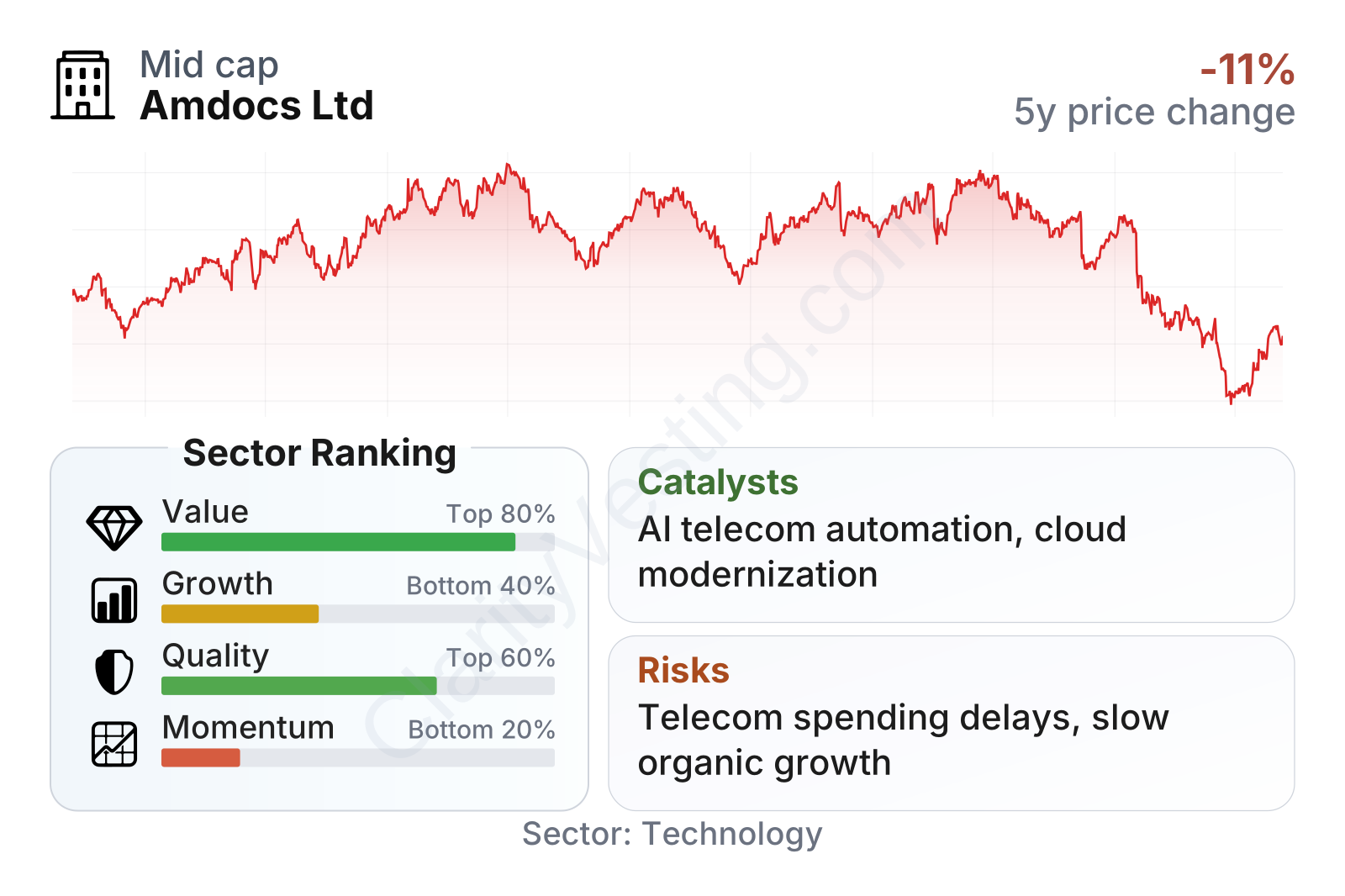
Amdocs stands out more for business quality and cash generation than for speed. Profitability is comfortably above the sector median, return on invested capital is healthy, and free cash flow yield is notably strong. By contrast, growth metrics rank weaker versus the broader technology sector, and the stock’s recent price performance has been among the softer names in its peer group. The low beta also points to a stock that has historically moved less than the broader market.
The stock chart reflects that mixed picture. After reaching much higher levels in 2023 and late 2024, the shares moved lower into 2026. That decline matters because the underlying business has remained profitable; the market appears to be reacting more to slower growth and execution concerns than to a collapse in the company’s financial base.
Growth
Amdocs operates in a sector that still has long-term demand drivers. Telecom and media companies continue to modernize legacy software, move workloads to the cloud, automate customer service, prepare networks for more data-intensive usage, and use AI tools to improve operations. Those trends support ongoing demand for vendors that can handle large-scale, complex migrations without disrupting customer billing or network processes. That is exactly the type of work Amdocs specializes in.
Its strategy is logical for that environment. Rather than chasing consumer-facing technology trends, Amdocs focuses on deeply embedded systems where switching costs are high and operational risk for customers is significant. This can make growth slower than in fast-moving software niches, but it can also create durable relationships and recurring revenue.
The challenge is that recent growth has been uneven. Revenue growth was solid in 2022 and 2023, slowed sharply in 2024, turned negative for several quarters, and then returned to low single-digit positive territory by early 2026. That pattern suggests the company is still participating in an attractive modernization market, but not capturing that demand in a consistently accelerating way.
Cash generation has been steadier than revenue. Free cash flow has generally trended upward over the last few years and recently reached its strongest level in this series, near $680 million on a trailing twelve-month basis. For a company of Amdocs’s size, that is meaningful because it provides flexibility for acquisitions, buybacks, dividends, and continued product investment even during slower sales periods.
A current catalyst is the continued buildout of cloud-based and AI-enabled telecom operations. Amdocs has been positioning around generative AI, service orchestration, customer experience tools, and network automation. If telecom operators move from pilot projects toward broader deployments, Amdocs could benefit because it already sits inside many customers’ core systems. Another important opportunity is vendor consolidation: service providers often prefer fewer strategic technology partners, which can favor established incumbents with a broad product suite.
Risks
This article is for informational purposes only and does not constitute financial advice. Some content is AI-generated. See Disclaimer