Stock Analysis · Dover Corporation (DOV)
Overview
Dover Corporation is a diversified industrial manufacturer. In simple terms, it owns a collection of businesses that make specialized equipment, components, software, and engineered products used in factories, vehicle repair, clean fuel handling, biopharma production, printing, packaging, refrigeration, and other industrial activities. The group is not built around one single product. Instead, it operates through several niche markets where reliability, service networks, and long customer relationships matter.
Dover’s revenue base is spread across five reporting segments. Based on its recent annual reporting structure, the business mix is approximately the following:
- Clean Energy & Fueling: about 29% of revenue. This segment includes fueling equipment, payment systems, software, and components tied to retail fueling, fleet fueling, and parts of the clean energy transition.
- Engineered Products: about 25% of revenue. This area includes vehicle service equipment, winches, industrial automation components, and other engineered systems sold into transportation and industrial end markets.
- Pumps & Process Solutions: about 18% of revenue. It sells pumps, connectors, precision components, and handling solutions used in sectors such as polymers, hygiene, food, industrial processing, and life sciences.
- Imaging & Identification: about 16% of revenue. This business provides marking, coding, digital printing, traceability, and product identification systems used in packaging and manufacturing.
- Climate & Sustainability Technologies: about 12% of revenue. This includes heat exchangers and refrigeration-related products used in commercial and industrial cooling applications.
The company’s business mix gives it exposure to recurring aftermarket demand, consumables, software, and service revenue, not just one-time equipment sales. That tends to make results more resilient than a pure heavy-machinery manufacturer. Over the last several years, revenue has stayed around the upper-single-digit billions, while profitability has generally remained solid, showing that the portfolio is broad enough to absorb weakness in one end market when another is stronger.
The operating picture shows a company with fairly stable gross profit generation and a disciplined cost structure. Revenue has moved up and down with portfolio changes and market conditions, but operating income has remained relatively strong, which supports the view that Dover’s niche positioning and pricing discipline matter more than raw scale alone.
Key Figures
| Metric | Value | Sector ⓘ |
|---|---|---|
| Date | Oct 31, 2026 | |
| Context | ||
| Sector | Industrials | |
| Industry | Specialty Industrial Machinery | |
| Market Cap ⓘ | $27.42B | |
| Beta ⓘ | 1.13 | |
Value (Cheapness) | ||
| P/E Ratio ⓘ | 24.06 | 21.91 |
| P/B Ratio ⓘ | 3.67 | 1.97 |
| FCF Yield ⓘ | 4.33% | 6.34% |
| Dividend Yield ⓘ | 1.03% | 1.88% |
| EBIT / EV ⓘ | 5.40% | 4.83% |
| PEG ⓘ | 1.48 | |
Growth (Business expansion) | ||
| Revenue Growth ⓘ | 7.50% | 9.50% |
| RPS Growth (5Y CAGR) ⓘ | 1.88% | 7.67% |
| EPS Growth (5Y CAGR) ⓘ | -1.81% | -11.63% |
| BVPS Growth (5Y CAGR) ⓘ | 16.79% | 6.14% |
| Margin Growth (5Y Trend) ⓘ | -0.72% | 0.71% |
| FCF Growth (5Y CAGR) ⓘ | 4.30% | 11.01% |
| DPS Growth (5Y CAGR) ⓘ | 0.94% | 9.31% |
Quality (Business durability) | ||
| ROIC (Latest) ⓘ | 11.39% | 10.70% |
| ROA (Latest) ⓘ | 8.61% | 5.45% |
| ROIC (5Y Median) ⓘ | 18.57% | 9.33% |
| ROA (5Y Median) ⓘ | 10.00% | 4.94% |
| Net Debt / EBIT (Latest) ⓘ | 1.02 | 2.03 |
| Net Debt / EBIT (5Y Median) ⓘ | 1.94 | 2.28 |
| Net Debt / EBITDA (Latest) ⓘ | 0.81 | 1.37 |
| Net Debt / Assets ⓘ | 11.49% | 19.16% |
| EBITDA / Interest ⓘ | 16.70 | 9.73 |
| Operating Margin (Latest) ⓘ | 17.94% | 10.49% |
| Operating Margin (5Y Median) ⓘ | 18.34% | 10.30% |
| Debt to Equity (Latest) ⓘ | 42.75% | 65.91% |
| Profit Margin (Latest) ⓘ | 13.60% | 6.61% |
| Free Cash Flow (Latest) ⓘ | $1.19B | |
Momentum (Price trend) | ||
| 3Y Return ⓘ | +67.47% | +69.18% |
| 12M Return (excl. last month) ⓘ | +15.15% | +12.04% |
| 6M Return ⓘ | -6.73% | +0.22% |
| Price vs. 200-Day MA ⓘ | -0.46% | +0.19% |
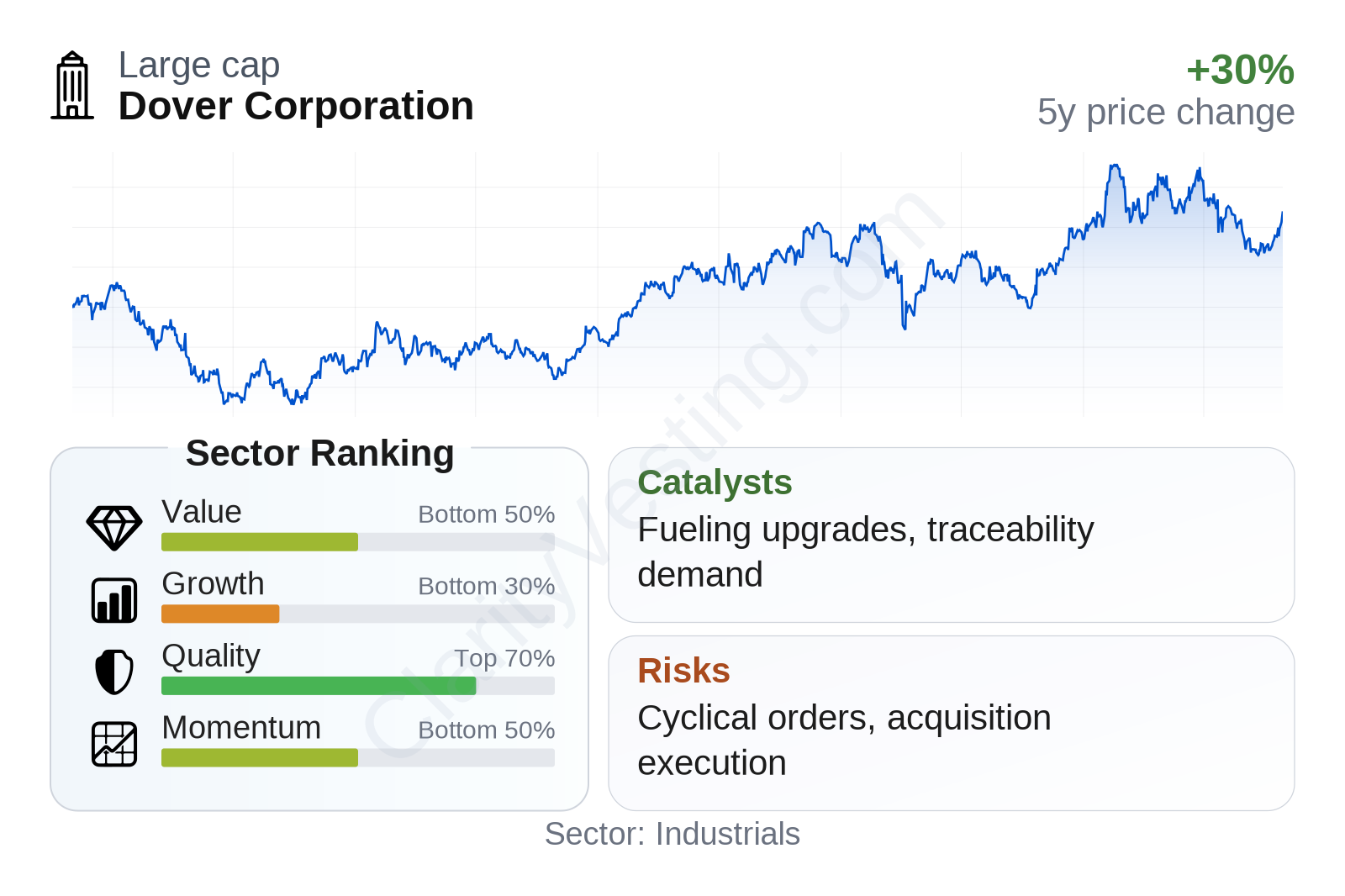
Dover is a large industrial company with moderate share-price volatility. The overall profile is mixed in an understandable way: quality measures are clearly stronger than the sector median, while growth measures are less impressive. Profitability, returns on capital, and balance-sheet leverage look healthy for an industrial manufacturer. By contrast, income yield and free-cash-flow yield are not especially high, and the valuation sits around the middle of the sector rather than at a discount. This combination points to a business that the market already recognizes as dependable, even if it is not being valued like a fast grower.
Growth
Dover operates in several markets with decent long-term support: fuel handling modernization, industrial automation, product traceability, biopharma processing, thermal management, and refrigeration efficiency. Not all of these are high-growth markets every year, but many benefit from durable themes such as stricter regulation, automation needs, energy efficiency, and demand for productivity tools in manufacturing and distribution.
The company’s strategy also makes sense for long-term expansion. Dover has spent years reshaping its portfolio toward more specialized businesses with stronger margins and more recurring revenue. That matters because niche industrial markets can produce attractive economics when a company has a meaningful installed base, aftermarket sales, and products that are costly for customers to switch away from. The company has also used acquisitions and divestitures to adjust the portfolio rather than trying to grow every segment in the same way.
Recent revenue growth has not been perfectly smooth, which is normal for a diversified industrial group exposed to different customer budgets and cycles. The pattern shows a period of contraction followed by a return to positive year-over-year growth in 2025 and 2026, with recent growth running in the high-single-digit range. That is an encouraging sign because it suggests Dover has moved past a softer period and is again finding support from orders, pricing, or portfolio changes.
Cash generation is an important part of Dover’s growth profile. Free cash flow has recovered strongly after a weaker period, and the latest trailing level is above $1 billion. That gives the company flexibility to fund acquisitions, invest in product development, pay dividends, and reduce debt without overreaching. For a long-term industrial business, this kind of cash conversion often matters more than a single year of headline revenue growth.
A notable catalyst is continued investment in fueling and convenience infrastructure, including equipment upgrades, payment technology, and systems linked to cleaner fuel formats. Another is product identification and traceability, where manufacturers and brand owners increasingly need coding, marking, and serialization tools. In climate-related markets, refrigeration efficiency and thermal-management requirements can also support demand over time. These are not speculative themes; they are tied to practical operating needs for customers.
Recent company communications have also highlighted ongoing portfolio shaping and productivity efforts. For Dover, that is significant because value creation has often come not just from top-line expansion, but from steadily improving the mix of businesses it owns.
Risks
This article is for informational purposes only and does not constitute financial advice. Some content is AI-generated. See Disclaimer