Stock Analysis · DocuSign Inc (DOCU)
Overview
DocuSign is a software company best known for electronic signatures, but its business is broader than signing documents online. It provides tools that help businesses and individuals prepare agreements, send them for signature, verify identity, manage workflows, and store or analyze completed contracts. The company refers to this broader category as intelligent agreement management, which aims to reduce paper-based steps and manual back-office work.
Its revenue is overwhelmingly subscription-based, which is typical for cloud software businesses and usually brings recurring sales. Based on recent annual reporting, the revenue mix is approximately:
- Subscription revenue: about 98% of total revenue. This includes access to eSignature, agreement workflow tools, contract lifecycle and management features, identity verification, analytics, and related cloud services.
- Professional services and other revenue: about 2% of total revenue. This mainly includes implementation, training, and customer support-related services tied to deployments.
From a business model perspective, DocuSign has the attractive economics of a software platform: revenue has kept rising, gross profit remains high, and operating income has turned positive after earlier losses. The main shift over the last few years is that the company is no longer being judged as a hypergrowth business. It is now being judged more on efficiency, customer retention, cross-selling, and how much value it can extract from its installed base.
The cost structure also shows a clear transition. Revenue has continued to expand while operating expenses have grown more slowly, allowing operating profit and net income to move from losses to meaningful profitability. One distortion to keep in mind is that one prior year benefited from an unusually large tax item, so normalized earnings are more informative than that single net income spike.
Key Figures
| Metric | Value | Sector ⓘ |
|---|---|---|
| Date | Sep 12, 2026 | |
| Context | ||
| Sector | Technology | |
| Industry | Software - Application | |
| Market Cap ⓘ | $12.27B | |
| Beta ⓘ | 0.90 | |
Value (Cheapness) | ||
| P/E Ratio ⓘ | 40.03 | 29.51 |
| FCF Yield ⓘ | 9.77% | 4.25% |
| EBIT / EV ⓘ | 3.78% | 2.85% |
| PEG ⓘ | 0.77 | |
Growth (Business expansion) | ||
| Revenue Growth ⓘ | 9.40% | 15.40% |
| RPS Growth (5Y CAGR) ⓘ | 10.08% | 8.56% |
| EPS Growth (5Y CAGR) ⓘ | -9.30% | -11.88% |
| Margin Growth (5Y Trend) ⓘ | 13.29% | 0.46% |
| FCF Growth (5Y CAGR) ⓘ | 24.19% | 9.80% |
Quality (Business durability) | ||
| ROIC (Latest) ⓘ | 17.84% | 9.44% |
| ROIC (5Y Median) ⓘ | 6.43% | 8.30% |
| Net Debt / EBIT (Latest) ⓘ | -0.78 | 0.54 |
| Net Debt / EBIT (5Y Median) ⓘ | -2.10 | 0.44 |
| Operating Margin (Latest) ⓘ | 13.16% | 9.58% |
| Operating Margin (5Y Median) ⓘ | 3.64% | 8.25% |
| Debt to Equity (Latest) ⓘ | 10.65% | 33.33% |
| Profit Margin (Latest) ⓘ | 9.82% | 7.14% |
| Free Cash Flow (Latest) ⓘ | $1.20B | |
Momentum (Price trend) | ||
| 3Y Return ⓘ | +41.49% | +45.48% |
| 12M Return (excl. last month) ⓘ | -14.58% | +23.48% |
| 6M Return ⓘ | +41.24% | +20.93% |
| Price vs. 200-Day MA ⓘ | +22.38% | +7.43% |
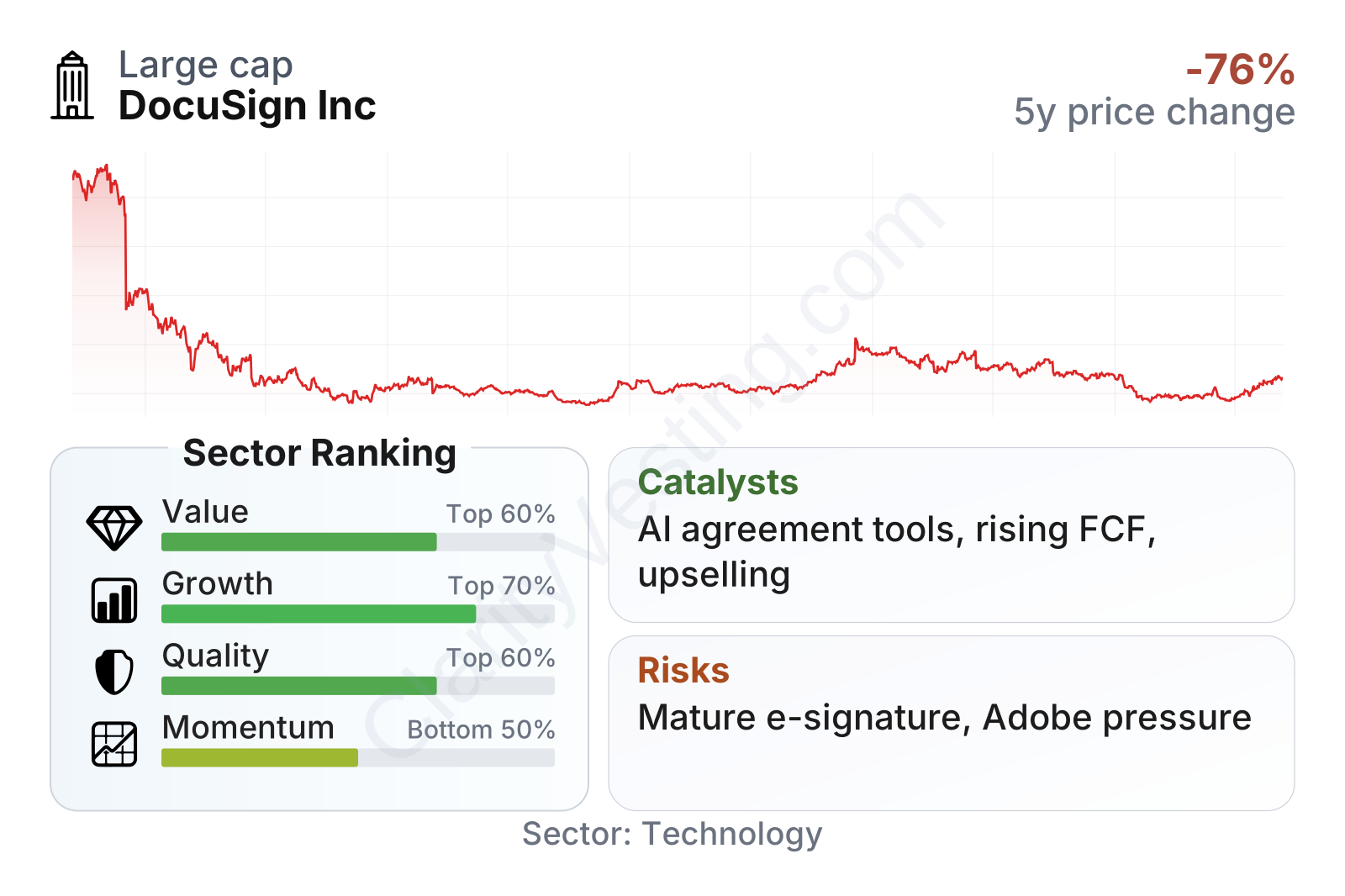
DocuSign stands out as a mid-sized software company with a relatively calm trading profile for tech, reflected in a beta below 1. On fundamentals, the picture is mixed but generally solid: value and quality measures are better than many software peers, helped by strong cash generation, low leverage, and returns on invested capital above the sector median. Growth is no longer exceptional, but multi-year free cash flow expansion and improving margins show that the business has matured in a healthy way. Share-price momentum has been weaker over longer periods, even though shorter-term performance has improved.
Growth
DocuSign operates in digital agreements, e-signature, workflow automation, and contract management, all of which sit inside the broader move toward paperless, cloud-based business operations. That is still a growing area over the long run because companies continue to replace manual approval processes, connect more workflows across departments, and look for ways to reduce friction in sales, procurement, HR, legal, and compliance tasks.
The challenge is that this market is more mature than it was during the pandemic surge, when adoption accelerated rapidly. That is visible in DocuSign’s revenue pattern: yearly growth has slowed from more than 40% at its peak to roughly high-single-digit to low-double-digit territory more recently.
This slower pace does not necessarily signal a broken business. In DocuSign’s case, it reflects a company moving from early land-grab expansion into a steadier phase where upselling, larger customers, international expansion, and broader platform adoption matter more than first-time e-signature adoption alone. Its current strategy makes sense in that context: deepen customer use cases rather than rely only on adding new basic eSignature seats.
One of the clearest positive signals is cash generation. Free cash flow has climbed strongly over the last several years, showing that the company has become much more efficient while still expanding revenue.
That matters because it gives DocuSign flexibility. A business producing more than $1 billion in trailing free cash flow can invest in product development, pursue AI features, support go-to-market efforts, and still maintain a conservative balance sheet. The company has been positioning its Intelligent Agreement Management platform as the next layer above simple e-signature, which could raise spending per customer if adoption broadens beyond legal and sales teams into enterprise-wide workflows.
A notable recent opportunity is the company’s push to embed artificial intelligence into agreement creation, review, and insight extraction. If customers view contracts not just as documents to sign but as data assets that can be searched, summarized, monitored, and connected to workflow systems, DocuSign’s addressable market becomes larger than e-signature alone. That does not guarantee faster growth immediately, but it creates a credible path to expand average contract value over time.
Risks
This article is for informational purposes only and does not constitute financial advice. Some content is AI-generated. See Disclaimer


