Stock Analysis · DigitalOcean Holdings Inc (DOCN)
Overview
DigitalOcean Holdings Inc. is a cloud infrastructure company focused on developers, startups, and small to midsize businesses. In simple terms, it rents out computing power, storage, networking, and software tools that let customers build websites, run applications, store data, and manage online services without owning their own servers. Its positioning is different from the biggest cloud platforms: rather than trying to serve every type of enterprise workload, DigitalOcean emphasizes ease of use, predictable pricing, and products designed for smaller teams with limited technical resources.
The business is largely subscription-like and usage-based. Customers typically pay monthly for cloud resources they consume. Based on company filings and product disclosures, revenue is concentrated in infrastructure and platform services, with smaller contributions from newer software offerings and support-related services.
- Cloud infrastructure services: approximately 80% to 90% of revenue. This includes compute instances, storage, bandwidth, networking, and core hosting services that form the backbone of the platform.
- Platform and managed services: approximately 10% to 20% of revenue. This includes managed databases, Kubernetes, application platform tools, and other higher-level services that help customers deploy and operate software more easily.
- Marketplace, support, and other services: low single-digit share when separated. This area includes add-on software, support offerings, and related cloud tools.
One important feature of DigitalOcean’s model is customer diversification. The company does not depend on a handful of giant corporate clients in the same way some enterprise software firms do. That can reduce customer concentration risk, although it also means growth depends on attracting and expanding many smaller accounts over time.
The broader financial picture has improved noticeably in recent years. Revenue has continued to rise, while profitability and operating income have moved from losses to meaningful positive levels. Gross profit has expanded steadily, and operating expenses have grown much more slowly than revenue, showing better cost discipline as the platform scales.
The operating model looks stronger than it did a few years ago: sales have increased consistently, gross profit has widened, and the company has turned a once loss-making structure into a business with solid operating leverage. That said, interest expense and infrastructure spending still matter, so the quality of that profitability remains an important point to watch.
Key Figures
| Metric | Value | Sector ⓘ |
|---|---|---|
| Date | Sep 12, 2026 | |
| Context | ||
| Sector | Technology | |
| Industry | Software - Infrastructure | |
| Market Cap ⓘ | $15.41B | |
| Beta ⓘ | 1.57 | |
Value (Cheapness) | ||
| P/E Ratio ⓘ | 60.11 | 29.51 |
| FCF Yield ⓘ | 0.10% | 4.25% |
| EBIT / EV ⓘ | 1.45% | 2.85% |
| PEG ⓘ | 1.54 | |
Growth (Business expansion) | ||
| Revenue Growth ⓘ | 28.60% | 15.40% |
| RPS Growth (5Y CAGR) ⓘ | 20.96% | 8.56% |
| EPS Growth (5Y CAGR) ⓘ | -5.61% | -11.88% |
| Margin Growth (5Y Trend) ⓘ | 28.29% | 0.46% |
| FCF Growth (5Y CAGR) ⓘ | 14.37% | 9.80% |
Quality (Business durability) | ||
| ROIC (Latest) ⓘ | 18.41% | 9.44% |
| ROIC (5Y Median) ⓘ | 1.93% | 8.30% |
| Net Debt / EBIT (Latest) ⓘ | 0.74 | 0.54 |
| Net Debt / EBIT (5Y Median) ⓘ | 11.86 | 0.44 |
| Operating Margin (Latest) ⓘ | 22.40% | 9.58% |
| Operating Margin (5Y Median) ⓘ | 5.16% | 8.25% |
| Debt to Equity (Latest) ⓘ | 161.03% | 33.33% |
| Profit Margin (Latest) ⓘ | 23.27% | 7.14% |
| Free Cash Flow (Latest) ⓘ | $14.88M | |
Momentum (Price trend) | ||
| 3Y Return ⓘ | +394.77% | +45.48% |
| 12M Return (excl. last month) ⓘ | +343.83% | +23.48% |
| 6M Return ⓘ | +85.67% | +20.93% |
| Price vs. 200-Day MA ⓘ | +24.45% | +7.43% |
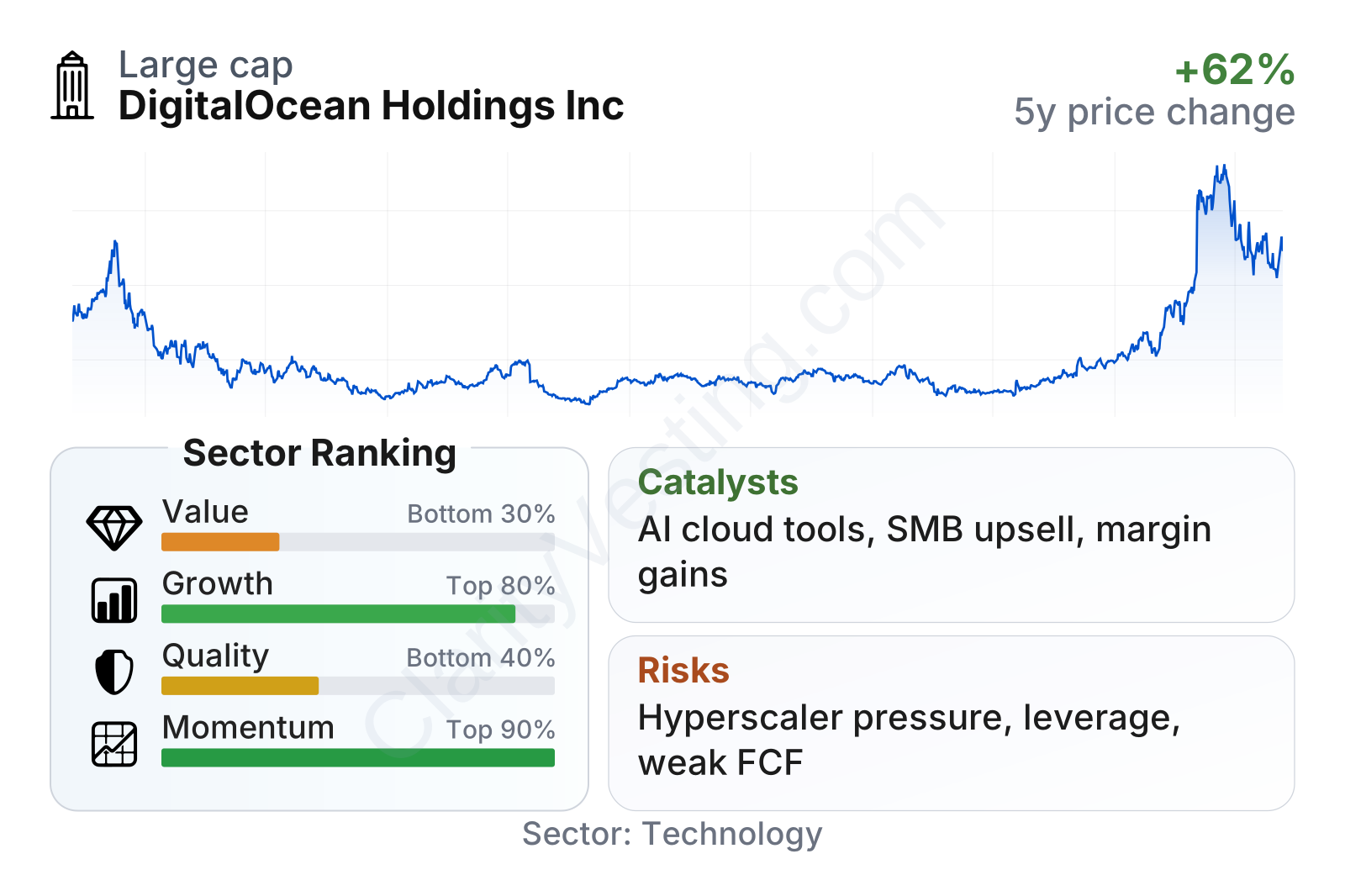
DigitalOcean currently sits in a mixed but interesting position. Growth and share-price momentum rank well versus much of the software infrastructure sector, while valuation metrics appear less favorable. Profitability is stronger than the sector median on margins and recent returns on capital, but leverage remains elevated. In practical terms, this is a company with strong business progress behind it, but one whose market value already reflects a meaningful part of that improvement.
Growth
DigitalOcean operates in a sector with durable long-term demand. Businesses of all sizes continue shifting workloads to the cloud, and many newer companies prefer outsourced infrastructure from day one. That structural trend is not new, but it remains powerful because software adoption, artificial intelligence tools, online commerce, and digital services all require computing resources. DigitalOcean’s niche within that market is especially relevant for smaller organizations that want simpler products and clearer pricing than what they may find at the largest cloud vendors.
The company’s strategy is logical for future expansion. Rather than competing head-on for the most complex global enterprise contracts, DigitalOcean focuses on accessibility, self-service onboarding, and a product stack that helps customers start small and spend more as their needs grow. That can support both new customer additions and higher revenue per customer over time. Its acquisitions in recent years, particularly in managed hosting and cloud monitoring, also broadened the platform beyond basic infrastructure.
Revenue growth slowed materially in 2023 and 2024 compared with the earlier post-IPO period, but the more recent trend points to reacceleration. The latest year-over-year pace is well above the sector median, suggesting that demand has improved after a softer stretch. For a company of DigitalOcean’s size, that matters because it signals that the business may be moving from a digestion period back into a stronger expansion phase.
Free cash flow has been more uneven. Over a multi-year period it improved significantly, which supports the idea that the business can generate cash as it scales. More recently, however, trailing free cash flow has dropped sharply from prior highs. That does not automatically mean the model is broken; cloud businesses can see cash flow swings from infrastructure investment, working capital movements, and product expansion. Still, it does mean the quality and durability of cash generation deserves close attention.
A meaningful catalyst is the rise of AI-related workloads among smaller businesses and developers. DigitalOcean has been positioning itself around simpler cloud solutions for building and deploying AI applications, including GPU-related offerings and developer-oriented tools. The opportunity is not on the same scale as hyperscale cloud leaders, but DigitalOcean does not need to dominate the market to benefit. If it becomes a practical option for startups and smaller teams experimenting with AI, that could support both customer growth and higher spending per account.
Another positive development is the company’s improving margin profile. Operating margin trends over the last five years have strengthened far faster than the sector median, which suggests that scale benefits are increasingly visible. If management can continue balancing product investment with disciplined spending, growth may convert into earnings more efficiently than it did in the past.
Risks
This article is for informational purposes only and does not constitute financial advice. Some content is AI-generated. See Disclaimer


