Stock Analysis · Dunelm Group PLC (DNLMY)
Overview
Dunelm Group PLC is a U.K.-based home furnishings retailer focused on affordable products for the home. Its assortment covers furniture, bedding, curtains, blinds, kitchenware, storage, lighting, decoration, and seasonal items. In simple terms, Dunelm sells many of the practical and decorative products people buy when moving, refreshing, or upgrading their homes.
The business is centered on the U.K. market and combines a large store network with digital sales. That matters because customers often want to browse visually online, but also like to touch fabrics, compare colors, or collect bulky items in person. Dunelm’s operating model is built around that blend of stores, website, and click-and-collect convenience.
Revenue mainly comes from merchandise sales rather than from financial services or international diversification. Based on the company’s reporting and business model, the broad revenue mix can be understood as follows:
- Homewares and soft furnishings: the largest share, including bedding, curtains, blinds, cushions, and decorative products.
- Furniture and larger home items: an important secondary contributor, including tables, chairs, storage, and selected larger furnishings.
- Kitchen, dining, and smaller accessories: a meaningful but smaller share, driven by repeat purchases and gifting.
- Delivery and other ancillary income: a relatively small contribution.
Dunelm does not usually present revenue in a highly granular public breakdown by product family, but geographically the group is overwhelmingly tied to the U.K. consumer. Financially, the business has shown a useful pattern for a retailer: sales have moved upward over the last several years, while gross profit has also expanded, suggesting that growth has not depended only on deep discounting.
The long-term picture shows a retailer that has grown revenue steadily from roughly £1.3 billion to about £1.8 billion over the last five fiscal years, while operating profit has remained solid. Gross profit has increased faster than cost of goods in that period, which points to decent merchandising discipline and pricing resilience.
Key Figures
| Metric | Value | Sector ⓘ |
|---|---|---|
| Date | Sep 12, 2026 | |
| Context | ||
| Sector | Consumer Cyclical | |
| Industry | Specialty Retail | |
| Market Cap ⓘ | $2.07B | |
| Beta ⓘ | 0.97 | |
Value (Cheapness) | ||
| P/E Ratio ⓘ | 9.86 | 17.10 |
| FCF Yield ⓘ | 22.06% | 8.53% |
| EBIT / EV ⓘ | N/A | 6.46% |
| PEG ⓘ | 1.93 | |
Growth (Business expansion) | ||
| Revenue Growth ⓘ | 2.50% | 5.75% |
| RPS Growth (5Y CAGR) ⓘ | 3.86% | 9.14% |
| EPS Growth (5Y CAGR) ⓘ | -6.47% | -18.21% |
| Margin Growth (5Y Trend) ⓘ | -1.84% | -0.23% |
| FCF Growth (5Y CAGR) ⓘ | 0.67% | 4.91% |
Quality (Business durability) | ||
| ROIC (Latest) ⓘ | 146.18% | 12.61% |
| ROIC (5Y Median) ⓘ | 70.51% | 10.72% |
| Net Debt / EBIT (Latest) ⓘ | 0.81 | 2.10 |
| Net Debt / EBIT (5Y Median) ⓘ | 1.45 | 2.32 |
| Operating Margin (Latest) ⓘ | 12.22% | 9.25% |
| Operating Margin (5Y Median) ⓘ | 12.50% | 9.64% |
| Debt to Equity (Latest) ⓘ | 258.52% | 75.78% |
| Profit Margin (Latest) ⓘ | 8.52% | 5.33% |
| Free Cash Flow (Latest) ⓘ | $455.81M | |
Momentum (Price trend) | ||
| 3Y Return ⓘ | -11.43% | +14.53% |
| 12M Return (excl. last month) ⓘ | -22.54% | +3.08% |
| 6M Return ⓘ | -6.44% | +0.55% |
| Price vs. 200-Day MA ⓘ | -11.73% | -0.54% |
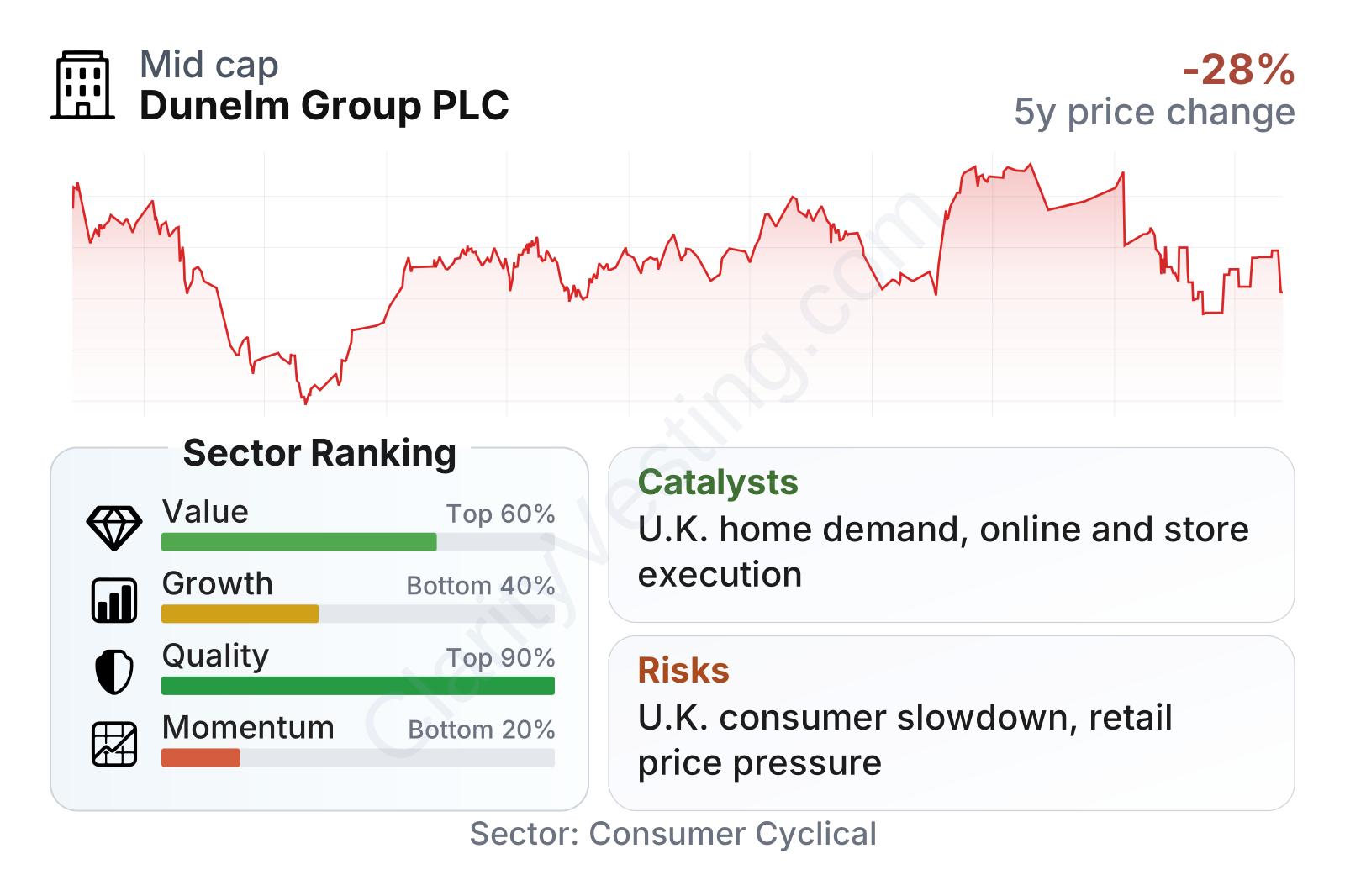
Dunelm’s current profile looks unusual in a good way on operating quality and cash generation, but much less impressive in market sentiment. Profitability metrics sit well above many specialty retail peers, and free cash flow generation is notably strong relative to its market value. Growth is positive rather than spectacular, which fits the picture of a mature but still advancing retailer. At the same time, recent share-price momentum has been weak, meaning the market has become more cautious even though the underlying business still appears operationally sound.
With a market capitalization around $2.2 billion and a beta close to 1, Dunelm is not behaving like an extreme high-volatility stock. The bigger takeaway is that its financial quality appears materially stronger than its stock performance over the past year.
Growth
Dunelm operates in a sector that is mature rather than structurally explosive. Home furnishings demand is tied to housing activity, moving trends, consumer confidence, and disposable income. That means the company is not in a fast-scaling technology niche, but it does participate in a large, recurring category where people continue to spend on comfort, renovation, and home personalization. Since the pandemic, the home has remained a priority spending area for many households, even if demand now fluctuates more with the economic cycle.
Dunelm’s strategy makes sense for this environment. It focuses on value, broad product choice, and an omnichannel model that links stores with online ordering and collection. That is practical in home retail, where baskets can include both low-cost accessories and bulky items. The group has also emphasized own-brand ranges, sourcing discipline, and digital improvements, which can support margins as well as customer retention.
Recent top-line growth has been modest rather than rapid, with revenue growth running below the broader sector median. Even so, the longer view is more encouraging: revenue has risen consistently over several years, and revenue per share has compounded at a respectable pace. This looks more like a steady compounding retailer than a business chasing aggressive expansion.
Cash generation is an important part of the growth case. Free cash flow has remained strong in absolute terms, even with some year-to-year fluctuations. Over a multi-year period, free cash flow has grown faster than the sector median, which suggests that Dunelm is not merely growing sales, but translating a meaningful portion of them into cash. That gives the company flexibility for dividends, inventory investment, technology upgrades, and selective expansion.
As for catalysts, the most visible ones are operational rather than transformational. Continued online execution, better use of stores as fulfillment points, improved product mix, and any recovery in U.K. consumer spending could all lift performance. A healthier housing market or more confidence-driven spending on home upgrades would also be supportive. In recent company updates, Dunelm has continued to present itself as a retailer gaining through value positioning and customer convenience, which is particularly relevant when household budgets remain under pressure.
Risks
This article is for informational purposes only and does not constitute financial advice. Some content is AI-generated. See Disclaimer


