Stock Analysis · Domino'S Pizza Enterprises Ltd (DMZPY)
Overview
Domino’s Pizza Enterprises Ltd is the master franchise operator for the Domino’s brand across a large group of markets in the Asia-Pacific and Europe region. It runs and supports pizza delivery and carryout stores, sells food and supplies to franchisees, operates some company-owned locations, and invests heavily in digital ordering, delivery logistics, and marketing. In simple terms, it is not just a pizza seller at the store level; it is also a brand operator, supply-chain business, and franchise system manager.
The business model matters for long-term analysis because franchise-led restaurant groups can scale efficiently when store networks expand and when franchisees remain healthy. Domino’s Pizza Enterprises has historically relied on store growth, same-store sales, and supply-chain revenue tied to the wider network of restaurants it serves.
Its revenue mix is not disclosed in a way that always maps neatly into a few universal categories for every market, but the business is broadly driven by the following sources, ranked from largest to smallest on an approximate basis:
- Food, ingredients, and supply-chain sales to stores: likely the largest contributor, often the majority of group revenue.
- Sales from company-operated stores: a meaningful but smaller share than supply-chain revenue.
- Franchise fees and royalties: usually a smaller share of reported revenue, but often important for profitability.
- Other revenue: including technology-related, service, and support income where applicable.
The overall financial flow shows a business that still produces large gross profit dollars, but more of that value has recently been absorbed by operating costs, interest expense, and weaker bottom-line conversion. That pattern helps explain why the company can still generate notable cash flow while reported earnings and market sentiment have come under pressure.
Key Figures
| Metric | Value | Sector ⓘ |
|---|---|---|
| Date | Sep 12, 2026 | |
| Context | ||
| Sector | Consumer Cyclical | |
| Industry | Restaurants | |
| Market Cap ⓘ | $1.18B | |
| Beta ⓘ | 1.03 | |
Value (Cheapness) | ||
| P/E Ratio ⓘ | 29.52 | 17.10 |
| FCF Yield ⓘ | 26.65% | 8.53% |
| EBIT / EV ⓘ | 9.87% | 6.46% |
| PEG ⓘ | N/A | |
Growth (Business expansion) | ||
| Revenue Growth ⓘ | -17.10% | 5.75% |
| RPS Growth (5Y CAGR) ⓘ | -4.62% | 9.14% |
| EPS Growth (5Y CAGR) ⓘ | 3.16% | -18.21% |
| Margin Growth (5Y Trend) ⓘ | -2.62% | -0.23% |
| FCF Growth (5Y CAGR) ⓘ | -20.55% | 4.91% |
Quality (Business durability) | ||
| ROIC (Latest) ⓘ | N/A | 12.61% |
| ROIC (5Y Median) ⓘ | 8.12% | 10.72% |
| Net Debt / EBIT (Latest) ⓘ | 3.73 | 2.10 |
| Net Debt / EBIT (5Y Median) ⓘ | 9.50 | 2.32 |
| Operating Margin (Latest) ⓘ | 7.10% | 9.25% |
| Operating Margin (5Y Median) ⓘ | 6.62% | 9.64% |
| Debt to Equity (Latest) ⓘ | 245.30% | 75.78% |
| Profit Margin (Latest) ⓘ | -6.56% | 5.33% |
| Free Cash Flow (Latest) ⓘ | $315.63M | |
Momentum (Price trend) | ||
| 3Y Return ⓘ | -57.57% | +14.53% |
| 12M Return (excl. last month) ⓘ | +6.60% | +3.08% |
| 6M Return ⓘ | -10.74% | +0.55% |
| Price vs. 200-Day MA ⓘ | -3.58% | -0.54% |
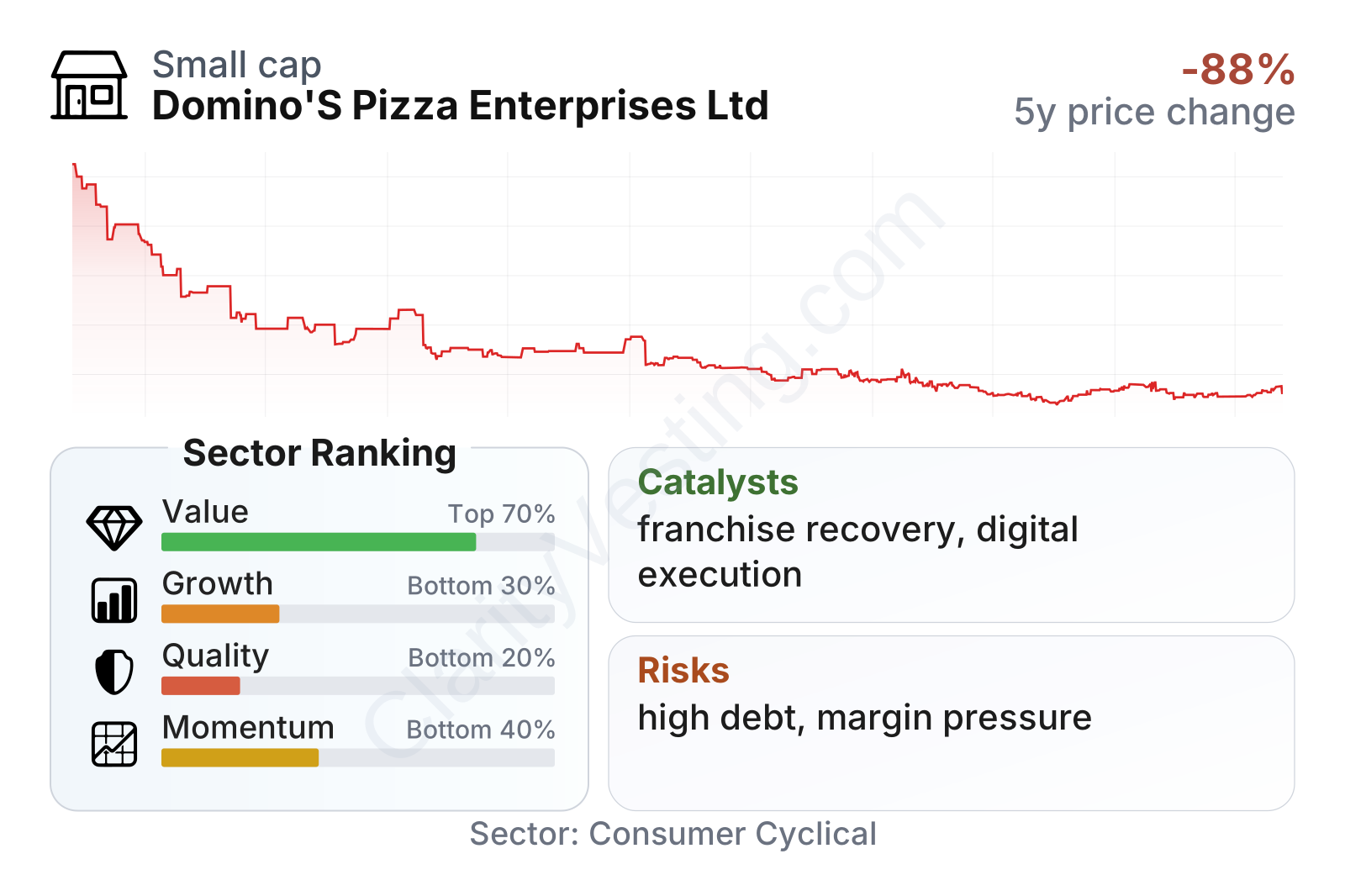
The company sits in an unusual position: market value is now much smaller than it used to be, price momentum has been weak for an extended period, and growth indicators rank poorly versus much of the restaurant sector. At the same time, free cash flow remains comparatively strong, which makes the picture more complex than the share-price decline alone would suggest. In short, the market appears to be discounting weak operating trends and balance-sheet pressure more heavily than cash generation.
Growth
Pizza delivery remains part of a large and durable consumer category, and Domino’s as a global brand still benefits from convenience, digital ordering habits, and a format that can travel across markets more easily than many dine-in concepts. That said, this is no longer a simple high-growth expansion case. The broader quick-service restaurant sector is still active, but competition, value sensitivity, and delivery economics have become tougher, especially when household budgets are under strain.
Domino’s Pizza Enterprises’ long-term strategy still makes sense on paper: grow store count, improve franchisee economics, use technology to simplify ordering and operations, and capture more demand through delivery and carryout. These are sensible levers for a scaled pizza operator. The issue is execution. Recent revenue trends have been weak, and the company’s growth profile now ranks near the bottom of its sector on several measures, including year-over-year sales and multi-year free cash flow growth.
The absence of visible top-line momentum is important. A mature franchise system can still be attractive when it compounds steadily, but recent trends point more to stagnation than acceleration. Revenue over the past several years has been uneven, and margin pressure has reduced the benefit of scale.
One encouraging point is that free cash flow remains sizable in absolute terms. That suggests the business still has underlying cash-generating capacity even during a difficult operating period. For long-term analysis, that matters because a company with meaningful cash flow has more room to fund operations, support debt obligations, and potentially reinvest in store systems and technology than a business that is burning cash.
A meaningful catalyst would be a sustained recovery in franchisee profitability and same-store sales across its major regions. If store-level economics improve, the company can benefit in several ways at once: healthier network expansion, stronger royalty streams, and better throughput in its supply chain. Additional support could come from simplification efforts, portfolio changes, or operational improvements in underperforming markets. Recent company updates and annual disclosures have also pointed to continued focus on efficiency, digital tools, and sharpening execution after a period of strain. That does not guarantee renewed growth, but it identifies a realistic path back to better performance.
Risks
This article is for informational purposes only and does not constitute financial advice. Some content is AI-generated. See Disclaimer