Stock Analysis · Delivery Hero SE (DLVHF)
Overview
Delivery Hero SE is a global online food delivery and quick-commerce company. Through its apps and platforms, customers can order meals, groceries, pharmacy items, and other convenience products for delivery. The group operates across Europe, Asia, the Middle East, North Africa, and Latin America, and it has built its business around large local platforms rather than one single global consumer brand. It is also the parent of foodpanda in many Asian markets and has held an important stake in Latin American delivery platform Rappi.
The business model is fairly simple at its core: Delivery Hero connects consumers, restaurants, shops, and riders, then takes a share of the transaction and adds service-related fees. As the company expanded, it moved beyond restaurant takeout into faster delivery of everyday items, which is meant to increase order frequency and make the platform more useful throughout the day.
Its revenue mix is not disclosed in a single simple line item for every operating activity, but based on company reporting the largest sources are broadly the following:
- Commissions and marketplace fees from restaurant and merchant orders — likely the largest contributor, roughly a majority of revenue.
- Own-delivery and service fees — delivery charges and logistics-related fees paid by customers and merchants, a meaningful second layer of revenue.
- Quick-commerce and retail sales — groceries and convenience items sold through dark stores and retail partnerships, increasingly important but usually lower-margin.
- Advertising and other platform services — sponsored listings, marketing services, and smaller ancillary revenues.
Over the last few years, the company has clearly shifted from pure expansion toward improving efficiency. Revenue has grown strongly, while operating losses have narrowed sharply and operating income turned slightly positive in the most recent full year shown. That change matters because Delivery Hero was long viewed as a scale-first company; it is now trying to prove that scale can convert into durable economics.
The long-term pattern is encouraging on the cost side. Revenue has more than doubled since 2021, gross profit expanded substantially, and total operating expenses have become much better controlled relative to sales. The main weak spot is that net income remains negative, held back by financing costs, taxes, and the still-demanding economics of international delivery operations.
Key Figures
| Metric | Value | Sector ⓘ |
|---|---|---|
| Date | Jul 18, 2026 | |
| Context | ||
| Sector | Consumer Cyclical | |
| Industry | Internet Retail | |
| Market Cap ⓘ | $13.24B | |
| Beta ⓘ | 1.86 | |
Value (Cheapness) | ||
| P/E Ratio ⓘ | N/A | 18.58 |
| FCF Yield ⓘ | 3.33% | 7.99% |
| EBIT / EV ⓘ | N/A | 5.91% |
| PEG ⓘ | N/A | |
Growth (Business expansion) | ||
| Revenue Growth ⓘ | 10.10% | 5.50% |
| RPS Growth (5Y CAGR) ⓘ | 18.56% | 9.20% |
| EPS Growth (5Y CAGR) ⓘ | -0.84% | -26.43% |
| Margin Growth (5Y Trend) ⓘ | N/A | -0.18% |
| FCF Growth (5Y CAGR) ⓘ | -32.08% | 5.02% |
Quality (Business durability) | ||
| ROIC (Latest) ⓘ | N/A | 12.03% |
| ROIC (5Y Median) ⓘ | -6.94% | 10.82% |
| Net Debt / EBIT (Latest) ⓘ | 10.68 | 2.12 |
| Net Debt / EBIT (5Y Median) ⓘ | N/A | 2.25 |
| Operating Margin (Latest) ⓘ | 0.98% | 9.28% |
| Operating Margin (5Y Median) ⓘ | -7.12% | 9.64% |
| Debt to Equity (Latest) ⓘ | 282.11% | 75.23% |
| Profit Margin (Latest) ⓘ | -5.57% | 5.28% |
| Free Cash Flow (Latest) ⓘ | $441.58M | |
Momentum (Price trend) | ||
| 3Y Return ⓘ | -1.49% | +10.68% |
| 12M Return (excl. last month) ⓘ | +68.75% | +5.26% |
| 6M Return ⓘ | +54.42% | -2.41% |
| Price vs. 200-Day MA ⓘ | +55.96% | +1.55% |
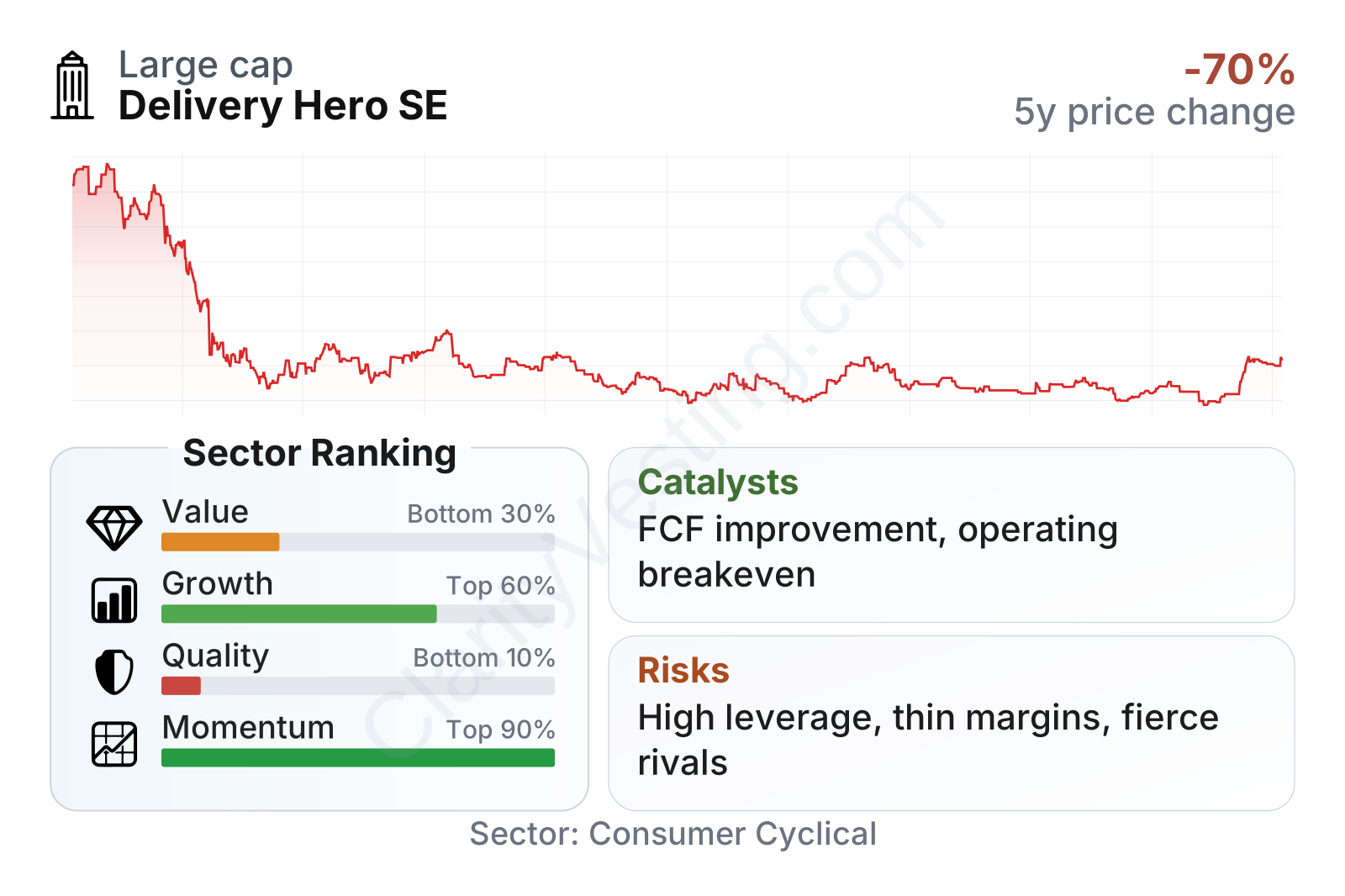
The overall profile is mixed. Delivery Hero shows above-average growth and very strong recent share-price momentum, but weaker quality and valuation metrics versus much of the consumer internet retail group. The company’s recent free cash flow is positive and revenue growth is still ahead of the sector median, yet margins, leverage, and returns on invested capital remain noticeably behind stronger peers. In simple terms, the market appears to be rewarding operational progress, while the underlying financial structure still looks unfinished.
With a market value around $12.5 billion, Delivery Hero is no longer being judged only on expansion potential. The stock’s volatility remains high, reflected by a beta well above 1, which means sentiment can shift quickly when growth, regulation, or profitability expectations change.
Growth
Online food delivery and local commerce remain part of a growing digital convenience market. Consumer behavior has changed structurally: many people now expect restaurants, groceries, and small daily purchases to be available on demand through a phone app. That broad direction still supports Delivery Hero’s business, especially in urban markets where density can improve delivery economics.
Delivery Hero’s strategy also makes sense in principle. It focuses on strong local market positions, logistics capabilities, and platform expansion beyond restaurant meals. That approach gives the company more ways to raise order frequency, cross-sell services, and deepen relationships with merchants. The quick-commerce push has been expensive, but if managed carefully it can make the ecosystem stickier and broaden the addressable market beyond lunch and dinner orders.
Recent growth remains solid rather than explosive. Year-over-year revenue growth is still running above the sector median, and the company’s multi-year revenue-per-share growth is notably stronger than many peers. This suggests Delivery Hero is still expanding its business footprint even after the post-pandemic normalization that hurt many delivery platforms.
Another important development is cash generation. Delivery Hero’s trailing free cash flow has turned positive, which is a meaningful signal for a company that spent years prioritizing expansion over financial discipline. Positive free cash flow does not automatically solve the profitability debate, but it does show that operating improvements are becoming more tangible.
A major catalyst for future growth is execution on margin improvement while keeping order volumes healthy. If the company can continue raising efficiency in delivery logistics, improve take rates, and benefit from advertising and higher-value merchant services, revenue growth does not need to be spectacular for earnings quality to improve. The other potential catalyst is portfolio simplification: disposal of non-core assets, tighter capital allocation, or stronger monetization of strategic holdings could help the market focus more on the core platform economics.
Recent company communications have continued to emphasize adjusted profitability, disciplined cost control, and cash flow progress. That matters because the next phase for Delivery Hero is less about proving demand exists and more about proving that demand can translate into a sustainable earnings model.
Risks
The biggest risk is that delivery is a hard business to make consistently profitable. It requires heavy spending on logistics, technology, incentives, customer service, and promotions, while consumers remain price-sensitive and merchants often resist higher commission rates. Even with scale, the margin structure can remain thin.
Leverage is another clear pressure point. Debt relative to equity is far above the sector median, and net debt relative to EBIT is also elevated. That leaves less room for operational setbacks and makes interest expense more important than it would be for a lower-leverage platform. The company has made progress at the operating line, but the balance sheet still looks stretched compared with stronger internet retail peers.
Profitability is improving, but not yet comfortably established. Operating margin has moved into slightly positive territory, which is an important step, yet net profit margin remains negative and still trails the sector by a wide margin. In practical terms, Delivery Hero has shown it can get closer to breakeven at the core business level, but not that it has fully solved the earnings equation.
Competition is intense and local. In different regions Delivery Hero faces rivals such as DoorDash, Uber Eats, Just Eat Takeaway, Meituan, Deliveroo in selected markets, and various local specialists. The company is a leader in several of its operating geographies, but it is not the undisputed global leader in the way a dominant platform might be. Its competitive advantages come more from local scale, logistics density, merchant relationships, and brand presence in specific markets than from a single unmatched global moat.
That creates a nuanced competitive position. Delivery Hero can be very strong where it has scale and efficient logistics, but weak economics in one region cannot always be offset easily by success elsewhere. The business is also exposed to labor regulation, courier classification debates, consumer spending slowdowns, and execution risk in quick-commerce. These are not abstract issues: even small shifts in fees, wages, or promotional intensity can have an outsized impact on margins.
There is also portfolio complexity. A company operating across many regions and formats can create diversification, but it can also make performance harder to evaluate. Investors need to separate the quality of the core marketplace from the drag or opportunity coming from quick commerce, minority stakes, and country-by-country restructuring decisions.
Valuation
A traditional price-to-earnings approach is not very useful here because earnings are still negative on a net basis, which is why the stock does not show a meaningful P/E history. That alone says something important about valuation: Delivery Hero is still being valued more on operational progress, cash flow direction, and future margin potential than on established bottom-line profits.
On broader measures, the valuation picture looks neither straightforwardly cheap nor clearly aggressive. The stock sits in the weaker part of the sector on value metrics, and its free cash flow yield is below the sector median. That suggests the market is already recognizing some of the turnaround progress, even though the business still carries above-average financial and execution risk.
The current price therefore seems tied to a transition narrative. If Delivery Hero can keep revenue growing at a decent pace while extending operating profitability and protecting free cash flow, today’s valuation can be understood as pricing in further normalization. If margin improvement stalls or competition forces heavier spending again, the valuation has less support because the company does not yet have strong net earnings or high returns on capital to fall back on.
In other words, the shares reflect a business that has moved beyond the most fragile phase, but not yet into the category of a mature, consistently profitable platform. That tends to justify a valuation that is highly sensitive to each step of operational execution.
Conclusion
Delivery Hero today looks more credible than it did a few years ago. Revenue growth remains healthy, free cash flow has turned positive, and operating losses have narrowed dramatically to the point that operating income is now slightly positive. For a company that spent years prioritizing expansion, that is a meaningful shift in quality.
At the same time, the business is not yet fully de-risked. Net profitability is still negative, leverage remains high, and the competitive environment is unforgiving. Delivery platforms can look powerful from the outside because they serve millions of users, but the real test is whether scale converts into durable margins after logistics, incentives, and financing costs. Delivery Hero has improved that equation, yet it has not fully proven it.
The overall picture is that of a large international platform moving from growth-at-all-costs toward operational discipline. That transition gives the company more substance than many weaker delivery peers, but it also leaves little room for disappointment. The valuation context suggests the market is already giving credit for better execution, while still waiting for clearer proof that profitability can become durable rather than temporary.
Sources:
- Delivery Hero SE – Annual Report 2025
- Delivery Hero SE – Investor Relations Presentations and Trading Updates 2026
- Delivery Hero SE – Public Earnings Call Materials hosted on Investor Relations
- Delivery Hero SE – Company Profile and Market Descriptions
- Wikipedia – Delivery Hero
This article is for informational purposes only and does not constitute financial advice. Some content is AI-generated. See Disclaimer