Stock Analysis · Trump Media & Technology Group Corp (DJT)
Overview
Trump Media & Technology Group Corp operates digital media and technology platforms. Its best-known product is Truth Social, a social media network built around user-generated content, engagement, and advertising opportunities. The company has also described a broader ambition to build a media and technology ecosystem that includes streaming and financial-related digital products, but its operating business remains centered on its social platform and related services.
Based on the company’s recent filings, revenue is still very small relative to its public market value, and disclosures do not show a broad, diversified revenue base at this stage. The main sources of revenue appear to be:
- Advertising and platform-related revenue: approximately the large majority of total revenue. This includes ad sales and monetization tied to Truth Social and related digital activity.
- Other revenue: a small residual portion, likely including limited ancillary platform-related income where disclosed.
What stands out most is not the mix itself, but the scale: annual revenue has remained in only the low single-digit millions of dollars in recent years, while operating expenses have been far higher. The business therefore still looks more like an early-stage platform with an audience-building objective than a mature media company with established monetization.
The financial flow also shows a persistent gap between modest revenue and very large operating costs. Research and development plus selling, general, and administrative expense have consumed far more cash than the business currently generates, which explains the company’s recurring losses.
The broad pattern has been consistent: revenue has stayed limited, while operating costs expanded sharply, especially in 2024 and 2025. That means the key question for long-term analysis is not whether the company has a recognizable brand—it does—but whether that brand can eventually support a much larger and more durable commercial engine.
Key Figures
| Metric | Value | Sector ⓘ |
|---|---|---|
| Date | Sep 12, 2026 | |
| Context | ||
| Sector | Communication Services | |
| Industry | Internet Content & Information | |
| Market Cap ⓘ | $2.44B | |
| Beta ⓘ | 4.08 | |
Value (Cheapness) | ||
| P/E Ratio ⓘ | N/A | 18.61 |
| FCF Yield ⓘ | 0.35% | 13.68% |
| EBIT / EV ⓘ | -43.33% | 4.54% |
| PEG ⓘ | N/A | |
Growth (Business expansion) | ||
| Revenue Growth ⓘ | 89.00% | 5.40% |
| RPS Growth (5Y CAGR) ⓘ | N/A | 4.62% |
| EPS Growth (5Y CAGR) ⓘ | N/A | -18.01% |
| Margin Growth (5Y Trend) ⓘ | N/A | 1.10% |
| FCF Growth (5Y CAGR) ⓘ | N/A | 5.88% |
Quality (Business durability) | ||
| ROIC (Latest) ⓘ | -33.56% | 8.38% |
| ROIC (5Y Median) ⓘ | -30.36% | 8.32% |
| Net Debt / EBIT (Latest) ⓘ | N/A | 1.99 |
| Net Debt / EBIT (5Y Median) ⓘ | N/A | 2.94 |
| Operating Margin (Latest) ⓘ | -23864.60% | 14.89% |
| Operating Margin (5Y Median) ⓘ | -6124.96% | 12.96% |
| Debt to Equity (Latest) ⓘ | 0.82% | 59.59% |
| Profit Margin (Latest) ⓘ | N/A | 8.77% |
| Free Cash Flow (Latest) ⓘ | $8.49M | |
Momentum (Price trend) | ||
| 3Y Return ⓘ | -46.31% | +46.64% |
| 12M Return (excl. last month) ⓘ | -52.63% | +2.16% |
| 6M Return ⓘ | -12.88% | +5.05% |
| Price vs. 200-Day MA ⓘ | -14.53% | +2.88% |
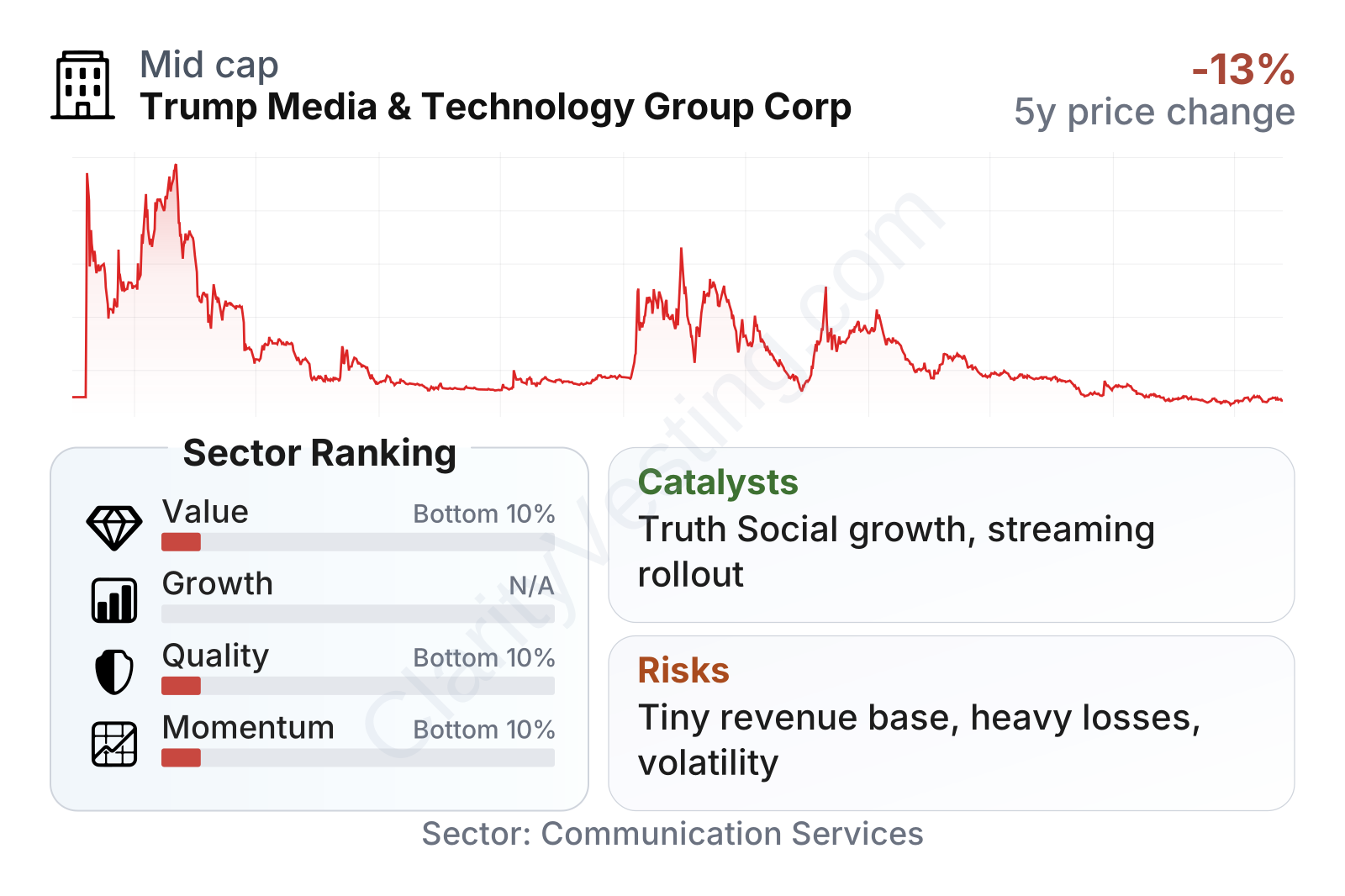
The overall profile is unusual. The company is mid-sized by market value, but its operating fundamentals rank near the bottom of the Communication Services sector on value, quality, and momentum measures. Revenue growth is roughly in line with the sector median recently, yet that comparison is less reassuring than it may sound because the starting revenue base is extremely small. Price volatility is also exceptionally high, with a beta above 4, which signals much larger share-price swings than the broader market.
The stock’s trading history reinforces that point. Since listing-related enthusiasm drove major spikes, the share price has trended sharply downward with repeated bursts of volatility. That pattern suggests market sentiment and news flow have been more influential than business performance.
Growth
Trump Media operates in a sector that can support large long-term winners. Digital advertising, online content distribution, creator ecosystems, and subscription or premium media models are all structurally important parts of the modern communications economy. In that sense, the company is participating in a relevant and potentially scalable market.
The challenge is that being in a growing sector is not the same as capturing growth. The company’s strategy depends heavily on turning brand recognition and political-cultural loyalty into a broader platform ecosystem. That can make strategic sense if management succeeds in deepening user engagement, attracting advertisers that want access to a distinct audience, and launching adjacent products that add monetization beyond social media alone.
Recent revenue growth has stabilized into a modest positive range after a very uneven period.
That stabilization matters, but it does not yet amount to breakout expansion. For a business at this size, long-term upside would likely require a much steeper increase in users, advertising demand, or paid offerings than what current revenue trends imply.
One more encouraging development is cash generation. Free cash flow was deeply negative for several years and then turned positive on a trailing twelve-month basis.
This improvement is notable because it shows the company is not moving in a straight line toward higher cash burn. Even so, one positive trailing period does not by itself establish a durable financial trend, especially when earnings and margins remain deeply negative.
As for catalysts, the strongest ones are tied to expansion beyond the current revenue base. Company communications have pointed to streaming and fintech-related initiatives as possible future opportunities, and any meaningful rollout that gains users or partners could widen the business model. The company’s public profile also gives it an unusual ability to attract attention at low marketing cost, which can be helpful when launching consumer-facing products. That said, visibility is only a catalyst if it converts into sustained usage and monetization.
Risks
This article is for informational purposes only and does not constitute financial advice. Some content is AI-generated. See Disclaimer


