Stock Analysis · Walt Disney Company (DIS)
Overview
The Walt Disney Company is one of the world’s largest entertainment groups. Its business combines filmed entertainment, television networks, direct-to-consumer streaming, theme parks, cruise vacations, consumer products, and sports media. That mix matters because Disney is not dependent on a single product: it can create characters and franchises, distribute them through theaters and streaming, monetize them through merchandise, and extend them into parks and experiences.
Disney reports its business in three main segments. Based on its latest annual structure and recent reporting, the main revenue sources are approximately:
- Experiences: about 38% of revenue. This includes domestic and international theme parks, resort hotels, Disney Cruise Line, vacation businesses, and consumer products licensing.
- Entertainment: about 45% of revenue. This includes linear TV networks, content sales and licensing, theatrical distribution, and direct-to-consumer services such as Disney+ and Hulu.
- Sports: about 17% of revenue. This is primarily ESPN and related sports media operations, including advertising, affiliate fees, and programming tied to live sports.
That revenue mix is useful for long-term analysis. The parks and experiences segment tends to generate strong cash flow and pricing power, while entertainment and sports provide global reach and franchise value. The key strategic question is whether Disney can turn its huge content library and sports rights into stronger streaming economics without weakening the cash generation of its older television model.
The long-term financial direction has improved meaningfully since the post-pandemic reset. Revenue has continued to climb, while operating income and net income have recovered much faster, showing that Disney’s recent progress has come not only from getting bigger, but also from becoming more efficient.
Over the last several years, Disney’s revenue has risen from roughly the upper-$60 billions to the mid-$90 billions, but the more important change is profitability. Operating income has expanded much faster than revenue, suggesting better cost control, improved parks performance, and a less loss-making streaming business than in earlier phases.
Key Figures
| Metric | Value | Sector ⓘ |
|---|---|---|
| Date | Sep 12, 2026 | |
| Context | ||
| Sector | Communication Services | |
| Industry | Entertainment | |
| Market Cap ⓘ | $182.72B | |
| Beta ⓘ | 1.41 | |
Value (Cheapness) | ||
| P/E Ratio ⓘ | 21.46 | 18.61 |
| FCF Yield ⓘ | 4.54% | 13.68% |
| EBIT / EV ⓘ | 8.02% | 4.54% |
| PEG ⓘ | 2.76 | |
Growth (Business expansion) | ||
| Revenue Growth ⓘ | 6.80% | 5.40% |
| RPS Growth (5Y CAGR) ⓘ | 9.04% | 4.62% |
| EPS Growth (5Y CAGR) ⓘ | 11.23% | -18.01% |
| Margin Growth (5Y Trend) ⓘ | 8.75% | 1.10% |
| FCF Growth (5Y CAGR) ⓘ | 50.03% | 5.88% |
Quality (Business durability) | ||
| ROIC (Latest) ⓘ | 8.39% | 8.38% |
| ROIC (5Y Median) ⓘ | 3.32% | 8.32% |
| Net Debt / EBIT (Latest) ⓘ | 2.31 | 1.99 |
| Net Debt / EBIT (5Y Median) ⓘ | 5.41 | 2.94 |
| Operating Margin (Latest) ⓘ | 17.90% | 14.89% |
| Operating Margin (5Y Median) ⓘ | 8.26% | 12.96% |
| Debt to Equity (Latest) ⓘ | 41.84% | 59.59% |
| Profit Margin (Latest) ⓘ | 8.70% | 8.77% |
| Free Cash Flow (Latest) ⓘ | $8.29B | |
Momentum (Price trend) | ||
| 3Y Return ⓘ | +31.33% | +46.64% |
| 12M Return (excl. last month) ⓘ | -7.92% | +2.16% |
| 6M Return ⓘ | +7.98% | +5.05% |
| Price vs. 200-Day MA ⓘ | +3.10% | +2.88% |
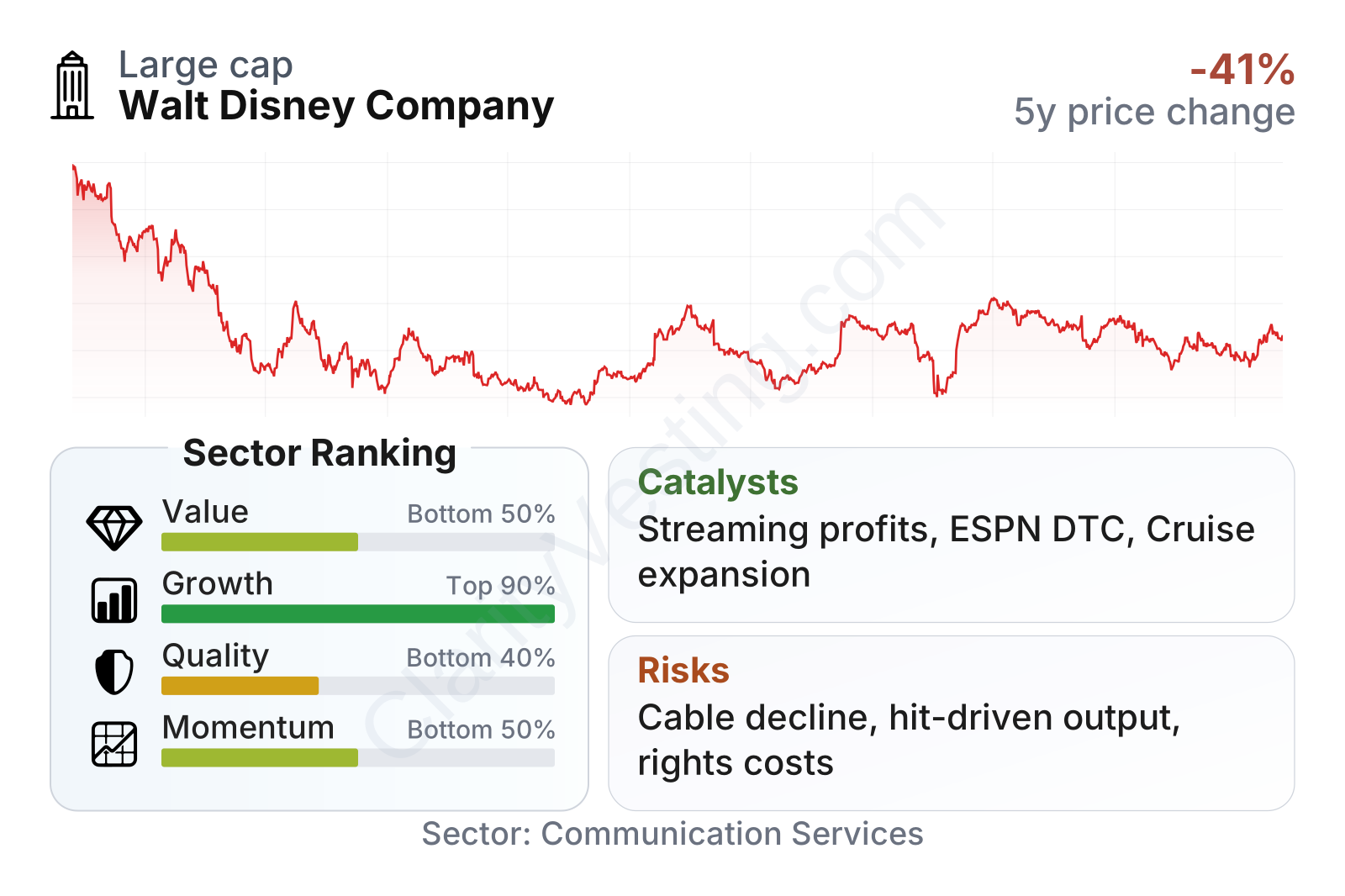
Disney remains a very large company, with a market value around the low hundreds of billions of dollars, but the profile is mixed. Growth measures are strong relative to much of the sector, helped by improving margins, better earnings, and a sharp multi-year recovery in free cash flow. Profitability is better than the sector median on operating margin, but overall quality still looks uneven because leverage remains meaningful and long-term returns on invested capital are still rebuilding from weaker years. Valuation metrics do not point to a clear bargain, and recent share-price momentum has been softer than much of the sector.
Growth
Disney operates in parts of the media and leisure industry that still have long-term growth potential, but the drivers are changing. Traditional television is a mature or declining area across the industry, while streaming, live sports, premium experiences, and franchise-based entertainment remain structurally attractive. Disney is well positioned in each of those growth pockets because it owns globally recognized intellectual property, has one of the strongest park portfolios in the world, and controls ESPN, one of the most valuable sports media brands.
The company’s strategy for future growth is coherent. Management has been trying to improve streaming profitability rather than chasing subscribers at any cost, while also leaning into areas where Disney has clear pricing power, especially parks, cruises, and branded experiences. This is important because the market is now rewarding media companies less for scale alone and more for durable cash generation.
Revenue growth has moderated from the post-reopening surge, but recent year-over-year growth has remained positive and has moved back into the mid-single-digit range. That is not explosive growth, yet it is healthy for a company of Disney’s size, especially when paired with better margins.
Free cash flow shows the biggest improvement in the business. After a much weaker period, Disney rebuilt annualized free cash flow into the high single-digit to low double-digit billions before a pullback more recently. Even with that decline, cash generation is still far stronger than it was a few years ago. For a company with large content spending and heavy capital needs in parks and cruises, that improvement is a central growth signal because it gives Disney more flexibility to invest, reduce debt, and support shareholder returns.
Several catalysts stand out. Disney continues to expand its cruise capacity, which extends one of its highest-demand experiences businesses. Its parks pipeline also supports future guest spending through new attractions and capacity additions. In media, the continued push to make streaming consistently profitable, together with deeper bundling across Disney+, Hulu, and sports content, could improve average revenue per user and reduce churn. ESPN’s ongoing transition toward broader direct-to-consumer distribution is another important opportunity because live sports remain one of the few forms of content with strong real-time audience demand.
Recent company updates have also reinforced that management is focused on execution and cost discipline rather than simply volume growth. For long-term analysis, that is a favorable shift because Disney’s strongest periods have historically come when creative output, pricing power, and operating discipline were all working together.
Risks
This article is for informational purposes only and does not constitute financial advice. Some content is AI-generated. See Disclaimer