Stock Analysis · Diodes Incorporated (DIOD)
Overview
Diodes Incorporated is a semiconductor company that designs and manufactures a wide range of analog and discrete components, plus selected mixed-signal products. In simple terms, it makes many of the small but essential chips that help electronic devices manage power, control signals, protect circuits, connect to displays, and support sensing functions. Its parts are used in everyday products such as cars, industrial equipment, smartphones, personal computers, consumer electronics, and communications hardware.
The business is diversified across both product categories and end markets. Based on the company’s recent annual filing, revenue is mainly organized by product type rather than by individual chip family.
- Analog products: about 43% of revenue. This category includes power management devices, amplifiers and comparators, voltage references, LED drivers, current-limit switches, and other signal-chain parts used to regulate and control electronic systems.
- Discrete products: about 42% of revenue. These are basic semiconductor building blocks such as diodes, rectifiers, transistors, MOSFETs, and protection devices that handle switching, power flow, and circuit protection.
- Logic and mixed-signal products: about 15% of revenue. This includes interface, timing, switching, and connectivity products, along with application-specific devices for display, sensing, and control functions.
Its sales are also spread across several end markets. Automotive and industrial have become increasingly important because modern vehicles and factory equipment need more power management, sensing, and protection chips. Consumer electronics, computing, and communications remain meaningful as well, but they tend to be more cyclical.
The financial profile shows a business that was highly profitable during the semiconductor upcycle of 2021-2023, then experienced a sharp drop in sales and earnings in 2024 before recovering in 2025 and into 2026. The notable point is that operating costs did not fall as quickly as revenue, which compressed profits during the downturn.
Over the last several years, revenue peaked above $2.0 billion in 2022, fell to about $1.3 billion in 2024, and then partially recovered to roughly $1.5 billion in 2025. Gross profit followed the same pattern, while research and development spending stayed comparatively resilient. That suggests management kept investing in product breadth even during the slowdown, but it also meant margins were more exposed when demand weakened.
Key Figures
| Metric | Value | Sector ⓘ |
|---|---|---|
| Date | Sep 12, 2026 | |
| Context | ||
| Sector | Technology | |
| Industry | Semiconductors | |
| Market Cap ⓘ | $4.22B | |
| Beta ⓘ | 1.90 | |
Value (Cheapness) | ||
| P/E Ratio ⓘ | 48.24 | 29.51 |
| FCF Yield ⓘ | 3.38% | 4.25% |
| EBIT / EV ⓘ | 1.84% | 2.85% |
| PEG ⓘ | 0.93 | |
Growth (Business expansion) | ||
| Revenue Growth ⓘ | 21.70% | 15.40% |
| RPS Growth (5Y CAGR) ⓘ | -5.14% | 8.56% |
| EPS Growth (5Y CAGR) ⓘ | -41.53% | -11.88% |
| Margin Growth (5Y Trend) ⓘ | -12.02% | 0.46% |
| FCF Growth (5Y CAGR) ⓘ | -8.70% | 9.80% |
Quality (Business durability) | ||
| ROIC (Latest) ⓘ | 2.95% | 9.44% |
| ROIC (5Y Median) ⓘ | 11.85% | 8.30% |
| Net Debt / EBIT (Latest) ⓘ | -5.15 | 0.54 |
| Net Debt / EBIT (5Y Median) ⓘ | -0.87 | 0.44 |
| Operating Margin (Latest) ⓘ | 4.28% | 9.58% |
| Operating Margin (5Y Median) ⓘ | 15.08% | 8.25% |
| Debt to Equity (Latest) ⓘ | 3.61% | 33.33% |
| Profit Margin (Latest) ⓘ | 5.27% | 7.14% |
| Free Cash Flow (Latest) ⓘ | $142.51M | |
Momentum (Price trend) | ||
| 3Y Return ⓘ | +22.97% | +45.48% |
| 12M Return (excl. last month) ⓘ | +100.26% | +23.48% |
| 6M Return ⓘ | +54.11% | +20.93% |
| Price vs. 200-Day MA ⓘ | +17.60% | +7.43% |
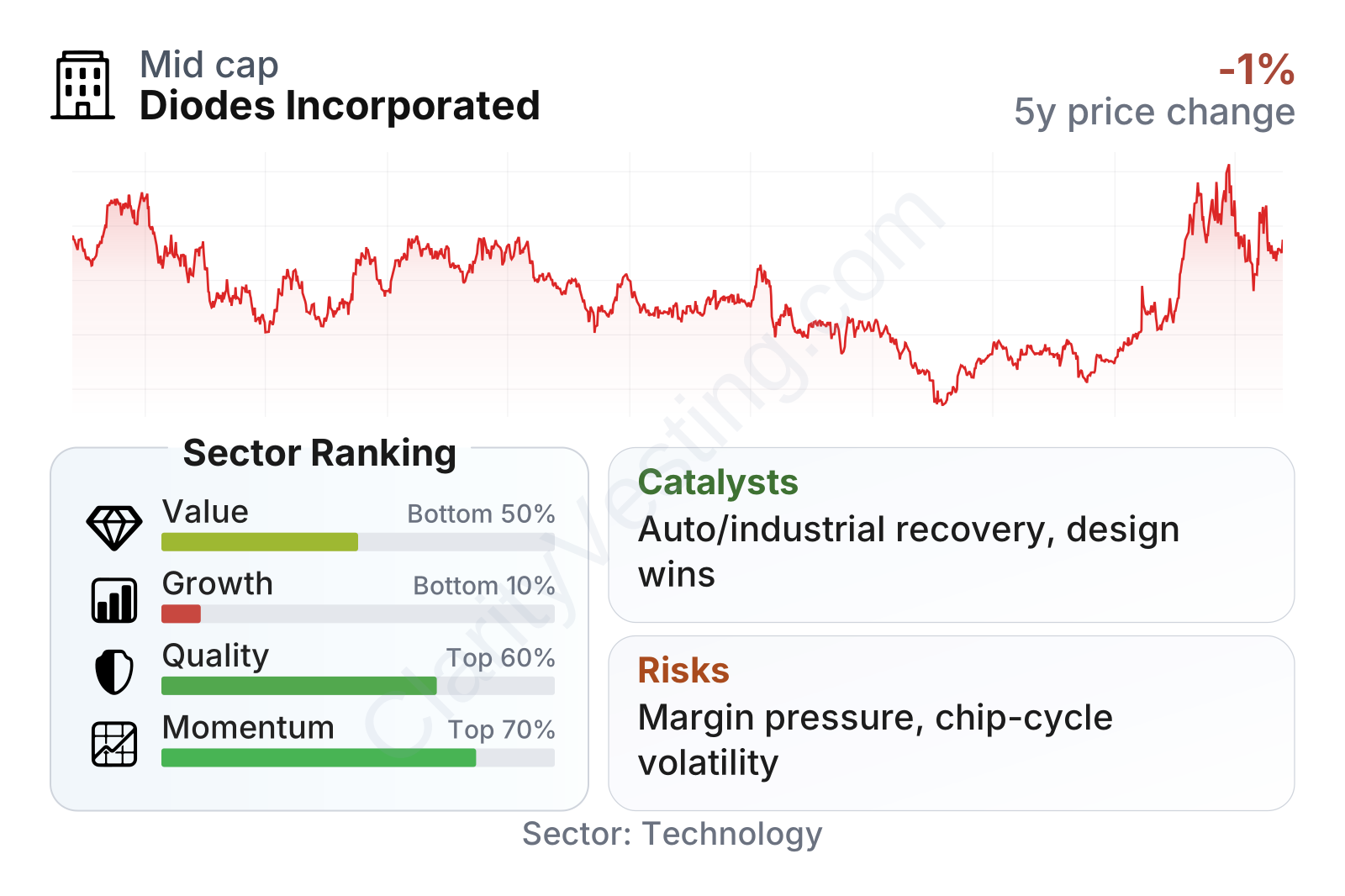
Diodes is a mid-sized semiconductor company, which can allow room for expansion but also usually brings more volatility than the largest chipmakers. The recent profile is mixed: balance sheet strength stands out, momentum has improved sharply, but value and growth rankings are weaker relative to the broader technology sector. Profitability is still below the sector median, while the company’s net cash position and very low leverage provide an important financial cushion.
Growth
Diodes operates in a sector with solid long-term demand drivers. Semiconductor content continues to rise in vehicles, industrial automation, electrification, power systems, and connected devices. That backdrop is favorable for a company focused on power discretes and analog chips, because these parts are needed in large volumes across many products, not only in cutting-edge processors or AI accelerators.
The company’s strategy also makes industrial sense. Diodes has built a broad catalog of lower-cost, high-volume components and supports customers across automotive, industrial, consumer, and communications markets. This helps reduce dependence on one single application. It also manufactures a meaningful portion of its products internally, which can help with supply control, quality, and margin management when utilization improves.
The recent revenue trend is encouraging after a difficult period. Sales contracted heavily through 2023 and most of 2024, which reflected weak semiconductor demand and inventory correction across customers. That picture turned more positive from late 2024 onward, and year-over-year growth moved back into the low- to mid-teens before rising above 20% in early 2026. That rebound suggests Diodes is participating in a broader recovery cycle rather than remaining stuck in a prolonged downturn.
Cash generation has been more uneven than revenue growth. Free cash flow remains positive, which matters, but it has not yet returned to the stronger levels seen earlier in the cycle. For long-term analysis, that means the recovery is real, but still incomplete: sales have improved faster than profitability and cash conversion.
A visible catalyst is the company’s exposure to automotive and industrial electronics, where content growth can outlast short consumer cycles. Electric vehicles, advanced driver-assistance systems, factory automation, power conversion, and smarter energy systems all require more of the kinds of chips Diodes sells. Recent company updates also point to design-win activity and recovery in demand patterns, which can support further normalization if customer inventories continue to improve.
Risks
This article is for informational purposes only and does not constitute financial advice. Some content is AI-generated. See Disclaimer


