Stock Analysis · DR Horton Inc (DHI)
Overview
D.R. Horton is one of the largest homebuilders in the United States. The company develops land, builds homes, markets communities, and sells finished houses to homebuyers across a wide geographic footprint. It also operates related businesses that support the home purchase process, including mortgage financing, title services, and insurance, and it has a rental platform that develops and owns single-family and multifamily rental properties.
Its business is still primarily tied to one big idea: selling new homes at scale. That gives D.R. Horton significant exposure to long-term housing demand in the U.S., especially in markets where population growth, job creation, and affordability remain important drivers.
The main revenue sources are approximately the following, based on the company’s recent annual structure:
- Homebuilding: about 97% of revenue. This includes the sale of single-family homes under brands that cover entry-level, move-up, and luxury buyers, as well as attached products in some markets.
- Financial services: about 2% of revenue. This segment includes mortgage origination and servicing-related activities, title services, and insurance products linked to home closings.
- Rental and other operations: about 1% of revenue. This includes development, construction, leasing, and occasional disposition activity tied to rental communities and other smaller operations.
D.R. Horton’s scale matters because homebuilding is a local business with national capital needs. A large platform can buy land more efficiently, spread overhead across many communities, negotiate better with suppliers, and keep a broader pipeline of lots and projects than smaller peers.
The revenue base expanded strongly from 2021 to 2024, while profits remained sizable even as margins cooled from unusually strong post-pandemic levels. The more recent picture shows a business that is still generating billions in earnings, but with a larger share of revenue being absorbed by construction costs and selling expenses than at the peak.
Key Figures
| Metric | Value | Sector ⓘ |
|---|---|---|
| Date | Sep 12, 2026 | |
| Context | ||
| Sector | Consumer Cyclical | |
| Industry | Residential Construction | |
| Market Cap ⓘ | $38.57B | |
| Beta ⓘ | 1.37 | |
Value (Cheapness) | ||
| P/E Ratio ⓘ | 12.92 | 17.10 |
| FCF Yield ⓘ | 8.58% | 8.53% |
| EBIT / EV ⓘ | 9.28% | 6.46% |
| PEG ⓘ | 1.14 | |
Growth (Business expansion) | ||
| Revenue Growth ⓘ | N/A | 5.75% |
| RPS Growth (5Y CAGR) ⓘ | 9.84% | 9.14% |
| EPS Growth (5Y CAGR) ⓘ | -19.11% | -18.21% |
| Margin Growth (5Y Trend) ⓘ | -5.45% | -0.23% |
| FCF Growth (5Y CAGR) ⓘ | 87.26% | 4.91% |
Quality (Business durability) | ||
| ROIC (Latest) ⓘ | 9.96% | 12.61% |
| ROIC (5Y Median) ⓘ | 18.01% | 10.72% |
| Net Debt / EBIT (Latest) ⓘ | 1.28 | 2.10 |
| Net Debt / EBIT (5Y Median) ⓘ | 0.41 | 2.32 |
| Operating Margin (Latest) ⓘ | 11.97% | 9.25% |
| Operating Margin (5Y Median) ⓘ | 17.81% | 9.64% |
| Debt to Equity (Latest) ⓘ | 30.16% | 75.78% |
| Profit Margin (Latest) ⓘ | 9.15% | 5.33% |
| Free Cash Flow (Latest) ⓘ | $3.31B | |
Momentum (Price trend) | ||
| 3Y Return ⓘ | +24.09% | +14.53% |
| 12M Return (excl. last month) ⓘ | -6.75% | +3.08% |
| 6M Return ⓘ | -0.23% | +0.55% |
| Price vs. 200-Day MA ⓘ | -7.48% | -0.54% |
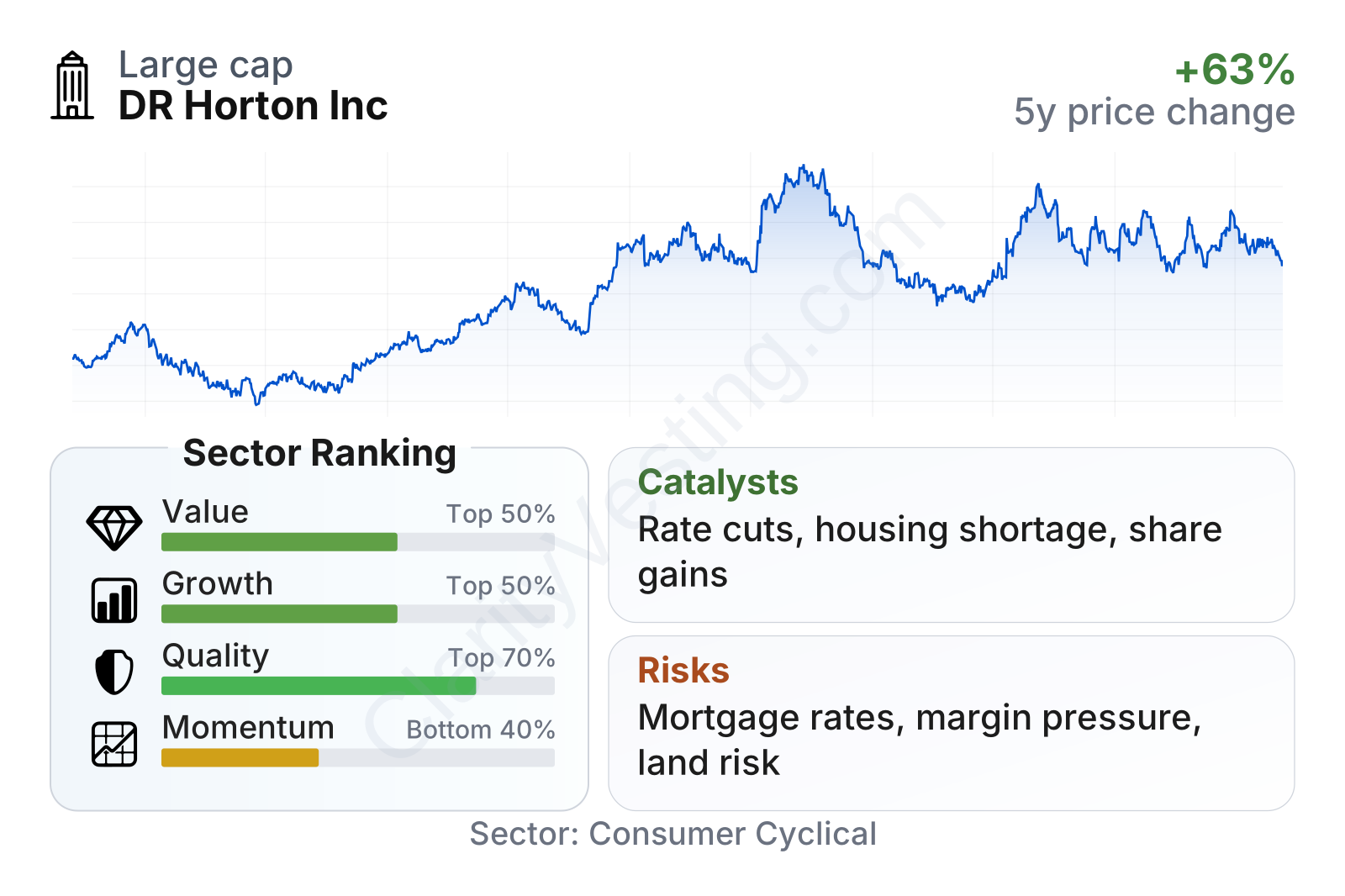
D.R. Horton stands out as a very large company in residential construction, with above-average operating profitability and a balance sheet that looks materially less leveraged than much of the sector. The factor mix is notable: value looks favorable relative to peers, quality is supported by strong historical returns and moderate debt, while growth is more mixed because recent revenue has flattened after a very strong multi-year run.
The stock’s recent path also reflects that pattern. Over several years it has risen meaningfully, but the shorter-term trading picture has been more uneven as the market tries to balance healthy fundamentals against a less supportive housing cycle.
Growth
Housing construction is a cyclical industry, but it sits inside a sector with durable long-term demand. The U.S. still faces structural housing needs in many regions, driven by population growth, household formation, and years of underbuilding relative to demand. That backdrop does not remove short-term volatility, but it does create a large market for builders that can operate efficiently across cycles.
D.R. Horton’s strategy is built around that opportunity. The company has emphasized broad geographic diversification, high sales volume, and a product lineup that reaches multiple buyer categories. Its entry-level focus is especially important because affordability remains the biggest issue in housing, and the largest buyer pool is often near the lower end of the new-home price spectrum. The company has also used financing incentives and mortgage rate buydowns to help keep sales moving when borrowing costs are elevated.
Recent revenue growth has slowed sharply compared with the unusually strong period of 2021 through 2024. The latest year-over-year pattern suggests stabilization rather than a clear reacceleration, which is consistent with a housing market adjusting to higher interest rates and affordability pressure. Even so, the longer view is more favorable: over five years, revenue per share has grown slightly faster than the sector median.
One encouraging sign is cash generation. Free cash flow moved from negative territory earlier in the cycle to well above $3 billion on a trailing basis more recently. For a homebuilder, that matters because land, development, and inventory absorb large amounts of capital. Stronger cash production gives the company more flexibility to buy land, repurchase shares, invest in rental projects, or simply preserve balance sheet strength when conditions soften.
Recent company updates have also pointed to continued use of lot supply discipline, community count management, and incentive-based selling tools rather than aggressive expansion at any price. That approach makes strategic sense in a slower housing environment. If mortgage rates ease meaningfully or existing-home supply remains constrained, large public builders such as D.R. Horton could keep taking share because they can offer financing support and newly built inventory that many smaller operators cannot match as easily.
Risks
This article is for informational purposes only and does not constitute financial advice. Some content is AI-generated. See Disclaimer


