Stock Analysis · Digi International Inc (DGII)
Stock Analysis · Digi International Inc (DGII)

Overview

Digi International is a connectivity company that helps businesses link physical equipment to digital networks. In simple terms, it sells the hardware, software, and services that let machines, sensors, vehicles, industrial systems, and remote sites communicate securely. Its products are used in areas such as industrial automation, utilities, transportation, healthcare, smart cities, and enterprise networking. A large part of its appeal is that it serves practical, recurring needs: keeping remote assets connected, monitored, managed, and increasingly automated.

The company reports through two main segments. IoT Products & Services is the core business and includes embedded modules, industrial routers, console servers, infrastructure management tools, and device management platforms. IoT Solutions is smaller and focuses on more packaged offerings, including smart utility and infrastructure-related solutions. Based on recent annual reporting, revenue is heavily concentrated in the first segment.

  • IoT Products & Services: roughly 85% to 90% of total revenue, the company’s largest source of sales and earnings.
  • IoT Solutions: roughly 10% to 15% of total revenue, smaller but tied to specialized use cases such as smart infrastructure and monitoring.
  • Within the mix: product revenue remains the largest piece, while software, subscriptions, and services add a more recurring element over time.

Digi’s business model has gradually become more attractive as customers look for complete connectivity platforms rather than stand-alone hardware. That matters because bundled software and services can improve customer retention and support steadier margins. Over the last several years, the company has also used acquisitions to broaden its product lineup and deepen exposure to industrial IoT, where switching costs can be meaningful once systems are deployed.

The operating picture has improved over time: revenue expanded materially from 2021 through 2025, gross profit also moved higher, and interest expense has fallen sharply from post-acquisition levels. That combination suggests a business that is becoming more efficient as scale builds and debt pressure eases.

Key Figures

MetricValueSector
DateJul 18, 2026
Context
SectorTechnology
IndustryCommunication Equipment
Market Cap $2.41B
Beta 0.96
Value
(Cheapness)
P/E Ratio 56.5731.76
FCF Yield 5.26%4.18%
EBIT / EV 2.40%2.56%
PEG 0.83
Growth
(Business expansion)
Revenue Growth 25.10%13.50%
RPS Growth (5Y CAGR) 5.39%8.57%
EPS Growth (5Y CAGR) -8.85%-21.87%
Margin Growth (5Y Trend) 8.28%0.41%
FCF Growth (5Y CAGR) 17.39%9.76%
Quality
(Business durability)
ROIC (Latest) 6.23%8.54%
ROIC (5Y Median) 8.30%8.12%
Net Debt / EBIT (Latest) 2.010.38
Net Debt / EBIT (5Y Median) 2.870.38
Operating Margin (Latest) 12.79%9.58%
Operating Margin (5Y Median) 9.87%8.25%
Debt to Equity (Latest) 23.11%33.52%
Profit Margin (Latest) 9.10%6.96%
Free Cash Flow (Latest) $126.75M
Momentum
(Price trend)
3Y Return +51.97%+30.91%
12M Return (excl. last month) +103.07%+28.90%
6M Return +47.96%+5.38%
Price vs. 200-Day MA +26.27%+7.61%
Better than sector median
Slightly worse than sector median
More than 20% worse than sector median

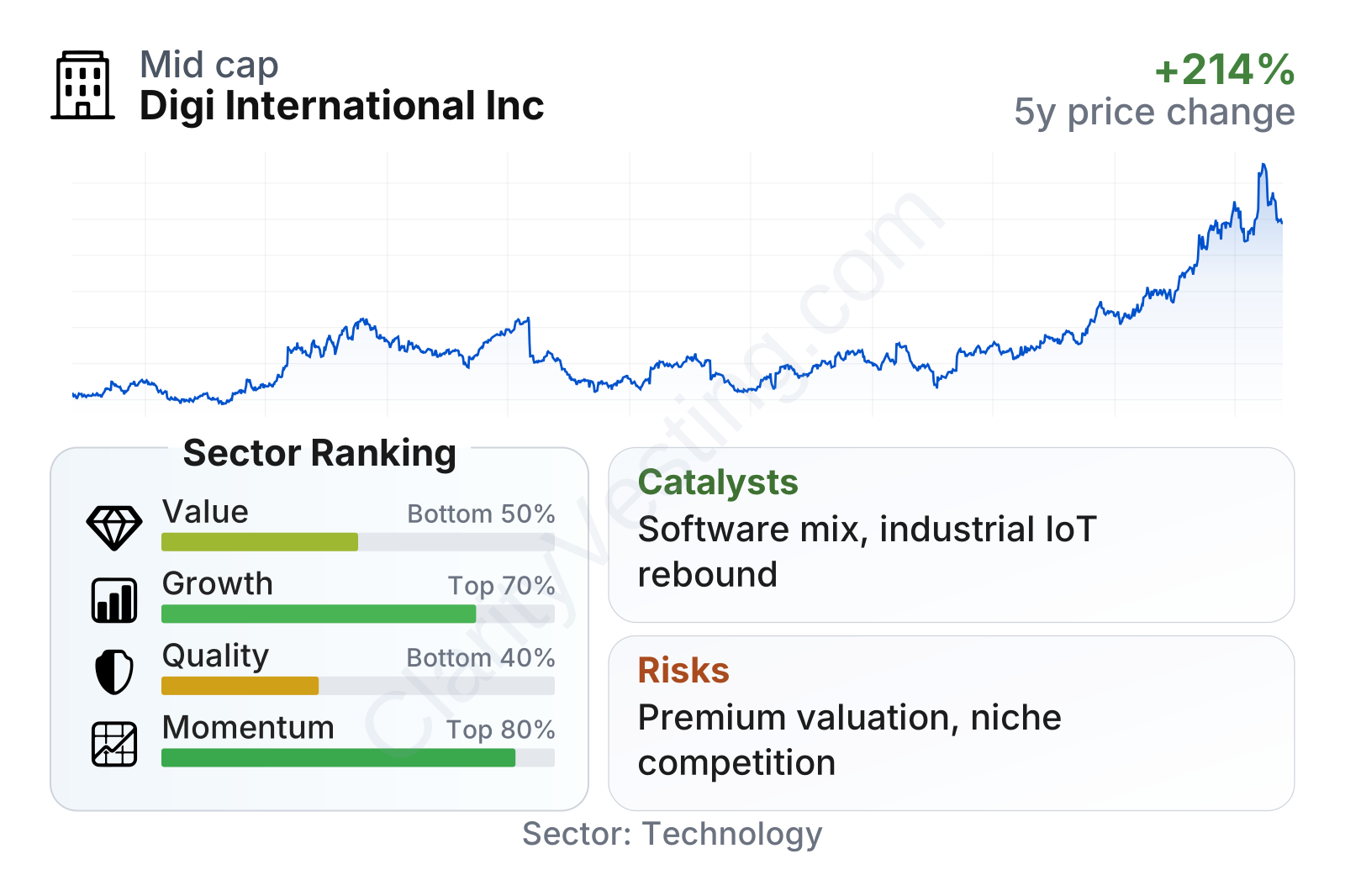
Digi sits in the mid-cap range at about $2.6 billion, with share-price volatility close to the broader market rather than extreme small-cap behavior. The overall profile is mixed but improving. Growth and market momentum rank above the middle of the technology sector, helped by a rebound in sales growth, stronger free cash flow generation, and a solid multi-year stock performance. Profitability is better than many peers on operating margin and net margin, but the quality picture is held back by leverage measures that still look elevated compared with the sector when using earnings-based debt ratios. On valuation, the stock trades at a premium earnings multiple, so the market is already recognizing part of this improvement.

Growth

Digi operates in a sector with favorable long-term demand drivers. Industrial IoT, remote monitoring, edge connectivity, and secure device management are all areas likely to remain relevant as more equipment is connected and managed outside traditional IT environments. This is not a fad business dependent on consumer excitement. It is tied to infrastructure, field operations, compliance, uptime, and cost control, which tend to be durable spending priorities for enterprise and industrial customers.

The company’s strategy also makes sense for this environment. Rather than competing only on one-off hardware sales, Digi has been building a broader platform around connectivity, device management, and application-specific solutions. That approach can make customer relationships deeper and longer lasting. A business that supplies both the connection layer and the management layer is often harder to replace than one that only ships components.

Recent growth has been uneven, but the latest direction is encouraging. Revenue growth turned negative during 2024 and early 2025, reflecting softer demand and more difficult comparisons, then recovered meaningfully and reached the mid-20% range most recently. That rebound stands well above the sector median and suggests that demand has strengthened again rather than merely stabilized.

Cash generation has been one of the clearest bright spots. Free cash flow has climbed sharply over the last few years and recently moved into a much higher range than it had historically. That matters because it gives Digi more flexibility to invest in product development, reduce debt, support acquisitions, and absorb industry swings without stretching the balance sheet.

A notable catalyst has been the company’s continued push into software-enabled recurring revenue and infrastructure-oriented markets where connectivity is mission critical. Public company updates in 2026 also pointed to improved execution, stronger profitability, and continuing demand in industrial IoT and enterprise connectivity. More broadly, if companies keep modernizing field equipment and remote operations, Digi is positioned to benefit from that long cycle.

Risks

Digi’s biggest risk is that it is not the dominant force in a giant market; it operates in specialized niches inside a competitive technology landscape. Larger networking and industrial technology companies can invest more heavily, bundle broader offerings, and pressure pricing. Demand can also be lumpy because many customers place orders tied to project cycles, infrastructure budgets, or industrial spending conditions rather than smooth consumer-style purchasing patterns.

The company does have competitive advantages, but they are narrower than those of the largest platform leaders. Its strengths appear to come from industrial know-how, a long operating history in machine-to-machine communications, a broad catalog for specific connectivity use cases, and sticky customer deployments once products are embedded in workflows. In those niches, Digi can be a strong specialist even if it is not the overall market leader across all communications equipment.

Main competitors vary by product category, but they include larger networking and industrial connectivity names such as Cisco in infrastructure management and remote networking, Cradlepoint within wireless WAN through Ericsson, Sierra Wireless assets within Semtech, Lantronix in device connectivity and out-of-band management, and various industrial automation vendors that offer adjacent connectivity solutions. Compared with these players, Digi is smaller but often more focused. That focus can help in execution, though it also means fewer resources if competition intensifies.

Balance-sheet risk looks more manageable than it did a few years ago. Debt to equity was much higher after acquisitions, but it has trended down substantially and now sits below the sector median. Even so, debt relative to EBIT remains above typical sector levels, which means leverage still deserves attention if earnings were to weaken.

Profitability has improved significantly. Net margin moved from low single digits several years ago to roughly 9% recently, now above the sector median. That is a positive sign, but margins in hardware-connected businesses can still fluctuate with product mix, supply chain costs, and the pace of enterprise spending. If revenue momentum slows again, some of the recent margin strength could come under pressure.

There do not appear to be any major public red flags involving scandal, governance breakdown, or reputational damage in the most recent company filings and official releases reviewed. The more relevant near-term risk is execution: maintaining growth while continuing the shift toward higher-value software and services, without overpaying for acquisitions or losing focus across a broad product lineup.

Valuation

The current valuation looks demanding on headline earnings. Digi’s price-to-earnings ratio is well above the sector median, which means the market is assigning a premium to its recent recovery, cash generation, and improving margins. On that narrow measure alone, the stock does not look cheap.

The longer view shows that Digi has often traded at elevated earnings multiples, sometimes far above the broader communications equipment peer group. The current level is below some of the company’s most stretched periods, but it still reflects meaningful expectations. In other words, the valuation leaves less room for disappointment than a lower-multiple industrial technology company would.

That said, valuation is not a one-line judgment. Digi’s PEG ratio is comparatively moderate, free cash flow yield is slightly better than the sector median, and the business has shown real improvement in operating margins and cash conversion. So the premium is at least partly supported by stronger business quality than the simple P/E ratio suggests. The key question is whether the recent acceleration in revenue and cash flow can persist long enough to justify that premium over time.

Conclusion

Digi International stands out as a focused industrial connectivity company with a clearer and stronger business profile than it had a few years ago. It participates in a market with durable long-term demand, has built a broader mix of hardware, software, and services, and has recently shown convincing progress in revenue momentum, margins, and cash generation. The company is not a sector giant, but it appears to occupy useful niches where reliability and integration matter more than consumer-style brand power.

The main challenge is that the stock already reflects much of that progress. Competition is real, growth has not been perfectly smooth, and leverage metrics still deserve monitoring even after visible improvement. Even so, the underlying direction of the business is favorable: stronger profitability, better cash flow, and exposure to industrial digitalization trends that should remain relevant well beyond the next quarter. Overall, Digi currently looks more like a strengthening specialized operator with premium expectations attached than a neglected bargain.

Sources:

  • Digi International, Inc. — Form 10-Q for the quarterly period ended March 31, 2026
  • Digi International, Inc. — Form 10-K for the fiscal year ended September 30, 2025
  • SEC EDGAR — Digi International, Inc. filings database
  • Digi International Investor Relations — earnings releases and investor presentation materials
  • Digi International Investor Relations — webcast and conference call materials
  • Wikipedia — Digi International

This article is for informational purposes only and does not constitute financial advice. Some content is AI-generated. See Disclaimer


Sign up for exclusive research and insights.

Unsubscribe anytime.
