Stock Analysis · Donnelley Financial Solutions Inc (DFIN)
Overview
Donnelley Financial Solutions Inc. is a financial compliance and capital markets software company. In simple terms, it helps large companies, investment firms, and other regulated organizations prepare, manage, and distribute important financial documents and data. Its tools are used for SEC filings, annual reports, proxy materials, earnings releases, virtual shareholder meetings, and deal-related documents for mergers, acquisitions, and fundraising transactions.
The business has gradually shifted from traditional print-heavy document services toward software, recurring subscriptions, and workflow tools. That matters because software revenue is usually steadier and can scale better than one-time project work. DFIN still has service and transactional exposure, but its strategic focus is increasingly on cloud-based platforms that support compliance, reporting, and capital markets activity.
Based on recent company filings, DFIN organizes revenue primarily into two operating lines:
- Capital Markets – approximately 55% to 60% of revenue: software and services used for public and private deal activity, SEC and regulatory filings, transactional communications, venue and data room solutions, and other event-driven capital markets workflows.
- Investment Companies – approximately 40% to 45% of revenue: compliance and reporting solutions for mutual funds, alternative investment vehicles, and insurance investment products, including filings, shareholder reports, regulatory communications, and related software tools.
Within those activities, recurring software and software-enabled revenue has become more important, while legacy print and distribution activities have become a smaller share over time. The business mix is therefore better than the company’s old image might suggest: it is not a pure software company, but it is also no longer mainly a traditional financial printing business.
Over the last several years, revenue has trended down from around $990 million in 2021 to roughly $770 million in 2025, but the cost structure has also improved. Cost of revenue has fallen faster than sales, helping gross profit stay relatively resilient. The more important recent concern is that operating income dropped sharply in 2025, showing that the transition toward a more software-led model still comes with earnings volatility.
Key Figures
| Metric | Value | Sector ⓘ |
|---|---|---|
| Date | Sep 12, 2026 | |
| Context | ||
| Sector | Technology | |
| Industry | Software - Application | |
| Market Cap ⓘ | $1.19B | |
| Beta ⓘ | 0.71 | |
Value (Cheapness) | ||
| P/E Ratio ⓘ | 31.82 | 29.51 |
| FCF Yield ⓘ | 12.81% | 4.25% |
| EBIT / EV ⓘ | 4.61% | 2.85% |
| PEG ⓘ | 0.97 | |
Growth (Business expansion) | ||
| Revenue Growth ⓘ | 2.80% | 15.40% |
| RPS Growth (5Y CAGR) ⓘ | -0.92% | 8.56% |
| EPS Growth (5Y CAGR) ⓘ | -6.42% | -11.88% |
| Margin Growth (5Y Trend) ⓘ | -14.46% | 0.46% |
| FCF Growth (5Y CAGR) ⓘ | -5.94% | 9.80% |
Quality (Business durability) | ||
| ROIC (Latest) ⓘ | 7.05% | 9.44% |
| ROIC (5Y Median) ⓘ | 19.04% | 8.30% |
| Net Debt / EBIT (Latest) ⓘ | 2.91 | 0.54 |
| Net Debt / EBIT (5Y Median) ⓘ | 1.08 | 0.44 |
| Operating Margin (Latest) ⓘ | 8.23% | 9.58% |
| Operating Margin (5Y Median) ⓘ | 17.91% | 8.25% |
| Debt to Equity (Latest) ⓘ | 54.65% | 33.33% |
| Profit Margin (Latest) ⓘ | 4.53% | 7.14% |
| Free Cash Flow (Latest) ⓘ | $152.30M | |
Momentum (Price trend) | ||
| 3Y Return ⓘ | -0.62% | +45.48% |
| 12M Return (excl. last month) ⓘ | -15.14% | +23.48% |
| 6M Return ⓘ | -1.11% | +20.93% |
| Price vs. 200-Day MA ⓘ | +2.46% | +7.43% |
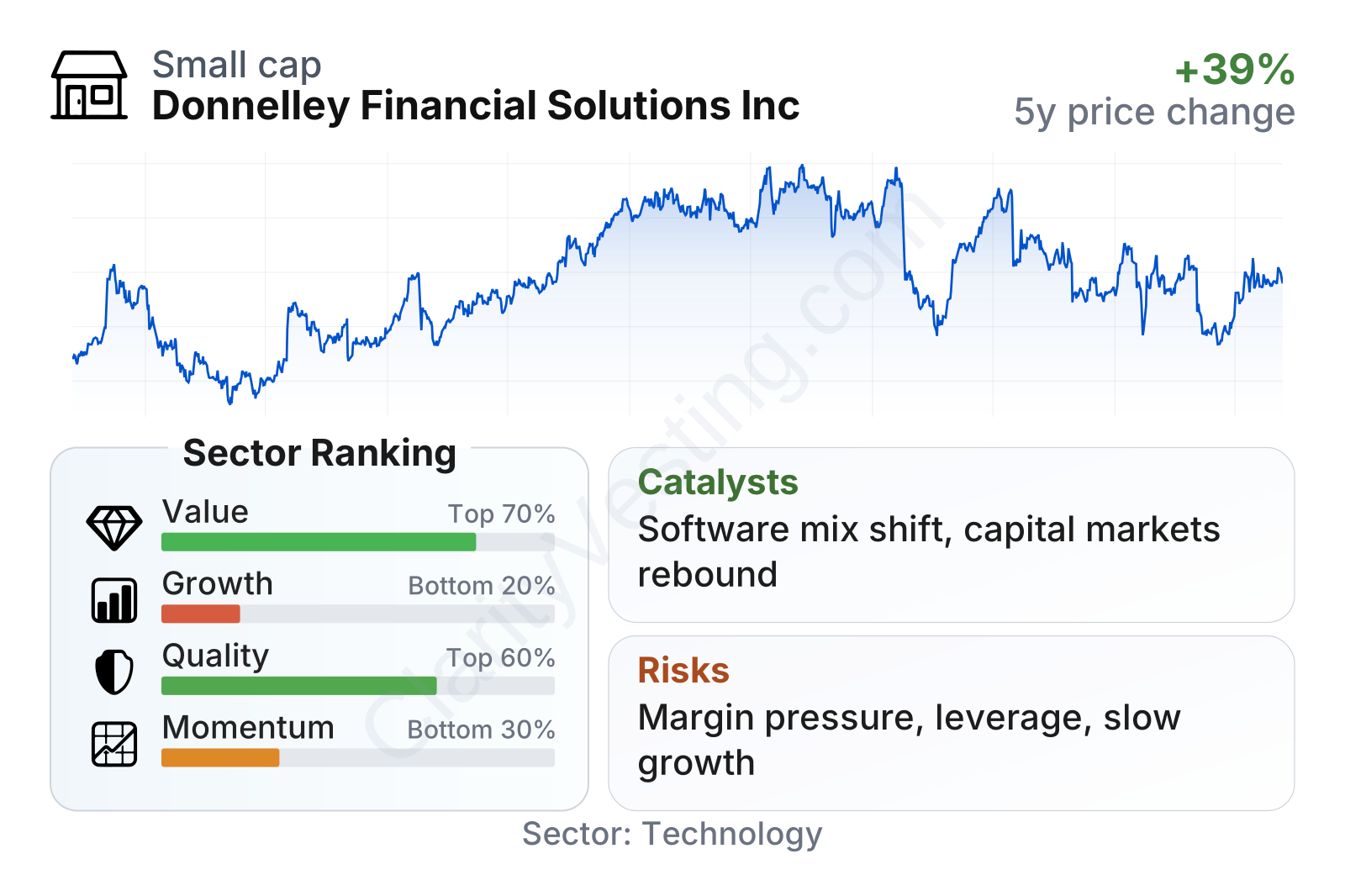
DFIN is a small-cap software and compliance company with lower share-price volatility than many technology names, as reflected by a beta well below 1. On valuation, it looks mixed: its earnings multiple is close to the sector norm, but cash-based measures look stronger, with free cash flow yield and EBIT relative to enterprise value standing above the sector median. Quality is respectable rather than exceptional. Long-term returns on invested capital have been solid, but current profitability and leverage are less attractive than many software peers. The weakest area is growth, where revenue expansion and multi-year trends lag the broader application software group by a wide margin.
Growth
DFIN operates in a market with durable long-term demand. Public companies, investment funds, and regulated financial institutions do not get to ignore compliance, disclosure, and shareholder communication requirements. That gives the company exposure to a sector that is not driven only by discretionary spending. Even when capital markets activity slows, clients still need filings, reporting, and governance tools. This creates a useful base level of demand.
The bigger growth question is not whether compliance exists, but whether DFIN can capture a larger share of that spending through software instead of lower-growth service work. Management’s strategy has centered on expanding recurring revenue through platforms such as ActiveDisclosure, Arc Suite, and Venue, while using automation and workflow integration to deepen customer relationships. Strategically, that direction makes sense: clients increasingly want fewer manual steps, more real-time collaboration, and tighter control over regulated data.
Recent revenue growth has turned modestly positive again, running around 2% to 3% year over year in the latest periods after several uneven years. That is an improvement from the deeper declines seen earlier in the cycle, but it is still well below typical software-sector growth rates. In other words, the business appears more stable than fast-growing. For a long-term view, that means the investment case depends more on resilience, recurring revenue mix improvement, and cash generation than on rapid top-line expansion.
Cash generation is a more encouraging part of the picture. Trailing free cash flow has recovered meaningfully and recently moved into the $140 million range, well above the levels seen in 2023 and 2024. That suggests the business still converts a meaningful share of revenue into cash even without strong sales growth. If DFIN continues to increase software mix and keeps costs disciplined, free cash flow could remain an important support for the overall financial profile.
A key external catalyst is any rebound in capital markets activity. More IPOs, debt issuance, mergers, restructurings, and other transactions tend to lift demand for filing, communications, and deal-management tools. Another catalyst is continued migration from legacy print and manual compliance processes toward cloud-based reporting and workflow software. Recent company updates in 2026 have continued to emphasize platform adoption, recurring software revenue, product innovation, and disciplined capital allocation, which fits the company’s longer-term repositioning.
Risks
This article is for informational purposes only and does not constitute financial advice. Some content is AI-generated. See Disclaimer


