Stock Analysis · Dell Technologies Inc (DELL)
Overview
Dell Technologies is a large technology hardware and infrastructure company best known for personal computers, but its business is broader than laptops and desktops. The company sells PCs, monitors, accessories, servers, storage systems, networking equipment, and related software and services. It serves both consumers and organizations, with a strong emphasis on commercial customers such as large companies, government agencies, healthcare systems, and schools.
Dell reports its business in two main segments. In fiscal 2026, which ended in early 2026, the company generated most of its revenue from the client device business, while infrastructure products represented the smaller but strategically important segment because it is tied to data centers and artificial intelligence deployments.
- Client Solutions Group: about 71% of revenue. This includes commercial PCs, consumer PCs, notebooks, desktops, workstations, displays, and peripherals.
- Infrastructure Solutions Group: about 29% of revenue. This includes servers, storage, networking, and related software and services used in data centers and enterprise IT environments.
That mix matters for long-term analysis. PCs are a mature and cyclical market, but Dell’s infrastructure business gives it exposure to faster-moving areas such as AI servers, modernized data centers, and enterprise storage upgrades. The company’s revenue base is also highly diversified by customer type and geography, which helps reduce dependence on any single product line.
The financial flow over recent years shows a business with very large revenue, thin but improving margins, and a cost structure still dominated by hardware production and selling expenses. Revenue dipped during the post-pandemic PC slowdown, then recovered strongly in fiscal 2026 as infrastructure demand accelerated.
Key Figures
| Metric | Value | Sector ⓘ |
|---|---|---|
| Date | Sep 12, 2026 | |
| Context | ||
| Sector | Technology | |
| Industry | Computer Hardware | |
| Market Cap ⓘ | $322.12B | |
| Beta ⓘ | 1.41 | |
Value (Cheapness) | ||
| P/E Ratio ⓘ | 29.51 | 29.51 |
| FCF Yield ⓘ | 2.66% | 4.25% |
| EBIT / EV ⓘ | 4.23% | 2.85% |
| PEG ⓘ | 0.63 | |
Growth (Business expansion) | ||
| Revenue Growth ⓘ | 57.70% | 15.40% |
| RPS Growth (5Y CAGR) ⓘ | 6.73% | 8.56% |
| EPS Growth (5Y CAGR) ⓘ | 12.18% | -11.88% |
| Margin Growth (5Y Trend) ⓘ | 0.39% | 0.46% |
| FCF Growth (5Y CAGR) ⓘ | 97.51% | 9.80% |
Quality (Business durability) | ||
| ROIC (Latest) ⓘ | 41.98% | 9.44% |
| ROIC (5Y Median) ⓘ | 18.42% | 8.30% |
| Net Debt / EBIT (Latest) ⓘ | 1.49 | 0.54 |
| Net Debt / EBIT (5Y Median) ⓘ | 3.24 | 0.44 |
| Operating Margin (Latest) ⓘ | 10.16% | 9.58% |
| Operating Margin (5Y Median) ⓘ | 6.76% | 8.25% |
| Debt to Equity (Latest) ⓘ | -2415.28% | 33.33% |
| Profit Margin (Latest) ⓘ | 7.53% | 7.14% |
| Free Cash Flow (Latest) ⓘ | $8.56B | |
Momentum (Price trend) | ||
| 3Y Return ⓘ | +741.58% | +45.48% |
| 12M Return (excl. last month) ⓘ | +246.42% | +23.48% |
| 6M Return ⓘ | +280.22% | +20.93% |
| Price vs. 200-Day MA ⓘ | +117.23% | +7.43% |
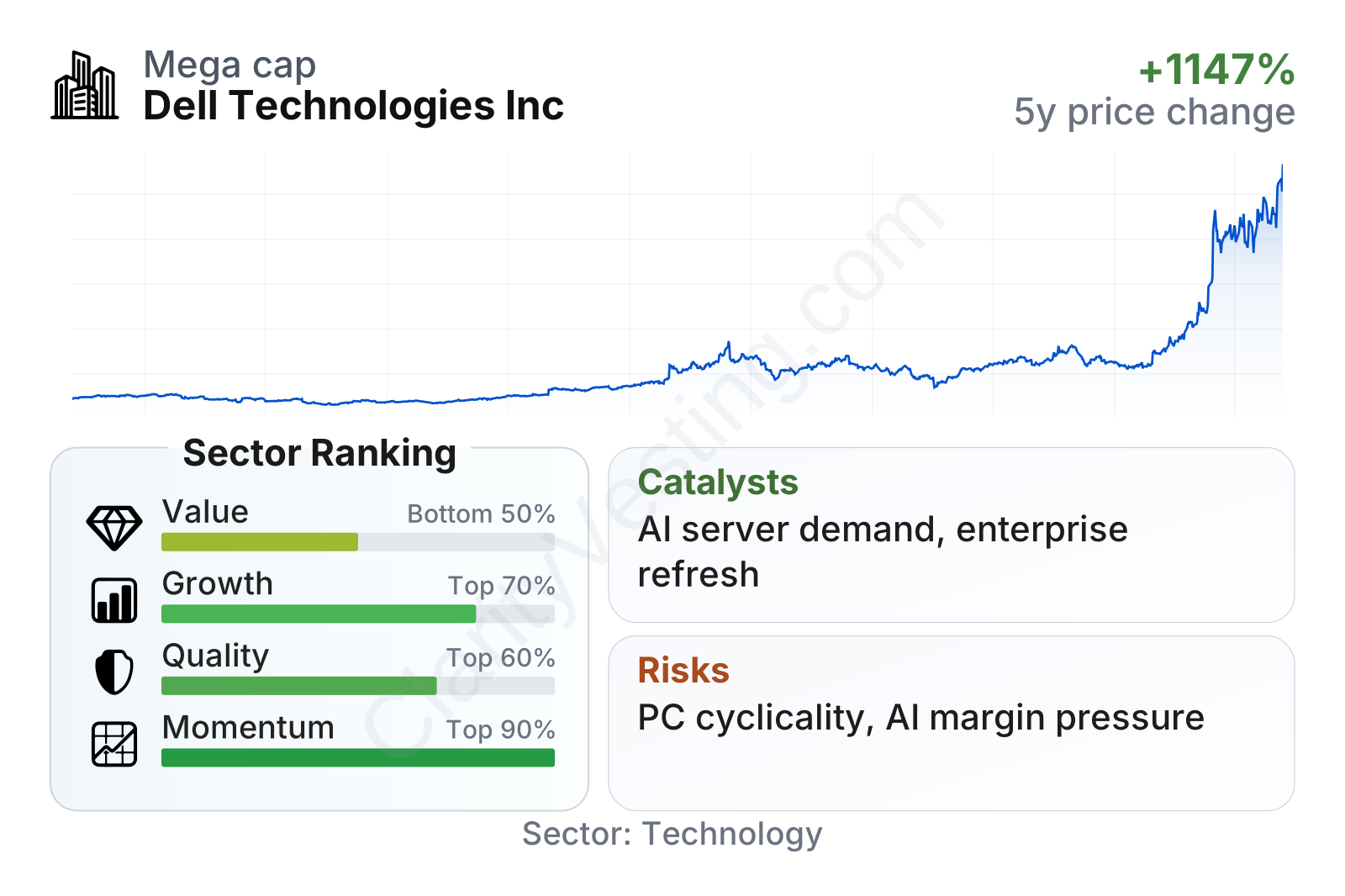
Dell is a mega-cap technology company, and its share price has been exceptionally strong over the last three years, far ahead of the typical technology stock. In the factor breakdown, momentum stands out the most, while quality looks solid thanks to very strong returns on invested capital. Growth has improved sharply, but the value profile looks more mixed because cash flow yield is below the sector median and the P/E ratio is now close to the broader technology median rather than deeply discounted.
The stock has also been more volatile than the market, as reflected by a beta above 1.4. That fits a company whose outlook is increasingly tied to enterprise hardware cycles and AI-related spending, both of which can create large swings in market expectations.
Growth
Dell operates in a mixed industry backdrop. Traditional PCs are not a structurally high-growth market, but enterprise infrastructure tied to cloud, AI, and data-center modernization is growing faster. That makes Dell’s positioning more interesting than a simple PC manufacturer. The company is using its established enterprise relationships to sell higher-value systems, especially AI-optimized servers and supporting infrastructure.
Recent growth has clearly accelerated. After a weak period marked by declining PC demand, revenue returned to growth and then surged in fiscal 2026. The strongest driver has been infrastructure, particularly servers linked to AI workloads. This is important because stronger growth from enterprise systems can improve the company’s business mix over time.
The pace of year-over-year revenue expansion has become much stronger than the sector median. That does not mean Dell has become a steady high-growth software company; it remains a hardware-led business with cyclical swings. Still, the recent rebound suggests the company is benefiting from a real spending wave rather than only from a short-term recovery in PCs.
Cash generation is another encouraging point. Free cash flow has been uneven from year to year, which is common in hardware and enterprise procurement cycles, but the latest trailing level is very strong and well above the low points seen earlier in the cycle.
That recovery in free cash flow matters because it gives Dell room to invest in product development, manage debt, and return capital while navigating demand swings. Public company materials in 2026 also highlighted AI server momentum, including a growing pipeline and backlog for AI infrastructure systems. This is one of the clearest catalysts for Dell because it connects the company to one of the largest current spending priorities in enterprise technology.
Dell’s strategy broadly makes sense for future growth: keep scale in PCs where it already has distribution strength, while using enterprise relationships to capture larger spending on servers, storage, and integrated AI infrastructure. If corporate PC refresh cycles improve at the same time that AI infrastructure remains strong, the company could benefit from two demand engines instead of one.
Risks
This article is for informational purposes only and does not constitute financial advice. Some content is AI-generated. See Disclaimer


