Stock Analysis · Deckers Outdoor Corporation (DECK)
Overview
Deckers Outdoor Corporation is a footwear and apparel company best known for owning brand-led lifestyle businesses rather than operating as a generic shoe manufacturer. Its portfolio includes UGG, HOKA, Teva, Koolaburra, and AHNU, with products sold through wholesale partners, the company’s own stores, and e-commerce websites. In simple terms, Deckers designs products, builds brand demand through marketing, and then earns revenue both from selling directly to consumers and through third-party retailers.
The business is heavily concentrated in a small number of brands, especially UGG and HOKA. Based on the latest annual filing for fiscal 2026, revenue sources can be summarized as follows:
- UGG: approximately 51% of revenue. This brand includes premium boots, slippers, sandals, sneakers, and related apparel and accessories.
- HOKA: approximately 39% of revenue. HOKA focuses on performance running shoes, walking footwear, hiking products, and related apparel.
- Teva: approximately 6% of revenue. Teva is centered on outdoor sandals, trail, and casual footwear.
- Other brands: approximately 4% of revenue combined, mainly Koolaburra and AHNU.
Another important split is channel mix. Deckers generates revenue through both wholesale and direct-to-consumer operations. In recent filings, wholesale remained the larger channel, while direct-to-consumer represented a substantial share supported by owned stores and online sales. That matters because direct sales usually carry higher margins and give the company more control over pricing, customer data, and brand presentation.
Deckers has also shown a remarkable ability to turn sales into profit. Over the last several fiscal years, revenue, gross profit, operating income, and net income all moved sharply higher, while interest expense stayed minimal. That combination suggests growth has not been driven by aggressive borrowing, but by stronger brand demand and favorable economics.
The operating picture has improved meaningfully over time: sales have expanded from a little above $3 billion to well above $5 billion in four fiscal years, while gross profit and operating income grew even faster. This points to stronger pricing power and a richer mix, especially from HOKA and direct sales.
Key Figures
| Metric | Value | Sector ⓘ |
|---|---|---|
| Date | Sep 12, 2026 | |
| Context | ||
| Sector | Consumer Cyclical | |
| Industry | Footwear & Accessories | |
| Market Cap ⓘ | $11.07B | |
| Beta ⓘ | 1.15 | |
Value (Cheapness) | ||
| P/E Ratio ⓘ | 11.37 | 17.10 |
| FCF Yield ⓘ | 10.86% | 8.53% |
| EBIT / EV ⓘ | 13.50% | 6.46% |
| PEG ⓘ | 0.98 | |
Growth (Business expansion) | ||
| Revenue Growth ⓘ | 5.70% | 5.75% |
| RPS Growth (5Y CAGR) ⓘ | 18.72% | 9.14% |
| EPS Growth (5Y CAGR) ⓘ | -31.67% | -18.21% |
| Margin Growth (5Y Trend) ⓘ | 6.29% | -0.23% |
| FCF Growth (5Y CAGR) ⓘ | 73.42% | 4.91% |
Quality (Business durability) | ||
| ROIC (Latest) ⓘ | 41.22% | 12.61% |
| ROIC (5Y Median) ⓘ | 39.32% | 10.72% |
| Net Debt / EBIT (Latest) ⓘ | -0.86 | 2.10 |
| Net Debt / EBIT (5Y Median) ⓘ | -1.15 | 2.32 |
| Operating Margin (Latest) ⓘ | 23.81% | 9.25% |
| Operating Margin (5Y Median) ⓘ | 22.89% | 9.64% |
| Debt to Equity (Latest) ⓘ | 20.52% | 75.78% |
| Profit Margin (Latest) ⓘ | 18.36% | 5.33% |
| Free Cash Flow (Latest) ⓘ | $1.20B | |
Momentum (Price trend) | ||
| 3Y Return ⓘ | -9.82% | +14.53% |
| 12M Return (excl. last month) ⓘ | -12.09% | +3.08% |
| 6M Return ⓘ | -19.29% | +0.55% |
| Price vs. 200-Day MA ⓘ | -20.72% | -0.54% |
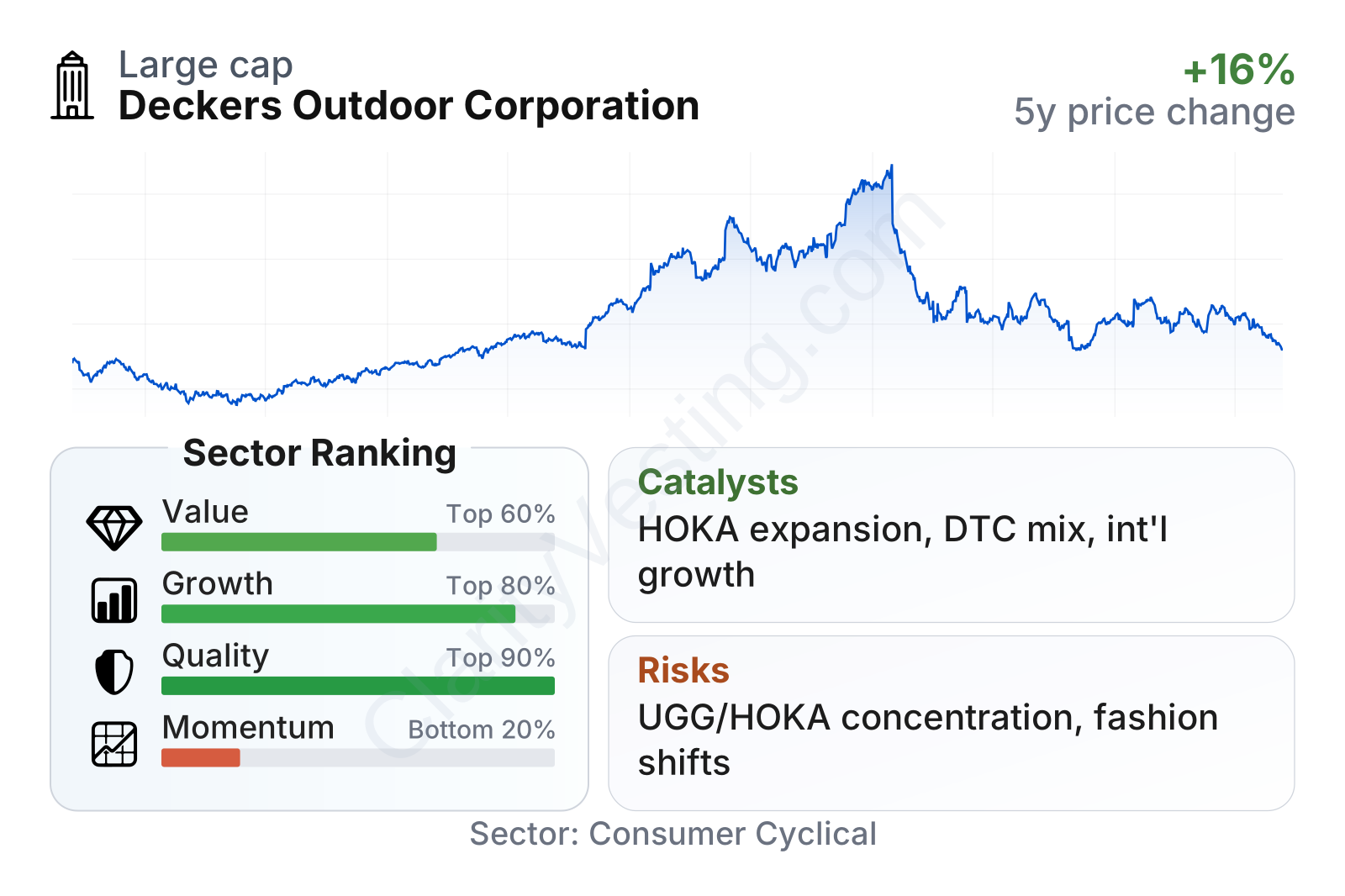
The overall profile is unusual in a positive way. Quality metrics stand near the top of the sector, supported by very high returns on invested capital, strong operating margins, and a net cash position rather than heavy leverage. Growth metrics are also strong over a multi-year period, especially on revenue per share and free cash flow, even though recent year-over-year sales growth has cooled from very high levels. The weaker area is momentum: the stock has lagged in recent months after a period of exceptional appreciation, which helps explain why valuation multiples have compressed.
Deckers is now a large but still focused branded footwear company, with share price history showing major gains through 2023 and 2024, followed by a substantial reset. That reset matters because the business fundamentals remain far stronger than the recent price trend suggests.
Growth
Deckers operates in attractive parts of the footwear market. Performance running, wellness-oriented footwear, casual premium comfort, and direct-to-consumer brand selling are all categories with long-term tailwinds. HOKA is especially important here because it sits at the intersection of running, walking, and everyday athletic use, which broadens its addressable market well beyond serious runners. UGG, meanwhile, has continued expanding beyond cold-weather boots into year-round lifestyle products, which helps reduce some seasonality.
The company’s strategy is coherent. Management has prioritized brand building, product innovation, selective international expansion, and a disciplined direct-to-consumer model. HOKA remains the main growth engine, while UGG contributes scale, profitability, and cash generation. This combination gives Deckers both a fast-growing brand and a mature cash-rich franchise under the same roof.
Revenue growth has clearly normalized. The business posted several periods above 15% and even above 20%, but more recent growth has moved closer to mid-single digits. That is not necessarily a negative signal on its own. After a phase of extraordinary expansion, especially at HOKA, slower growth can simply mean the company is lapping a much larger base. The bigger question is whether margins and cash generation remain healthy as growth moderates, and so far they do.
Free cash flow has climbed dramatically over the last few years, rising from a little above $100 million to well above $1 billion. That is one of the strongest indicators in Deckers’ profile because cash flow is harder to inflate than accounting earnings. It gives the company flexibility for share repurchases, reinvestment, supply chain support, and international brand expansion without depending on lenders.
Recent company updates in fiscal 2026 continued to emphasize growth in HOKA, international opportunity, and ongoing investment in direct-to-consumer capabilities. The most significant opportunity remains simple: if HOKA continues gaining share in global performance footwear while UGG stays resilient and profitable, Deckers still has room to grow faster than many larger apparel and footwear peers.
Risks
This article is for informational purposes only and does not constitute financial advice. Some content is AI-generated. See Disclaimer


