Stock Analysis · Dillard's Inc (DDS)
Overview
Dillard’s is a U.S. department store chain focused on fashion apparel, cosmetics, shoes, accessories, and home products. The company operates stores primarily in malls and shopping centers across the South, Southwest, and Midwest, and it also sells online through its e-commerce platform. Its model is straightforward: it buys branded and private-label merchandise, sells it through its stores and website, and earns additional income from service-related activities connected to its retail operations.
The business is still heavily centered on traditional department store retailing, with revenue coming mainly from merchandise sales. Based on company reporting, the main sources of revenue can be summarized as follows:
- Women’s apparel and accessories: approximately 24% to 26% of merchandise sales. This includes women’s clothing, lingerie, handbags, and related accessories.
- Cosmetics: approximately 17% to 19%. This category includes beauty products and fragrances, an area that tends to support higher gross margins than many apparel lines.
- Men’s apparel and accessories: approximately 16% to 18%. This covers men’s clothing, dresswear, sportswear, and related items.
- Home and furniture: approximately 14% to 16%. This includes home furnishings, housewares, and decorative goods.
- Shoes: approximately 13% to 15%. This includes footwear across women’s, men’s, and children’s categories.
- Children’s apparel and accessories: approximately 8% to 10%.
- Other and service-related revenue: a smaller share, generally in the low single-digit percentage range, including shipping income and other retail-related revenue items.
Dillard’s does not have the same level of diversification as larger mass merchants or off-price chains. That makes category execution, inventory discipline, and customer traffic especially important. The flow of earnings over the last few years shows a business that can produce strong profitability when merchandise margins are healthy, but it is also sensitive to shifts in consumer demand and store traffic.
The long-term pattern shows that sales have stayed fairly stable in recent years, while profit has come down from unusually strong post-pandemic levels. Even so, the company continues to convert a meaningful share of revenue into operating income and net income, which is notable for a department store chain.
Key Figures
| Metric | Value | Sector ⓘ |
|---|---|---|
| Date | Sep 12, 2026 | |
| Context | ||
| Sector | Consumer Cyclical | |
| Industry | Department Stores | |
| Market Cap ⓘ | $10.16B | |
| Beta ⓘ | 1.19 | |
Value (Cheapness) | ||
| P/E Ratio ⓘ | 14.91 | 17.10 |
| FCF Yield ⓘ | 6.22% | 8.53% |
| EBIT / EV ⓘ | 9.71% | 6.46% |
| PEG ⓘ | 2.24 | |
Growth (Business expansion) | ||
| Revenue Growth ⓘ | -0.40% | 5.75% |
| RPS Growth (5Y CAGR) ⓘ | 6.94% | 9.14% |
| EPS Growth (5Y CAGR) ⓘ | -25.85% | -18.21% |
| Margin Growth (5Y Trend) ⓘ | -6.52% | -0.23% |
| FCF Growth (5Y CAGR) ⓘ | -14.66% | 4.91% |
Quality (Business durability) | ||
| ROIC (Latest) ⓘ | 26.67% | 12.61% |
| ROIC (5Y Median) ⓘ | 56.33% | 10.72% |
| Net Debt / EBIT (Latest) ⓘ | -0.74 | 2.10 |
| Net Debt / EBIT (5Y Median) ⓘ | -0.21 | 2.32 |
| Operating Margin (Latest) ⓘ | 12.24% | 9.25% |
| Operating Margin (5Y Median) ⓘ | 13.92% | 9.64% |
| Debt to Equity (Latest) ⓘ | 21.54% | 75.78% |
| Profit Margin (Latest) ⓘ | 10.33% | 5.33% |
| Free Cash Flow (Latest) ⓘ | $631.72M | |
Momentum (Price trend) | ||
| 3Y Return ⓘ | +137.88% | +14.53% |
| 12M Return (excl. last month) ⓘ | +38.94% | +3.08% |
| 6M Return ⓘ | +13.51% | +0.55% |
| Price vs. 200-Day MA ⓘ | +7.66% | -0.54% |
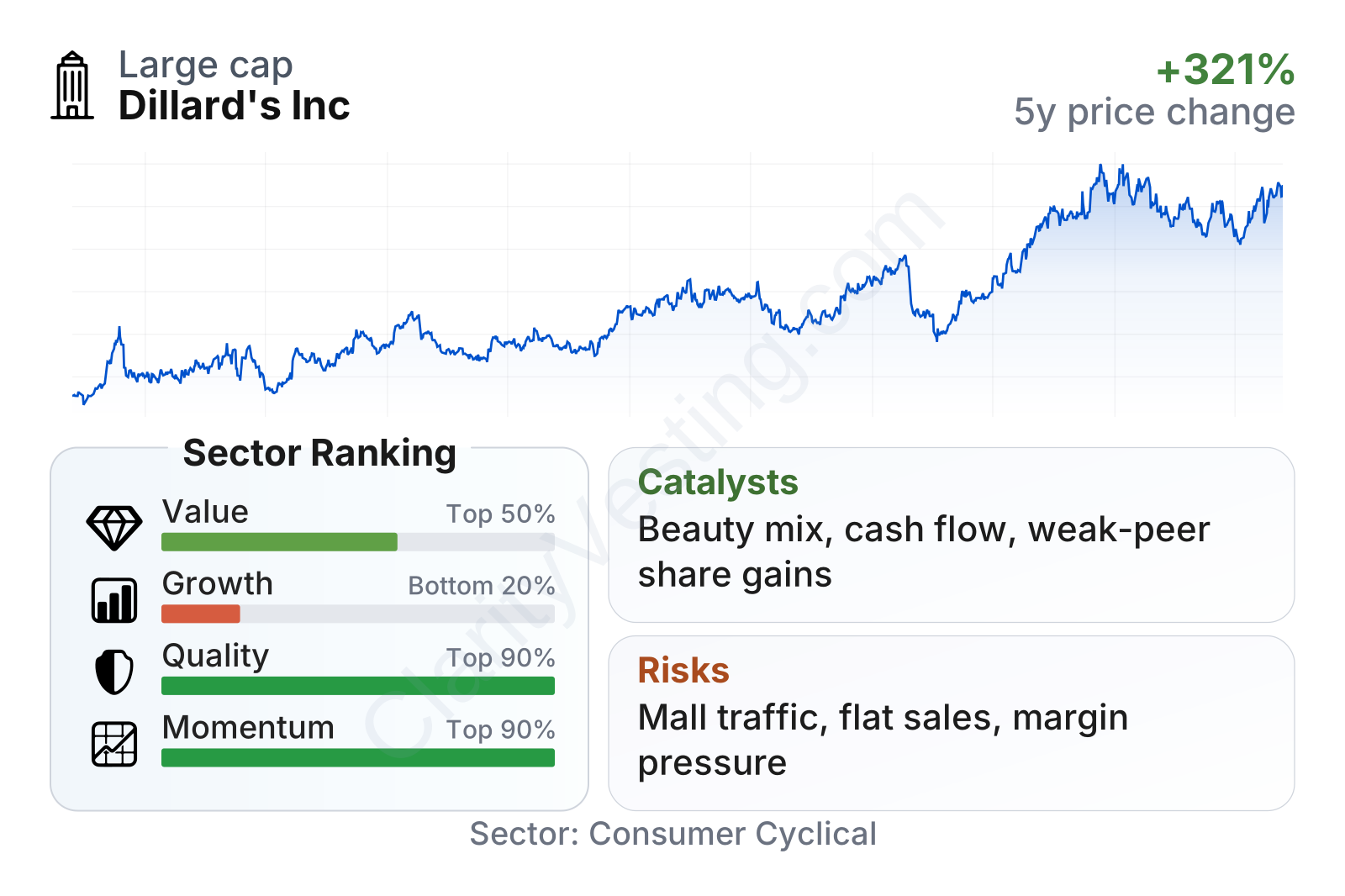
Dillard’s stands out more for business quality than for growth. Profitability and capital efficiency remain well above much of the consumer cyclical sector, while leverage is unusually low. At the same time, recent growth metrics are weak, which helps explain why the valuation is not especially demanding despite the company’s strong margins and cash generation.
The stock has also had a very strong multi-year run, although the shorter-term trend has been more mixed. That combination usually points to a company the market respects for discipline and profitability, but not one currently viewed as a major growth platform.
Growth
The department store industry is not a fast-growing area of retail. In the United States, it is a mature segment facing long-term pressure from e-commerce specialists, off-price chains, big-box retailers, and direct-to-consumer brands. That means growth for Dillard’s depends less on store expansion and more on gaining market share, improving merchandise mix, supporting its online channel, and protecting margins through careful inventory management.
Dillard’s strategy is sensible for that environment. The company has emphasized higher-margin categories such as beauty and better apparel, kept a relatively conservative store footprint, invested in its website and omnichannel capabilities, and maintained tight control over promotions compared with many traditional department store peers. This approach does not create rapid top-line expansion, but it can support durable profitability if customer demand remains steady.
Recent sales growth has been uneven. After the strong rebound period that followed the pandemic, year-over-year revenue trends have mostly hovered around flat to modestly negative levels, with occasional short recoveries. That suggests Dillard’s is operating in a low-growth environment where maintaining sales is already a competitive task.
Free cash flow remains one of the more constructive parts of the picture. It has declined from earlier peaks, but it is still solid in absolute terms for a retailer of this size. That gives Dillard’s room to support capital spending, preserve balance sheet strength, and continue returning capital when management sees fit. For a mature retailer, consistent cash generation can matter as much as revenue growth.
A meaningful catalyst is the possibility that Dillard’s can keep outperforming weaker department store peers through discipline rather than expansion. If competitors close stores, lose brand relevance, or rely too heavily on discounting, Dillard’s may be able to defend or gradually improve its position in selected markets. Another potential support is its continued focus on owned real estate and conservative finances, which can provide flexibility in a difficult retail cycle.
Recent company updates have also shown continued attention to merchandising, inventory, and shareholder returns rather than aggressive risk-taking. That is not the profile of a high-growth retailer, but it does fit a business trying to preserve earnings power in a mature sector.
Risks
This article is for informational purposes only and does not constitute financial advice. Some content is AI-generated. See Disclaimer


