Stock Analysis · Datadog Inc (DDOG)
Overview
Datadog is a cloud software company that helps businesses monitor, secure, and understand their digital systems. In simple terms, its platform collects data from servers, applications, databases, cloud services, networks, and security tools, then turns that information into dashboards, alerts, analytics, and troubleshooting tools. Customers use Datadog to keep websites and apps running smoothly, detect incidents faster, manage cloud infrastructure, and strengthen cybersecurity.
The company sells its services mainly through subscriptions delivered as software over the internet. Datadog reports revenue as one main category, but its products can be grouped into a few major engines of demand based on company disclosures and product positioning.
- Infrastructure monitoring and observability: approximately 45% to 55% of revenue. This includes infrastructure monitoring, application performance monitoring, log management, digital experience monitoring, database monitoring, network monitoring, and related analytics. This remains the core of the platform.
- Security and cloud protection: approximately 15% to 25% of revenue. This includes cloud security, application security, threat detection, identity and posture management, and security monitoring products. Management has highlighted security as one of its faster-growing areas.
- Log management and data analytics expansion: approximately 15% to 20% of revenue. Some of this overlaps with observability, but it is meaningful because log volumes, analytics, and usage-based consumption can materially expand customer spending over time.
- Other emerging products: approximately 10% to 15% of revenue. This includes incident management, workflow automation, product analytics, cloud cost management, and newer AI-related capabilities.
What matters for long-term analysis is less the exact split and more the model behind it: Datadog starts with monitoring, then tries to sell more modules to the same customer. That creates a land-and-expand structure, where one platform can gradually cover operations, developer tools, and security needs.
The financial profile also shows why the model is attractive. Revenue has scaled from just over $1.0 billion in 2021 to more than $3.4 billion in 2025, while gross profit has stayed high. At the same time, the company has continued to invest heavily in research and development, which explains why accounting earnings have not expanded as quickly as sales.
The broad trend is clear: Datadog has been converting a fast-growing top line into rising gross profit and solid cash generation, but it is still spending aggressively to widen its product platform and defend its position in a highly competitive market.
Key Figures
| Metric | Value | Sector ⓘ |
|---|---|---|
| Date | Sep 12, 2026 | |
| Context | ||
| Sector | Technology | |
| Industry | Software - Application | |
| Market Cap ⓘ | $79.43B | |
| Beta ⓘ | 1.49 | |
Value (Cheapness) | ||
| P/E Ratio ⓘ | 433.75 | 29.51 |
| FCF Yield ⓘ | 1.45% | 4.25% |
| EBIT / EV ⓘ | 0.18% | 2.85% |
| PEG ⓘ | 1.12 | |
Growth (Business expansion) | ||
| Revenue Growth ⓘ | 35.60% | 15.40% |
| RPS Growth (5Y CAGR) ⓘ | 29.73% | 8.56% |
| EPS Growth (5Y CAGR) ⓘ | -6.04% | -11.88% |
| Margin Growth (5Y Trend) ⓘ | 3.77% | 0.46% |
| FCF Growth (5Y CAGR) ⓘ | 41.37% | 9.80% |
Quality (Business durability) | ||
| ROIC (Latest) ⓘ | 3.19% | 9.44% |
| ROIC (5Y Median) ⓘ | 2.18% | 8.30% |
| Net Debt / EBIT (Latest) ⓘ | 5.17 | 0.54 |
| Net Debt / EBIT (5Y Median) ⓘ | 8.40 | 0.44 |
| Operating Margin (Latest) ⓘ | 4.52% | 9.58% |
| Operating Margin (5Y Median) ⓘ | 3.13% | 8.25% |
| Debt to Equity (Latest) ⓘ | 29.26% | 33.33% |
| Profit Margin (Latest) ⓘ | 4.48% | 7.14% |
| Free Cash Flow (Latest) ⓘ | $1.15B | |
Momentum (Price trend) | ||
| 3Y Return ⓘ | +125.22% | +45.48% |
| 12M Return (excl. last month) ⓘ | +86.81% | +23.48% |
| 6M Return ⓘ | +73.96% | +20.93% |
| Price vs. 200-Day MA ⓘ | +24.69% | +7.43% |
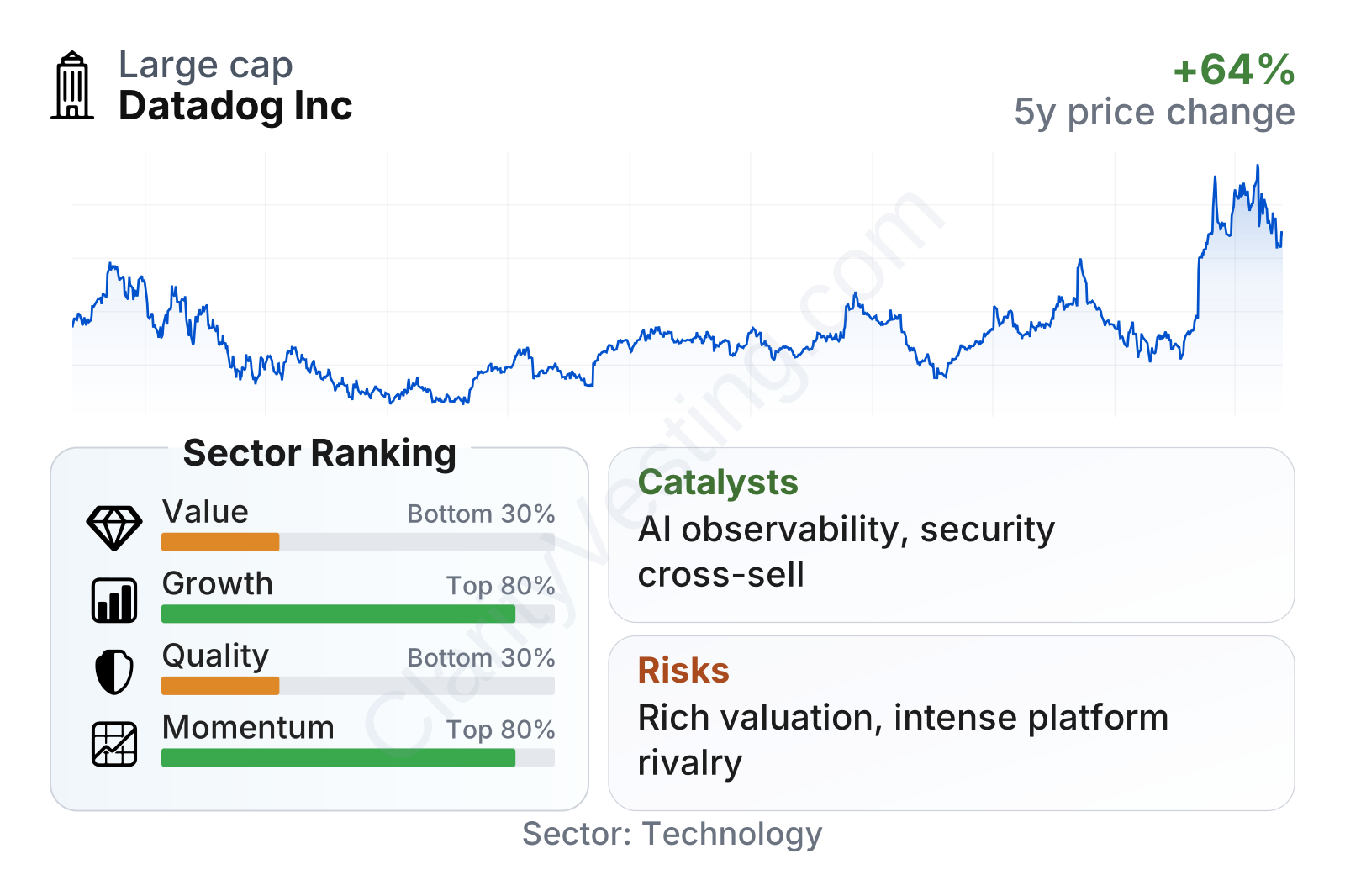
Datadog is now a large software company by market value, but its operating profile still looks more like a growth business than a mature one. Growth and share-price momentum rank well above much of the sector, while value and quality factors look weaker. That combination usually means the market is paying a premium for future expansion rather than current earnings power. The stock has also been volatile, with a beta above 1.5, which fits the pattern of a fast-growing software name whose valuation can swing sharply when sentiment changes.
Growth
Datadog operates in a market that still has room to expand. Cloud adoption continues to increase, software systems are becoming more complex, and companies need tools that can monitor performance, manage incidents, analyze machine data, and secure cloud workloads in one place. Those needs are not temporary. As more business activity moves online and more applications are built across multiple cloud environments, observability and cloud security become more essential.
Datadog’s strategy is coherent for this environment. Instead of selling a single-point tool, it keeps adding products around a shared data platform. That matters because customers often prefer fewer vendors when tools can work together. A company may begin with infrastructure monitoring, then add application performance monitoring, logs, cloud security, user experience tools, and workflow automation. This cross-sell model is one of Datadog’s strongest growth levers.
Revenue growth has slowed from the exceptionally high levels seen earlier in its public-company life, which is normal as the business becomes larger. Even so, the recent pace has reaccelerated to roughly the mid-30% range year over year, clearly above the sector median of about 16%. That suggests demand remains strong and that Datadog is still taking share despite a tougher comparison base.
Cash generation has also improved in a meaningful way. Trailing free cash flow has moved from a few hundred million dollars a few years ago to above $1.0 billion more recently. For a company still investing heavily in product development, this is an important sign. It shows the business can produce real cash even before reaching the profit margins typical of more mature software companies.
One of the biggest long-term catalysts is artificial intelligence infrastructure. AI workloads are complex, compute-intensive, and expensive to run, which increases the need for monitoring, reliability tools, cost visibility, and security oversight. Datadog has been building AI observability features and expanding product capabilities that help customers manage large-scale, cloud-native systems. If AI deployments continue to move from experimentation into production, that can broaden Datadog’s role inside customer environments.
Another catalyst is security convergence. Many companies want fewer separate tools for operations and cybersecurity. Datadog is trying to capture this by combining observability and security on the same platform. If successful, this can raise spending per customer and make the platform more deeply embedded.
Risks
This article is for informational purposes only and does not constitute financial advice. Some content is AI-generated. See Disclaimer


