Stock Analysis · Dauch Corporation (DCH)
Overview
Dauch Corporation operates in the automotive parts industry. The business designs and manufactures components and systems used by vehicle makers, with exposure to passenger vehicles, commercial vehicles, and replacement parts markets. In simple terms, it supplies products that go into vehicles rather than selling finished cars directly to consumers.
Its revenue base is tied mainly to auto production volumes and customer programs with original equipment manufacturers. Public company materials indicate a business mix centered on vehicle components, while aftermarket and service-related activity play a smaller role. Exact current 2026 revenue splits are not clearly disclosed in the material available here, so the most reliable way to frame the business is by end market and product focus rather than by a precise segment percentage.
The business model is typical for a large auto supplier: win long production contracts, manufacture at scale, and manage raw material, labor, logistics, and engineering costs tightly. That cost discipline matters a lot because margins in auto parts are usually not very wide, and Dauch’s recent results show that profitability has been especially sensitive to that pressure.
- Core automotive components: the main source of sales, tied to long-term supply programs with vehicle manufacturers.
- Commercial and specialty vehicle exposure: an additional source of demand linked to truck, fleet, or specialized vehicle production cycles.
- Aftermarket or replacement-related activity: a smaller contribution, generally more dependent on repair and maintenance demand than on new vehicle production.
Over the last several years, revenue has remained in the multibillion-dollar range, but the path from sales to profit has been uneven. The company has shown that it can generate meaningful gross profit, yet interest costs and operating execution have had a major effect on final earnings.
The overall pattern shows a company with substantial revenue scale, but only a thin portion of that revenue has consistently reached net income. Interest expense has absorbed a meaningful share of operating profit, which helps explain why bottom-line results have swung between modest profits and losses.
Key Figures
| Metric | Value | Sector ⓘ |
|---|---|---|
| Date | Sep 12, 2026 | |
| Context | ||
| Sector | Consumer Cyclical | |
| Industry | Auto Parts | |
| Market Cap ⓘ | $1.56B | |
| Beta ⓘ | 1.64 | |
Value (Cheapness) | ||
| P/E Ratio ⓘ | N/A | 17.10 |
| FCF Yield ⓘ | -1.97% | 8.53% |
| EBIT / EV ⓘ | 1.78% | 6.46% |
| PEG ⓘ | 0.43 | |
Growth (Business expansion) | ||
| Revenue Growth ⓘ | 92.40% | 5.75% |
| RPS Growth (5Y CAGR) ⓘ | 3.06% | 9.14% |
| EPS Growth (5Y CAGR) ⓘ | 2.28% | -18.21% |
| Margin Growth (5Y Trend) ⓘ | -0.31% | -0.23% |
| FCF Growth (5Y CAGR) ⓘ | -19.59% | 4.91% |
Quality (Business durability) | ||
| ROIC (Latest) ⓘ | 0.14% | 12.61% |
| ROIC (5Y Median) ⓘ | N/A | 10.72% |
| Net Debt / EBIT (Latest) ⓘ | 41.94 | 2.10 |
| Net Debt / EBIT (5Y Median) ⓘ | 13.35 | 2.32 |
| Operating Margin (Latest) ⓘ | 1.28% | 9.25% |
| Operating Margin (5Y Median) ⓘ | 3.81% | 9.64% |
| Debt to Equity (Latest) ⓘ | 350.59% | 75.78% |
| Profit Margin (Latest) ⓘ | -2.01% | 5.33% |
| Free Cash Flow (Latest) ⓘ | -$30.70M | |
Momentum (Price trend) | ||
| 3Y Return ⓘ | -16.49% | +14.53% |
| 12M Return (excl. last month) ⓘ | +18.74% | +3.08% |
| 6M Return ⓘ | +22.03% | +0.55% |
| Price vs. 200-Day MA ⓘ | +1.66% | -0.54% |
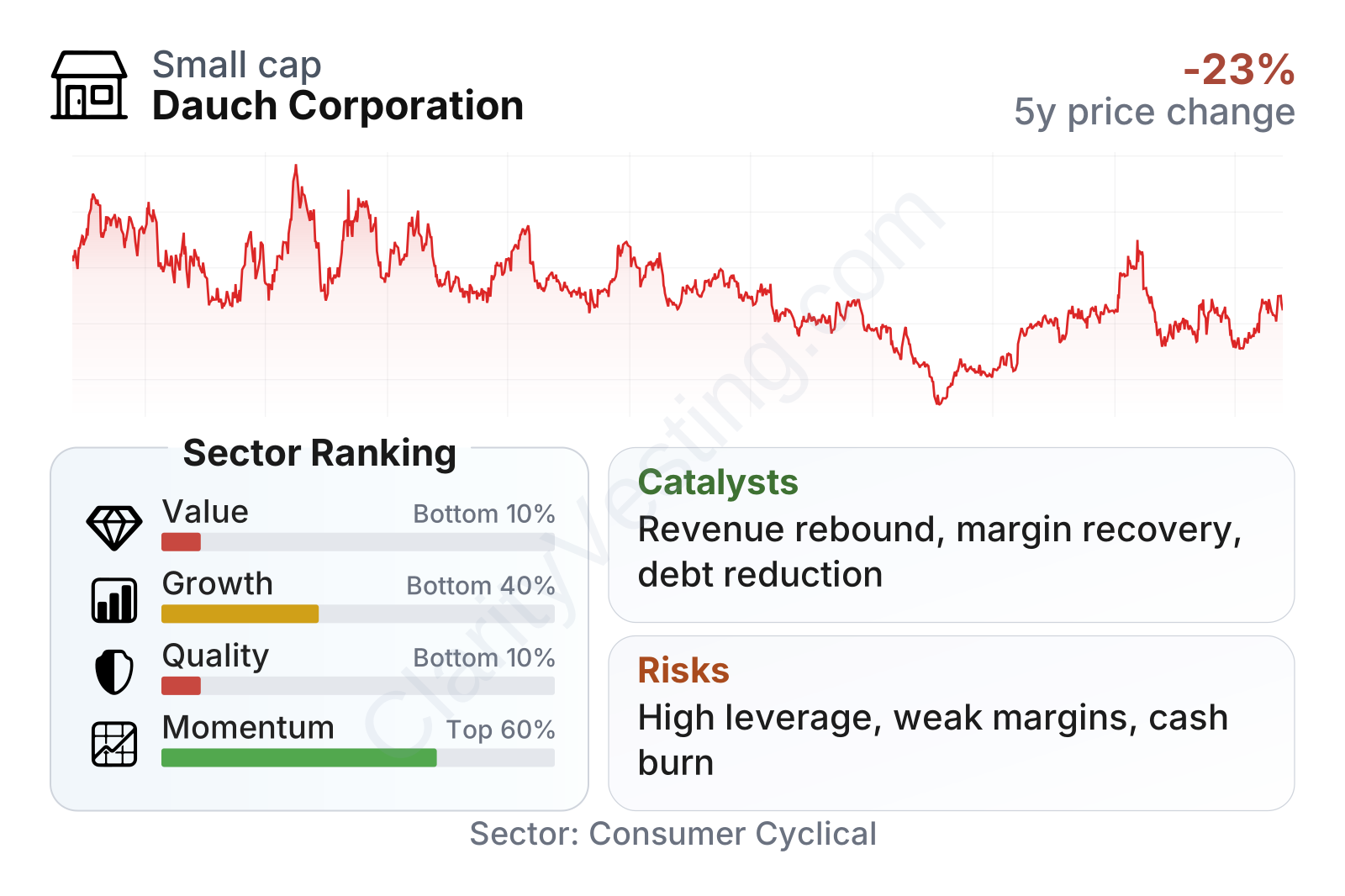
The broad picture is mixed. Dauch is a small-cap company with above-average share price volatility, and its latest factor profile looks weak relative to the broader consumer cyclical group. Growth metrics are distorted by a very strong recent rebound in revenue, but quality and value measures remain pressured by low profitability, negative free cash flow, and heavy leverage. Momentum has improved somewhat over parts of the last year, although the longer stock record still reflects a difficult multiyear stretch.
The stock history also shows that the market has treated the company as cyclical and execution-sensitive. Shares have moved sharply over the last few years rather than trending steadily upward, which fits a business where margins, debt, and industry demand can change sentiment quickly.
Growth
Dauch operates in a sector that can grow over time, but not in a straight line. Auto parts suppliers benefit from rising vehicle content, ongoing electrification, stricter efficiency and safety requirements, and the need for manufacturers to refresh platforms regularly. These trends can create opportunities even when total vehicle production grows only moderately.
For Dauch specifically, the strategic logic for future growth depends on whether it can turn recent sales momentum into durable earnings and cash generation. Recent year-over-year revenue growth has accelerated sharply, with the latest reading far above the sector median. That kind of jump can indicate new program launches, easier comparisons, customer recovery, acquisition effects, or a combination of those factors. It is encouraging as a signal of demand, but long-term relevance depends on whether it converts into better margins.
The revenue trend suggests a major rebound in the most recent periods after a softer 2024-2025 phase. That is a clear positive for business activity, but the longer five-year growth record remains less impressive than the sector median, so the recent surge still needs to prove it is sustainable rather than temporary.
Cash generation is the other important growth test. A manufacturer can report strong sales growth while still straining the balance sheet if working capital, tooling, restructuring, or capital spending absorb the cash. Dauch’s trailing free cash flow has deteriorated sharply from strong positive levels a few years ago to roughly breakeven and then negative territory more recently. That weakens the quality of the recent top-line rebound.
The free cash flow trend is one of the biggest issues in the growth case. Earlier periods showed that the business can produce meaningful cash, but the latest move toward near-zero and negative free cash flow suggests that current expansion has not yet translated into financial flexibility.
A meaningful catalyst would be any evidence that new business wins or volume recovery are now flowing through to operating margin instead of only boosting revenue. Another useful catalyst would be debt reduction funded by internally generated cash rather than by asset actions or refinancing. In a company with Dauch’s profile, even a modest improvement in margin can have an outsized effect on earnings because the starting point is so compressed.
Risks
This article is for informational purposes only and does not constitute financial advice. Some content is AI-generated. See Disclaimer


