Stock Analysis · Diebold Nixdorf Incorporated (DBD)
Overview
Diebold Nixdorf Incorporated is a financial and retail technology company best known for automated teller machines, self-service hardware, and the software and services that keep those systems running. Its customers are mainly banks, credit unions, large retailers, and other businesses that need secure cash handling, checkout, and branch or store automation. The company operates globally, with a particularly strong presence in Europe and the Americas.
Its business model combines equipment sales with recurring revenue from software, maintenance, implementation, and managed services. That mix matters because the hardware side can be cyclical, while service and software contracts tend to be steadier and often support profitability.
Based on recent company reporting, revenue is organized primarily around two customer groups:
- Banking segment: about 80% to 85% of revenue. This includes ATMs, cash recyclers, branch automation, software for transaction processing and fleet management, professional services, and ongoing maintenance.
- Retail segment: about 15% to 20% of revenue. This includes self-checkout systems, point-of-sale equipment, retail software, installation, and support services.
Within those segments, the broader revenue mix is typically led by product-related sales, followed by services, with software becoming increasingly important because it can carry better margins and deeper customer relationships. The company’s recent operating profile also shows improving gross profit and lower interest expense compared with earlier years, suggesting that the restructuring phase has been moving toward a more stable earnings base.
The long-term pattern points to a business that has not grown quickly at the top line, but has become more efficient. Revenue has stayed around the same general range in recent years, while operating expenses and interest costs have come down, helping profits and cash generation recover.
Key Figures
| Metric | Value | Sector ⓘ |
|---|---|---|
| Date | Sep 12, 2026 | |
| Context | ||
| Sector | Technology | |
| Industry | Software - Application | |
| Market Cap ⓘ | $2.23B | |
| Beta ⓘ | 1.14 | |
Value (Cheapness) | ||
| P/E Ratio ⓘ | 21.73 | 29.51 |
| FCF Yield ⓘ | 10.08% | 4.25% |
| EBIT / EV ⓘ | 6.28% | 2.85% |
| PEG ⓘ | N/A | |
Growth (Business expansion) | ||
| Revenue Growth ⓘ | 1.70% | 15.40% |
| RPS Growth (5Y CAGR) ⓘ | 19.67% | 8.56% |
| EPS Growth (5Y CAGR) ⓘ | N/A | -11.88% |
| Margin Growth (5Y Trend) ⓘ | 1.74% | 0.46% |
| FCF Growth (5Y CAGR) ⓘ | 38.29% | 9.80% |
Quality (Business durability) | ||
| ROIC (Latest) ⓘ | 8.53% | 9.44% |
| ROIC (5Y Median) ⓘ | 7.95% | 8.30% |
| Net Debt / EBIT (Latest) ⓘ | 3.13 | 0.54 |
| Net Debt / EBIT (5Y Median) ⓘ | 4.61 | 0.44 |
| Operating Margin (Latest) ⓘ | 5.96% | 9.58% |
| Operating Margin (5Y Median) ⓘ | 3.95% | 8.25% |
| Debt to Equity (Latest) ⓘ | 114.40% | 33.33% |
| Profit Margin (Latest) ⓘ | 2.87% | 7.14% |
| Free Cash Flow (Latest) ⓘ | $224.60M | |
Momentum (Price trend) | ||
| 3Y Return ⓘ | +264.56% | +45.48% |
| 12M Return (excl. last month) ⓘ | +16.24% | +23.48% |
| 6M Return ⓘ | -10.34% | +20.93% |
| Price vs. 200-Day MA ⓘ | -13.02% | +7.43% |
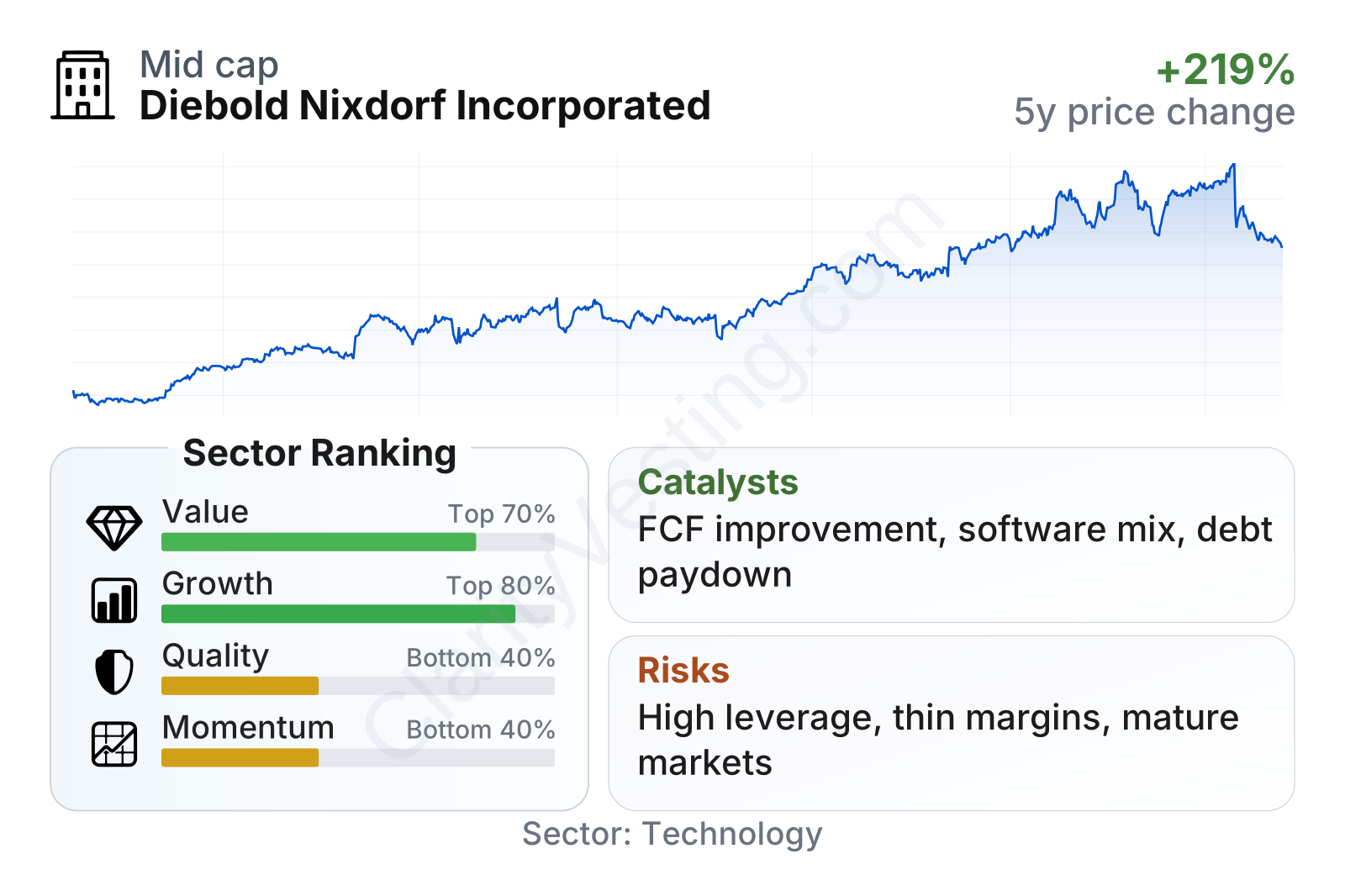
Diebold Nixdorf is a mid-sized technology company with a stock that has been more volatile than the broad market, but not extremely so. The share price climbed strongly over the last two years before pulling back from recent highs, which suggests that expectations improved meaningfully as the company repaired its balance sheet and returned to positive earnings.
The overall metric profile is mixed but understandable. On valuation, the company looks stronger than much of its sector, helped by a free cash flow yield near 9% and EBIT-to-enterprise-value well above the sector median. Growth indicators are uneven in the short run, but the longer-term trend in revenue per share, cash flow, and margin improvement has been favorable. Quality remains the weaker area because leverage is still high and operating margins remain below many software peers.
Growth
Diebold Nixdorf operates in markets that are mature in some areas and growing in others. ATMs and traditional banking hardware are not high-growth categories on their own, especially in developed markets. However, the company is positioned in parts of the market that still matter: branch modernization, cash recycling, ATM outsourcing, security software, and self-service automation for both banks and retailers. These are not fast-moving consumer tech markets, but they can produce durable demand because large institutions replace equipment in cycles and rely on long-term service relationships.
The company’s strategy appears centered on improving the mix of business rather than chasing pure volume growth. That means emphasizing software, services, and operational efficiency while keeping a strong installed base of machines in the field. For a company like Diebold Nixdorf, this approach makes sense. A bigger installed base creates future maintenance revenue, software upgrades, and managed-service opportunities, which can be more valuable than a one-time hardware sale.
Recent revenue growth has been modest and somewhat uneven. The company moved from stronger post-restructuring growth rates into a softer period, then returned to low positive growth. That pattern suggests stabilization rather than rapid expansion. Compared with the broader technology sector, current revenue growth is relatively slow, so the growth case depends more on execution, margin expansion, and cash generation than on a major sales surge.
Cash generation is a more encouraging part of the picture. Free cash flow improved from deeply negative levels to clearly positive territory and remains substantial on a trailing basis. That is important because it gives the company more flexibility to reduce debt, support operations, and absorb business volatility. A strong cash recovery is one of the clearest signs that the turnaround has had real operating substance behind it.
A meaningful catalyst is the company’s push to expand recurring and software-related revenue around its installed base. Financial institutions continue to invest in branch automation, transaction security, and cash efficiency even while digital banking grows. In retail, self-checkout and store automation remain relevant as merchants look for labor savings and faster throughput. If management keeps improving operating discipline while growing these higher-value offerings, the earnings profile could become more resilient over time.
Recent company updates have also highlighted continued focus on refinancing, debt reduction, and execution against profitability targets. For a business that recently came through a major balance-sheet reset, that matters as much as headline revenue growth.
Risks
This article is for informational purposes only and does not constitute financial advice. Some content is AI-generated. See Disclaimer


