Stock Analysis · Deutsche Bank AG (DB)
Overview
Deutsche Bank AG is a large global bank headquartered in Germany. It serves corporations, governments, institutional investors, wealthy individuals, and retail banking clients. Its activities span classic lending and deposit gathering, investment banking, trading, cash management, wealth management, and asset management. For a long-term reader, the simplest way to think about Deutsche Bank is as a diversified financial group whose earnings depend on interest income, fees from advisory and asset services, and market-related income from trading and securities activities.
The group reports its business through four main operating divisions. Based on recent annual reporting, the largest sources of revenue are approximately:
- Corporate Bank: about 35% of revenue. This includes cash management, payment services, trade finance, lending, and treasury services for companies and institutions.
- Investment Bank: about 31% of revenue. This includes fixed income and currency trading, financing, origination, and advisory work linked to debt and capital markets.
- Private Bank: about 25% of revenue. This covers retail banking, consumer finance, deposits, mortgages, business clients, and wealth-related banking services.
- Asset Management: about 8% of revenue. This is mainly DWS, which manages investment products and earns management and performance fees.
- Other items: roughly 1% to 2%, largely corporate-level adjustments and smaller activities.
This mix matters because it gives Deutsche Bank several earnings engines rather than depending on a single niche. It also means results can move differently depending on interest rates, market volatility, corporate activity, and the health of the European economy.
Over the last several years, revenue expanded materially, while net income has been more uneven. Expenses improved sharply in 2025, which helped profitability recover after a softer 2024. That pattern supports the view that the restructuring work has had real effects, but also shows that earnings can still swing meaningfully from year to year.
Key Figures
| Metric | Value | Sector ⓘ |
|---|---|---|
| Date | Nov 21, 2026 | |
| Context | ||
| Sector | Financial Services | |
| Industry | Banks - Regional | |
| Market Cap ⓘ | $60.80B | |
| Beta ⓘ | 1.04 | |
Value (Cheapness) | ||
| P/E Ratio ⓘ | 8.47 | 12.01 |
| P/B Ratio ⓘ | N/A | 1.48 |
| FCF Yield ⓘ | 43.20% | 8.77% |
| Dividend Yield ⓘ | 2.95% | 3.01% |
| EBIT / EV ⓘ | N/A | 8.31% |
| PEG ⓘ | 1.50 | |
Growth (Business expansion) | ||
| Revenue Growth ⓘ | 2.80% | 6.70% |
| RPS Growth (5Y CAGR) ⓘ | 26.74% | 12.35% |
| EPS Growth (5Y CAGR) ⓘ | 0.70% | -0.27% |
| BVPS Growth (5Y CAGR) ⓘ | 5.66% | 4.83% |
| Margin Growth (5Y Trend) ⓘ | -3.19% | -4.16% |
| FCF Growth (5Y CAGR) ⓘ | N/A | 4.69% |
| DPS Growth (5Y CAGR) ⓘ | 5.33% | 8.82% |
Quality (Business durability) | ||
| ROIC (Latest) ⓘ | N/A | 9.49% |
| ROE (Latest) ⓘ | 9.09% | 14.02% |
| ROA (Latest) ⓘ | 0.48% | 1.53% |
| ROIC (5Y Median) ⓘ | 2.74% | 7.80% |
| ROE (5Y Median) ⓘ | 6.10% | 12.09% |
| ROA (5Y Median) ⓘ | 0.36% | 1.28% |
| Net Debt / EBIT (Latest) ⓘ | N/A | 0.88 |
| Net Debt / EBIT (5Y Median) ⓘ | 3.37 | 0.73 |
| Net Debt / EBITDA (Latest) ⓘ | 0.38 | 0.71 |
| Operating Margin (Latest) ⓘ | N/A | 23.37% |
| Operating Margin (5Y Median) ⓘ | 12.82% | 24.29% |
| Debt to Equity (Latest) ⓘ | 187.60% | 59.34% |
| Profit Margin (Latest) ⓘ | 22.67% | 26.65% |
| Free Cash Flow (Latest) ⓘ | $26.26B | |
Momentum (Price trend) | ||
| 3Y Return ⓘ | +186.74% | +73.29% |
| 12M Return (excl. last month) ⓘ | +3.54% | +18.35% |
| 6M Return ⓘ | +1.67% | +3.24% |
| Price vs. 200-Day MA ⓘ | -6.69% | +2.17% |
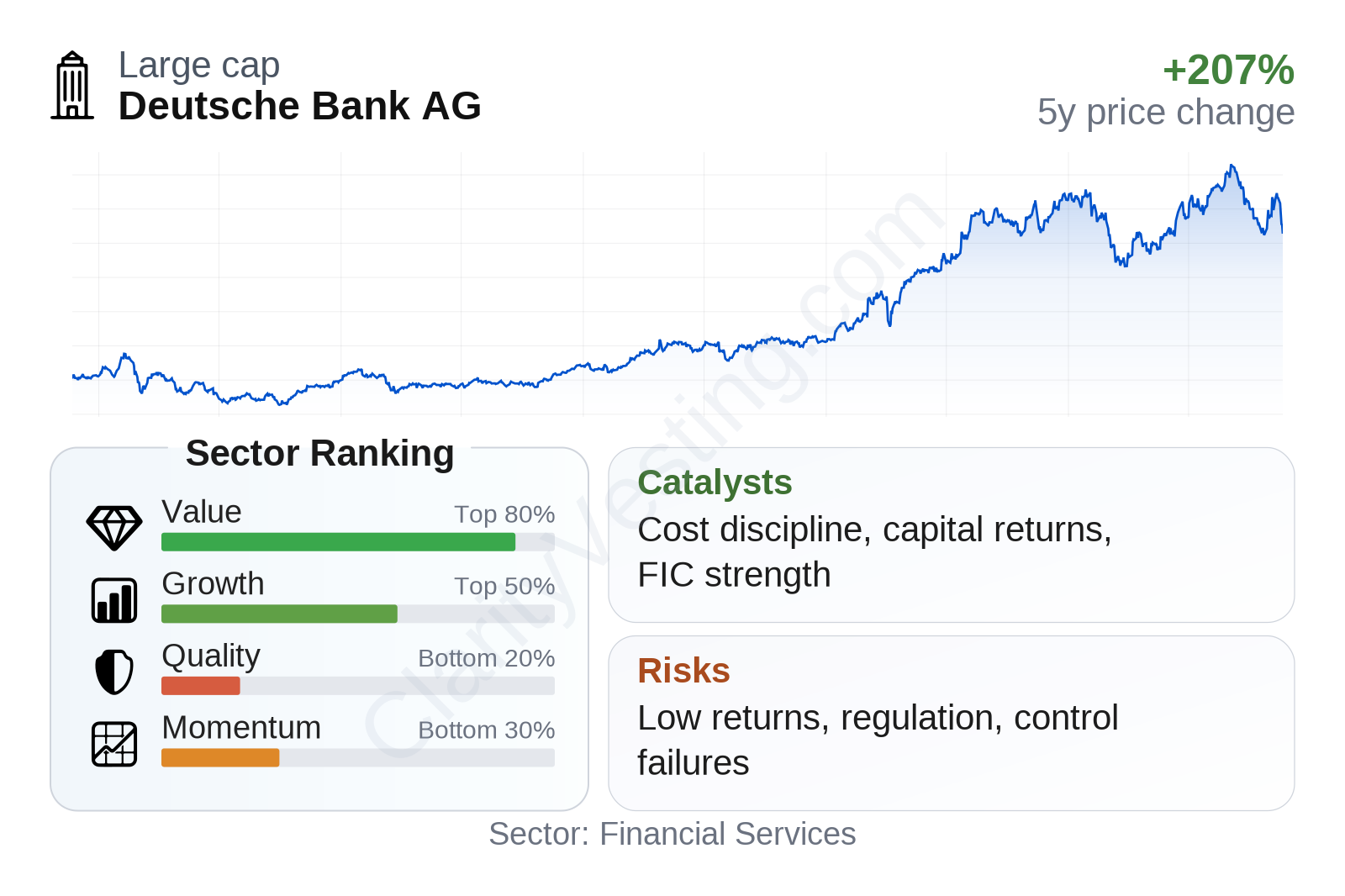
Deutsche Bank is a large financial institution with a market value in the tens of billions of dollars and a share price that has risen strongly over the past three years, far ahead of the sector median over that longer period. More recently, the picture has been less one-sided: medium-term momentum has remained solid, but the 12-month performance excluding the latest month has trailed the sector, suggesting the easy part of the rerating may already have happened.
On valuation, the stock trades at a lower earnings multiple than the sector median, while its dividend yield is close to the sector norm. Growth indicators are mixed: recent year-over-year revenue growth has been modest, but five-year revenue per share growth has been strong, and book value per share has continued to rise steadily. The weakest area is quality, where returns on equity and assets remain below many banking peers. In simple terms, the market is not assigning Deutsche Bank a premium multiple, and that discount reflects a bank that has improved but still has profitability gaps versus stronger peers.
Growth
Banking is not a fast-growth sector in the same way as software or semiconductors, but it remains essential and can grow steadily when a bank gains share, improves efficiency, and benefits from supportive rate conditions. Deutsche Bank’s sector exposure is broadly favorable in that transaction banking, financing, wealth management, and asset management are durable activities with long-term relevance. Corporate clients still need cross-border payments, risk management, funding access, and capital markets services, and those needs tend to persist across economic cycles.
The company’s strategy also makes practical sense for future growth. Over recent years, Deutsche Bank has focused on businesses where it already has scale and client relationships, especially the Corporate Bank and parts of the Investment Bank, while trying to make the overall group more efficient. That is a more disciplined approach than trying to compete everywhere at once. The private banking and wealth activities add balance, while asset management provides a fee-based business that is less dependent on lending spreads.
Earnings per share have generally trended upward since 2021, with some pauses along the way. That suggests the bank’s turnaround has translated into actual shareholder earnings rather than only headline restructuring claims. The five-year earnings growth rate is not spectacular, but it compares well with a sector median that has been weaker. For a mature bank, consistency matters as much as speed.
Book value per share has risen steadily over the last five years, which is an important signal for a bank. It means the company has been building capital value per share over time, even while navigating uneven profitability. That increase, combined with the strong rerating in the stock, helps explain why the market has become more willing to price Deutsche Bank closer to its underlying balance-sheet value than it did a few years ago.
A notable catalyst is the bank’s continued effort to lift efficiency and returns through cost control, capital discipline, and higher distributions tied to stronger profitability. Another potential support is its positioning in European corporate banking and fixed income, where scale and client connectivity can become more valuable if European capital markets deepen further. Recent company updates have also pointed to ongoing capital return ambitions and a focus on improving operating leverage, which can create meaningful upside if revenue stays stable and costs remain contained.
Risks
This article is for informational purposes only and does not constitute financial advice. Some content is AI-generated. See Disclaimer