Stock Analysis · DoorDash Inc (DASH)
Overview
DoorDash is a digital commerce and local delivery company best known for restaurant food delivery, but its platform now extends well beyond meals. It connects consumers, merchants, and delivery workers through a marketplace that handles ordering, logistics, payments, and customer support. Over time, the company has expanded into grocery, convenience, retail, alcohol where permitted, and business services for merchants. It also operates subscription programs and advertising tools that help merchants reach customers inside the app.
Its revenue is reported mainly in broad categories rather than by every end market, but the business can still be understood through its largest economic drivers. Based on recent company disclosures, the revenue mix is centered on marketplace and platform services tied to orders placed on DoorDash-owned marketplaces, followed by merchant and consumer add-ons such as advertising and subscriptions.
- Marketplace revenue: about 85% to 90% — commissions and fees tied to orders placed through DoorDash marketplaces, including restaurant, grocery, convenience, and retail orders.
- Advertising and other merchant services: about 7% to 10% — sponsored listings, promotions, and tools that help merchants acquire customers and improve visibility on the platform.
- Subscription and other consumer-related revenue: about 3% to 6% — mainly DashPass membership revenue and certain consumer service fees not already included above.
The broader financial picture has improved meaningfully in recent years. Revenue has scaled from under $5 billion in 2021 to more than $13 billion in 2025, while operating results moved from losses to solid profitability. At the same time, spending on product development and sales support has continued to rise, showing that DoorDash is still investing heavily to strengthen its platform while becoming more efficient.
A notable trend is the shift from rapid top-line expansion with large losses to a more balanced model with positive operating income and net income. Gross profit has grown steadily, while operating expenses have increased at a slower pace than revenue, which suggests improving scale economics.
Key Figures
| Metric | Value | Sector ⓘ |
|---|---|---|
| Date | Sep 12, 2026 | |
| Context | ||
| Sector | Consumer Cyclical | |
| Industry | Internet Retail | |
| Market Cap ⓘ | $87.50B | |
| Beta ⓘ | 1.79 | |
Value (Cheapness) | ||
| P/E Ratio ⓘ | 105.18 | 17.10 |
| FCF Yield ⓘ | 2.74% | 8.53% |
| EBIT / EV ⓘ | 1.02% | 6.46% |
| PEG ⓘ | 2.51 | |
Growth (Business expansion) | ||
| Revenue Growth ⓘ | 35.60% | 5.75% |
| RPS Growth (5Y CAGR) ⓘ | 21.09% | 9.14% |
| EPS Growth (5Y CAGR) ⓘ | N/A | -18.21% |
| Margin Growth (5Y Trend) ⓘ | N/A | -0.23% |
| FCF Growth (5Y CAGR) ⓘ | 47.85% | 4.91% |
Quality (Business durability) | ||
| ROIC (Latest) ⓘ | 6.66% | 12.61% |
| ROIC (5Y Median) ⓘ | -6.64% | 10.72% |
| Net Debt / EBIT (Latest) ⓘ | -1.29 | 2.10 |
| Net Debt / EBIT (5Y Median) ⓘ | N/A | 2.32 |
| Operating Margin (Latest) ⓘ | 5.47% | 9.25% |
| Operating Margin (5Y Median) ⓘ | -6.68% | 9.64% |
| Debt to Equity (Latest) ⓘ | 33.31% | 75.78% |
| Profit Margin (Latest) ⓘ | 5.29% | 5.33% |
| Free Cash Flow (Latest) ⓘ | $2.40B | |
Momentum (Price trend) | ||
| 3Y Return ⓘ | +143.69% | +14.53% |
| 12M Return (excl. last month) ⓘ | -19.61% | +3.08% |
| 6M Return ⓘ | +24.85% | +0.55% |
| Price vs. 200-Day MA ⓘ | +7.12% | -0.54% |
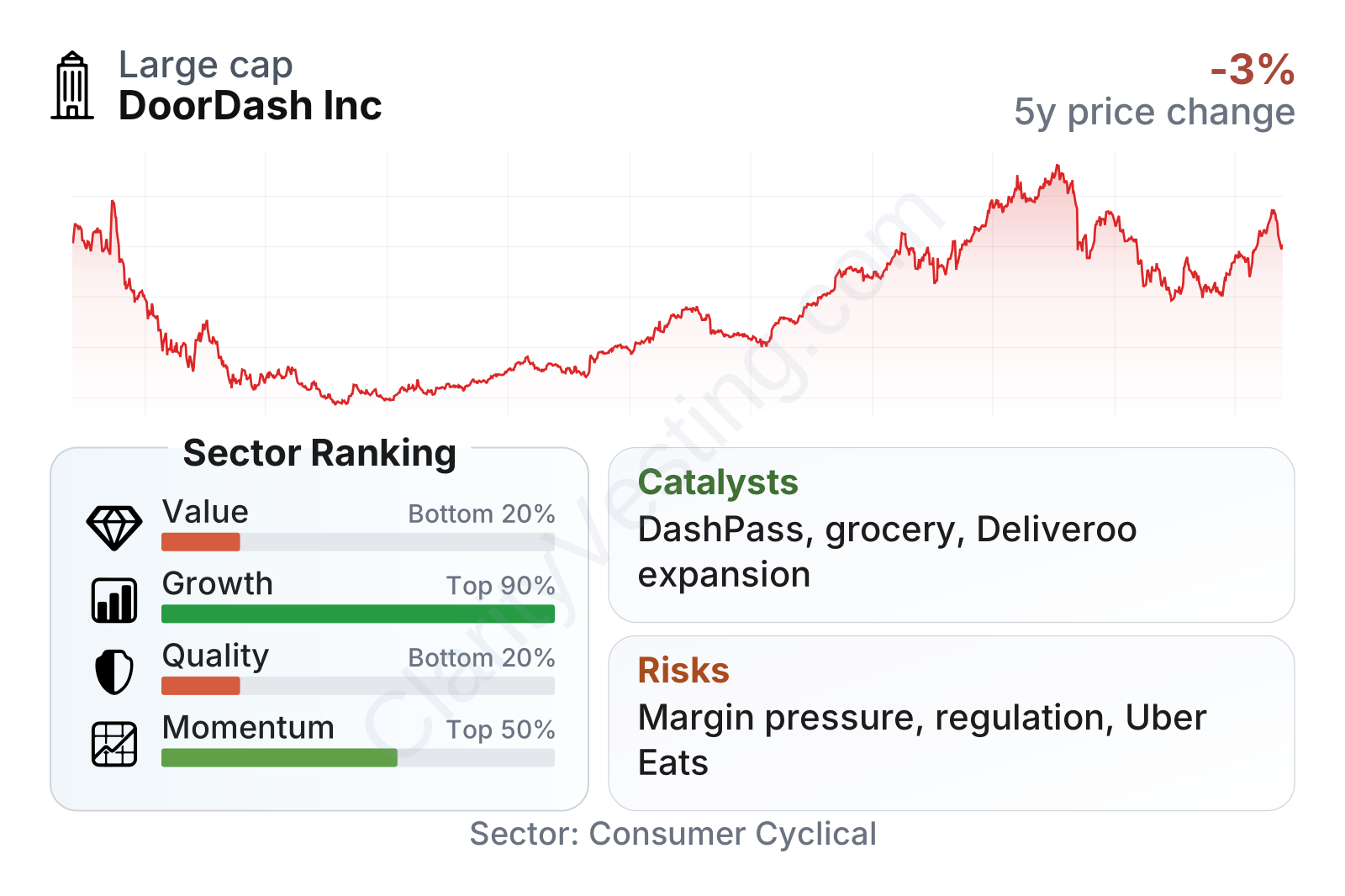
DoorDash is now a very large company in market value terms, but its financial profile is still unusual compared with much of the consumer discretionary sector. Growth ranks near the top of the group, helped by revenue growth of roughly 36% year over year and strong multi-year expansion in revenue per share and free cash flow. Balance-sheet strength is also notable, with net cash rather than net debt and debt-to-equity around 33%, well below the sector median. The weaker points are valuation and operating efficiency relative to mature peers: the earnings multiple remains far above the sector norm, while returns on invested capital and operating margin still trail stronger established businesses.
Growth
DoorDash operates in a sector that still has room to grow. Consumers continue shifting more everyday purchases into on-demand digital channels, and merchants increasingly want outsourced logistics, better app visibility, and broader customer reach. Food delivery is already well known, but the larger opportunity is local commerce more generally: grocery, convenience, pharmacy, and retail are much bigger categories in total consumer spending than restaurant delivery alone.
The company’s strategy is coherent for long-term expansion. Instead of remaining just a meal delivery app, DoorDash is trying to become a broader local commerce infrastructure layer. That matters because a larger platform can spread fixed costs across more orders, attract more merchants, improve delivery density, and create more opportunities for advertising and subscriptions. DashPass is especially important because it can increase ordering frequency and make customers more likely to stay within the ecosystem across multiple categories.
Revenue growth has remained unusually strong for a company of this size. Even though the pace has fluctuated, recent growth has stayed far above the sector median, which suggests DoorDash is still gaining share and benefiting from category expansion rather than simply riding a mature market.
Cash generation has also improved sharply over the last few years. Free cash flow rose from a modest level in 2022 to well above $1.5 billion more recently, reaching about $2.8 billion on a trailing basis in the latest metrics. That is important because it shows the business is no longer dependent on growth alone; it is increasingly translating scale into cash.
One of the strongest catalysts is international and category expansion. The acquisition of Deliveroo, announced in 2025 and completed in 2026, significantly increased DoorDash’s geographic footprint and broadened its merchant network outside the United States. Management has also continued to emphasize grocery, retail, and advertising, each of which can deepen customer engagement without relying only on restaurant order growth. If these newer areas continue to scale, DoorDash could become more diversified and less dependent on any single ordering category.
Risks
This article is for informational purposes only and does not constitute financial advice. Some content is AI-generated. See Disclaimer


