Stock Analysis · Dana Inc (DAN)
Overview
Dana Inc. is an automotive and commercial-vehicle supplier that designs and manufactures drivetrain and propulsion systems. In simple terms, it makes many of the components that help vehicles move, turn, transfer power, and increasingly operate with electric propulsion. Its products are used in light vehicles, pickup trucks and SUVs, commercial trucks, off-highway equipment such as construction and agricultural machines, and industrial applications.
The business has historically been organized around major product families rather than a consumer brand. Based on recent company reporting, revenue mainly comes from the following areas:
- Light Vehicle Driveline and e-Propulsion: a large share of sales, tied to axles, driveshafts, sealing products, thermal-management products, and electrified systems used in passenger vehicles and light trucks.
- Commercial Vehicle Driveline and Motion Systems: a meaningful share of sales, including axles, driveshafts, transmissions, sealing and thermal products for medium- and heavy-duty trucks and buses.
- Off-Highway Drive and Motion Systems: a meaningful share of sales, covering drivetrain, transmission, motion, and electrification products for construction, agriculture, and material-handling equipment.
- Power Technologies and aftermarket-related activity: a smaller but still important contribution, including sealing, thermal-management, and replacement-part demand across vehicle categories.
Dana’s revenue mix is broad by end market, which helps reduce reliance on a single type of vehicle, but it is still heavily tied to global production volumes in transportation and industrial equipment. Geographically, the company operates on a global basis, with North America, Europe, and other international markets all contributing to sales.
The financial flow shows a business with very high manufacturing costs relative to revenue, which is typical for auto parts suppliers, but also leaves little room for error. Revenue rose from roughly $8.9 billion in 2021 to more than $10 billion in 2023 before falling back to about $7.5 billion in 2025, while operating profit and net income were much more volatile than sales. That pattern suggests Dana’s scale is significant, but its earnings power has been inconsistent.
Key Figures
| Metric | Value | Sector ⓘ |
|---|---|---|
| Date | Sep 12, 2026 | |
| Context | ||
| Sector | Consumer Cyclical | |
| Industry | Auto Parts | |
| Market Cap ⓘ | $3.34B | |
| Beta ⓘ | 2.00 | |
Value (Cheapness) | ||
| P/E Ratio ⓘ | N/A | 17.10 |
| FCF Yield ⓘ | 3.95% | 8.53% |
| EBIT / EV ⓘ | 2.91% | 6.46% |
| PEG ⓘ | 6.85 | |
Growth (Business expansion) | ||
| Revenue Growth ⓘ | 3.90% | 5.75% |
| RPS Growth (5Y CAGR) ⓘ | -3.13% | 9.14% |
| EPS Growth (5Y CAGR) ⓘ | 19.09% | -18.21% |
| Margin Growth (5Y Trend) ⓘ | -1.53% | -0.23% |
| FCF Growth (5Y CAGR) ⓘ | N/A | 4.91% |
Quality (Business durability) | ||
| ROIC (Latest) ⓘ | 0.83% | 12.61% |
| ROIC (5Y Median) ⓘ | 3.53% | 10.72% |
| Net Debt / EBIT (Latest) ⓘ | 9.02 | 2.10 |
| Net Debt / EBIT (5Y Median) ⓘ | 7.54 | 2.32 |
| Operating Margin (Latest) ⓘ | 1.70% | 9.25% |
| Operating Margin (5Y Median) ⓘ | 3.08% | 9.64% |
| Debt to Equity (Latest) ⓘ | 78.28% | 75.78% |
| Profit Margin (Latest) ⓘ | 14.55% | 5.33% |
| Free Cash Flow (Latest) ⓘ | $132.00M | |
Momentum (Price trend) | ||
| 3Y Return ⓘ | +112.12% | +14.53% |
| 12M Return (excl. last month) ⓘ | +61.64% | +3.08% |
| 6M Return ⓘ | -1.77% | +0.55% |
| Price vs. 200-Day MA ⓘ | +2.97% | -0.54% |
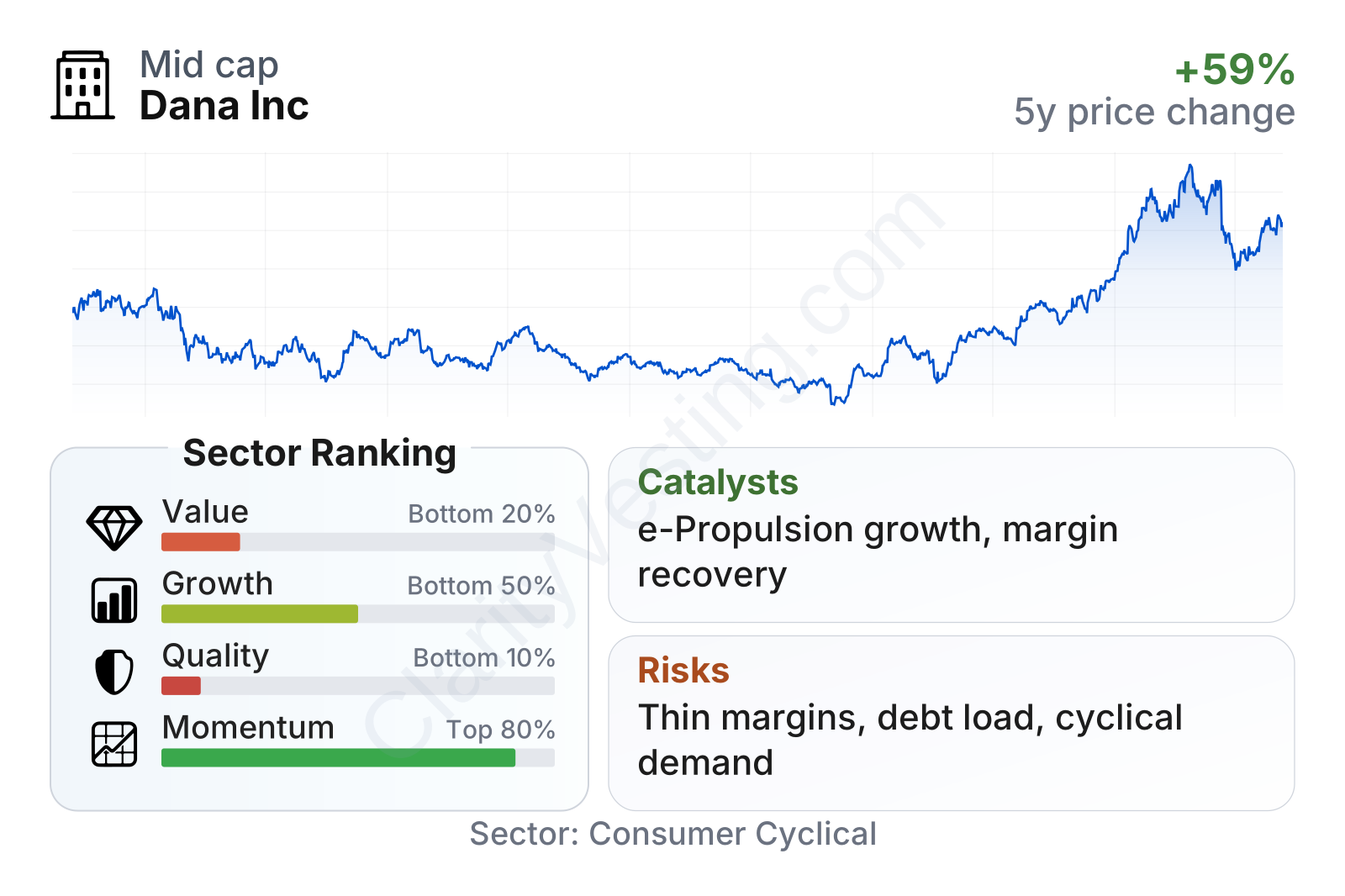
Dana is a mid-sized auto-parts company with a stock that has been much more volatile than the broader market, as shown by its high beta near 2. The factor summary points to mixed characteristics: momentum has been relatively strong over longer periods, but value, growth, and especially quality rank weakly against the sector. In practical terms, the market has recently rewarded the shares, yet the operating profile still looks fragile. Free cash flow is positive, but the yield is below the sector median, and leverage remains a notable pressure point.
Growth
Dana operates in a sector that still has long-term relevance because vehicles, trucks, and industrial machines will continue to need driveline, thermal, sealing, and power-transfer systems. The more interesting part of the growth case is electrification. Dana has spent several years building e-Propulsion capabilities for both on-road and off-highway vehicles. That strategy makes industrial sense: manufacturers increasingly want suppliers that can deliver both traditional mechanical systems and newer electric-drive components.
At the same time, the growth picture has not been smooth. Revenue growth was solid in 2021 through 2023, then turned sharply negative in several later periods before returning to modest positive growth most recently. This suggests Dana is exposed not only to its own execution, but also to weak customer production schedules, uneven freight markets, and slower equipment demand in some end markets.
Cash generation looks more stable than headline earnings. Free cash flow moved from deeply negative territory in 2022 to positive levels in the following years and has stayed positive in recent periods. That matters because suppliers in cyclical industries need cash to manage working capital swings, interest expense, restructuring, and product investment. A business that can stay cash-positive during uneven demand has more flexibility than one that depends entirely on accounting profits.
Potential catalysts are fairly clear. A recovery in global truck production, stabilization in off-highway equipment demand, and broader adoption of electric propulsion systems could all support better volume and mix. Dana has also been simplifying parts of the business and focusing on operational improvement, which can matter a lot in an industry where small margin gains can meaningfully change earnings. Recent company updates have also highlighted actions related to portfolio reshaping and efficiency efforts, which could improve returns if execution is disciplined.
Risks
This article is for informational purposes only and does not constitute financial advice. Some content is AI-generated. See Disclaimer


